Showing posts sorted by date for query Christmas. Sort by relevance Show all posts

Wednesday, January 6, 2021

From Loneliness to Solidarity


Greetings from the center of U.S. politics the day I write this, election day in Georgia January 5, 2021. I won’t know the results of our two senatorial elections determining the balance of the U.S. Senate until after you read this, perhaps not until l-o-n-g after you read this. I schedule each post on Tuesdays for publication on Wednesdays at 5 a.m. eastern time and, considering the volume of mail-in votes to be counted and the possible vote-twisting of the losers, delays are likely.

My senior status gave me the opportunity to vote weeks ago, Wade driving me to the only drop-box near us in downtown Atlanta where we had deposited our presidential votes in November. Wade voted before Christmas during early voting. We both received numerous texts, emails and voicemails reminding us to encourage everyone we know to vote, not to mention the television and radio commercials that bombarded us.

When I first moved to Atlanta, I was surprised that, unlike my home state of California, I did not get a non-partisan sample ballot automatically in the mail, explaining the candidates and the propositions. We still don’t receive sample ballots, non-partisan or otherwise, but now we receive mailings from various campaigns.

A Trump-voting relative asked in jest if we were exhausted voting so many times in the presidential election, and I kidded back about how much time it took to fill in all the extra ballots for Biden. “The real work,” I explained, “Was erasing all those filled-in ovals for Trump!”

I hope I don’t see this reported on social media or a certain network or Q-Anon as reality!

“This is Reality!” was a common refrain from the first Presbyterian pastor I worked alongside, the Rev. Dr. Ross Greek, in the late 70s and early 80s at what was then the West Hollywood Presbyterian Church. Reared a Quaker, his political instincts were left-of-center, and he had finely tuned a litany of societal wrongs which he punctuated with the response, “This is Reality!” waving his index finger for emphasis.

It was this left-leaning pastor who inspired our ministries with the Flower Children of the 60s on Sunset Strip, advised conscientious objectors, halfway-housed former prisoners and those with mental health issues, championed the Civil Rights Movement and the Peace Movement, welcomed LGBTQ people who provided worship for gay jail inmates and sack lunches for the homeless, and initiated a transition program for sex workers.

When California defeated a 1978 proposition that would have banned LGBT school teachers and any teacher who advocated gay rights, my personal “pride parade” was dampened by Ross’s dismay at the reinstitution of the death penalty and the election of a conservative governor.

Using the lyrics of Judy Collins, I’ve seen politics “from both sides now.” As a 13-year-old I volunteered at Goldwater headquarters. By the next election, I supported Senator Eugene McCarthy who opposed the Vietnam war, and progressive has been my persuasion ever since. Education helped, but frankly, I believe I simply grew into the kind of person Jesus called me to be.

Jesus may have called you to be a different kind of person, but that, I believe, is why we are part of the same Body of Christ, to consider one another’s values and needs and hopes and beliefs, to pray for one another and call one another to serve God’s commonwealth.

President Trump caused me to pray daily for the president and vice president and all of our leaders in this nation and the world—praying for compassion, wisdom, knowledge, truth, and justice. I pray the same daily for our electorates as well, as our leaders reflect our own limitations and possibilities.

I pray too for humanity’s deliverance from the pandemic, giving thanks to God for scientists and chaplains, the medical profession, frontline workers, healthcare workers and volunteers, grocery clerks and stockers and pharmaceutical workers, mail carriers and delivery persons.

Coping with the isolation of the pandemic, our congregation is enjoying a January series, “From Loneliness to Solitude,” based on the first movement of the spiritual life described in Henri Nouwen’s book, Reaching Out. This has prompted me to name this post, “From Loneliness to Solidarity.” That, I believe, is our ultimate goal in spirituality, to feel a solidarity with all that transcends partisanship.


Beginning this year, tax-deductible donations may be made safely in Chris Glaser’s name to the LGBTQ Religious Archives Network.

Personal gifts may be made safely by clicking here.  Thank you!

Copyright © 2021 by Chris R. Glaser. Permission granted for non-profit use with attribution of author and blogsite. Other rights reserved.


Wednesday, December 30, 2020

Full of Grace and Truth


“Full of grace and truth” has stayed with me this Christmas 2020 season to dispel the gloom of unreformed Scrooges, unredeemed Grinches, and an unrelenting pandemic.

The Gospel writer John used “full of grace and truth” to describe God’s coming into this world through the beloved child and prophet Jesus. John gets credit as a theologian for his elevated prologue beginning “In the beginning was the Word…” but, in truth, we are all theologians, speculating in our own “Tiny Tim” ways about the nature of the universe, of humanity, and the nature of God.

In early Christianity, “theologia” was communion with God, so maybe it’s better to consider John a mystic, a contemplative whose vision revealed a thin place—Jesus—where God’s grace and truth could touch, heal, transform our confusions and delusions and self-elevating pride.

Blending grace and truth, to my very human perspective, is as challenging as mixing divinity and humanity. When I think of those among us full of grace, they seem able to be gracious because they hold their tongues when it comes to truth: “No, you don’t look fat.” “No, your profits are well-deserved.” “Yes, you are super.

When I think of those among us full of truth, they come across as challenging, even judgmental, spoilers, disagreeable. Yes, they are prophets and whistleblowers and much needed in our self-deceptive, aggrandizing, fame- and wealth-driven world, but dinner with them? Heavens, please, no!

But one of the characteristics that makes divinity “divine” seems to me to be its ability to integrate both grace and truth. “Yes, you belong,” grace says. “Yes, you belong,” truth says. In the view of process theologian Daniel Day Williams, belonging is as vital (as in life-giving) as believing. Grace tells us we belong. Truth tells us we belong.

The belonging Jesus proclaimed confirms our place in creation and our citizenship in God’s common spiritual wealth, neither of which is to be taken lightly. That’s grace with a dose of truth.

Happy New Year!

Chris


Relevant New York Times columns by Peter Weimer:

The Forgotten Radicalism of Jesus Christ

The Uncommon Power of Grace

How Can I Possibly Believe that Faith is Better than Doubt?

Donations to Progressive Christian Reflections may be given safely by clicking here and scrolling down to the donate link below its description. Thank you!

Copyright © 2020 by Chris R. Glaser. Permission granted for non-profit use with attribution of author and blogsite. Other rights reserved.  


Wednesday, December 23, 2020

Tricked by Grace


This was my 200th post, published on December 10, 2014. I recently read that the opposite of faith is not doubt, but certainty. Merry Christmas!

A few weeks ago I was reading one of Southern writer Flannery O’Connor’s last short stories, entitled “Revelation,” published posthumously in her collection All That Rises Must Converge. She takes the book’s title from Teilhard de Chardin, whose writings as both a scientist and a mystic she greatly admired.

The story is written from the perspective of an older woman who finds herself in a doctor’s waiting room, looking from person to person, engaging in small talk. Her judgmentalism is in high gear as she silently evaluates their appearance, their interactions and lack thereof, as well as sharing aloud the foibles of people in general with another woman. I was especially put off by her frequent use of the “n-word.”  In that brief story I saw the unabbreviated word more often than I have seen it in recent decades.

Needless to say, I too was frothing with judgment (of the protagonist) as the story came to a surprising twist. Without giving the story away, something happens that upsets her certainty about things, and later, watching the sun set, she has an unsettling vision of what was to come: all the people she routinely judged marching nonetheless toward heaven, “battalions of freaks and lunatics shouting and clapping and leaping like frogs.” The story continues:

And bringing up the end of the procession was a tribe of people whom she recognized at once as those who, like herself and Claud, had always had a little of everything and the God-given wit to use it right. She leaned forward to observe them closer. They were marching behind the others with great dignity, accountable as they had always been for good order and common sense and respectable behavior. They alone were on key. Yet she could see by their shocked and altered faces that even their virtues were being burned away.

I cried with recognition. I was her. Flannery O’Connor tricked me, even as grace tricks us all. We think we will be saved by our many words—prayers, sermons, posts—or our many deeds—charitable, political, religious. But it’s grace that really saves us.

In the woods around her the invisible cricket choruses had struck up, but what she heard were the voices of the souls climbing upward into the starry field and shouting hallelujah.


Donations to Progressive Christian Reflections may be given safely by clicking here and scrolling down to the donate link below its description. Thank you!

Copyright © 2014 by Chris R. Glaser. Permission granted for non-profit use with attribution of author and blogsite. Other rights reserved. 


Wednesday, December 16, 2020

Go Toward the Dark

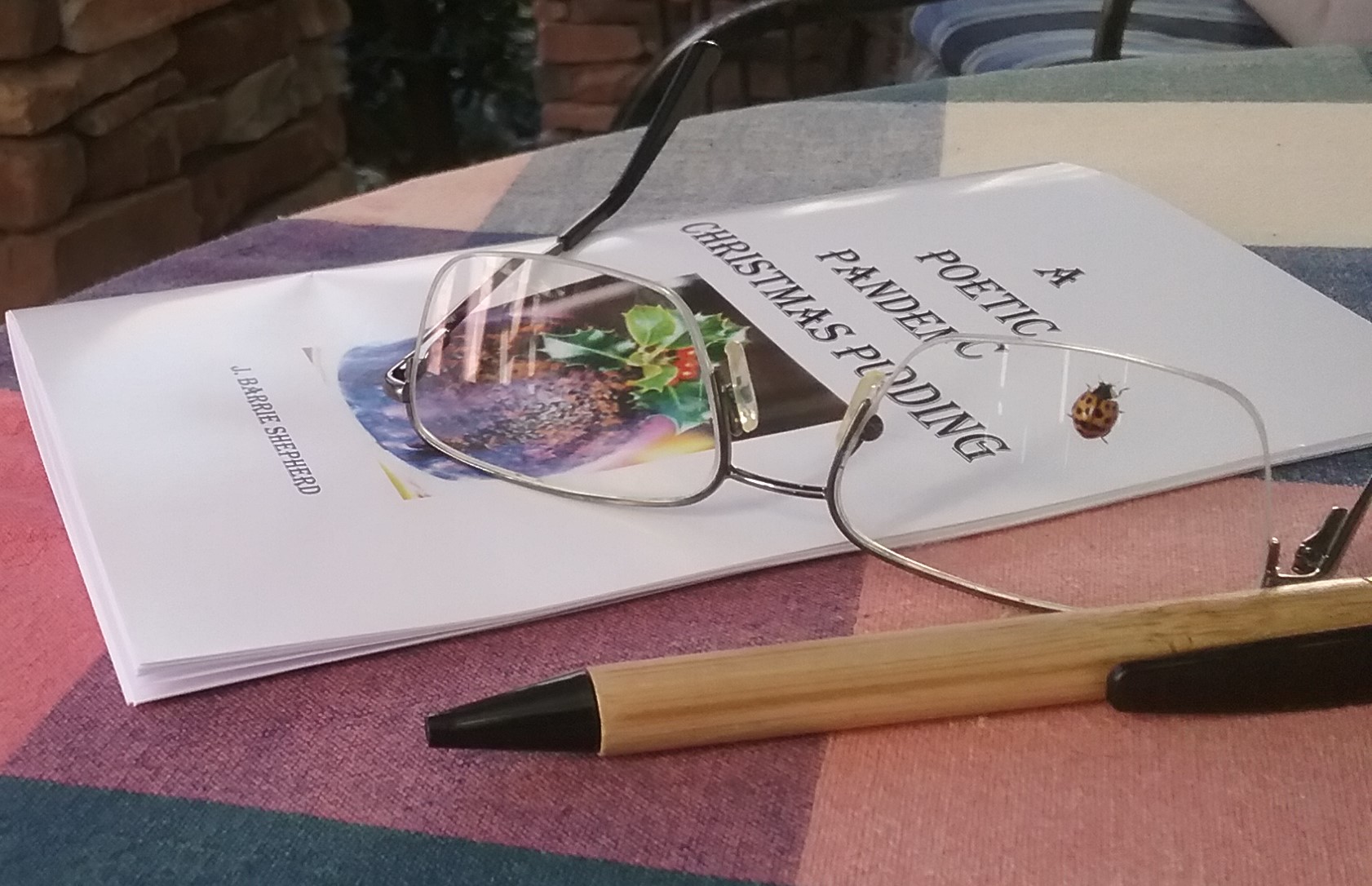
Ladybug season again at our place. 
This one crawled along the book, the pen and then my glasses.

Spiritual gurus admonish us to “go toward the light,” and especially in this winter season of a pandemic, that seems preferable to wallowing in darkness. But a line in a poem entitled “Lux et Veritas” in J. Barrie Shepherd’s latest chapbook, A Poetic Pandemic Christmas Pudding, reminds me of the vitality of darkness.

Contrasting our light displays during this season with the humble lighting of Jesus’ stable cave that allowed “the clear radiance that streamed above, around, beyond that battered-blessed manger,” poet and pastor Shepherd recalls introducing his first granddaughter to “the black-velvet-spread celestial of The Milky Way” “one sparkling island night in Maine”:

Her sheer astonishment made clear that we must

claim our darkness too, if we would glimpse

the glory of the elemental light.

Sunday over Zoom, Ormewood Church had a glimpse of the glory that may come when we “claim our darkness too.” Preaching on Mary’s Magnificat, Rev. Jenelle Holmes shared a recent dark moment in her life and offered her own “Magnificat,” and she has graciously allowed me to share it with you: 

My soul deepens and broadens the Lord’s presence and my spirit rejoices with God who saves me each and every day. God has looked with eyes of mercy on me, when some in the world have looked on me with disdain. God has seen the ways I am held back by others and has handed me support. People call me blessed because God has walked with me on hard roads of rejection, depression and anxiety and anger, and God has carried me through. God’s name is holy and God is a holy space for me. When I could have turned around and cursed God, I took God’s presence seriously and God has honored that with a strong arm of confidence and love.  

Those who wish me harm through rejection or fear or ignorance, God has dealt with in the privacy of their hearts. Those who have sought to harm me by using their voices of privilege, even in the church and in my family, God has shouted over them that I am loved and that I am who I was created to be.  

And as I look to my neighbors who are without homes, I have seen God’s people provide shelter. As I look to my neighbors who have lost their jobs, I have seen God’s people write checks. As I look to my neighbors who are lonely and isolated, I have seen God’s presence ignite ideas and rhythms of faith. As I look to my neighbors who have experienced one setback after another, I have seen God provide one day after another.  

And the rich, the powerful, the ignorant: God will show them the emptiness of their greed. They will be hungry for the good work of God.  

And as I think of how God helped ancient Israel escape Pharaoh, how God has helped the barren experience new life and the dead come back to life, and the marginalized be handed a voice, I remember God’s mercy forever, in every generation, even my own, even in 2020. My soul magnifies the Lord and my spirit rejoices with God who saves me each and every day.                                                                                    –Rev. Jenelle Holmes

Having lived in a metaphoric dark closet during my childhood and youth as a gay kid, I knew where the light was—it was outside my protective, defensive, even necessary shell. The glory of God and my own glory lay beyond my captive, seductive defenses and others’ captive, destructive offenses. Remember Jung’s suggestion that religion is a kind of defense against God? My closet—my and others’ rigid conceptions of God—kept me from God’s glory. 

My most recent “aha” about who God is, is that God is the glory at the climax of the prayer Jesus taught us: “For thine is the kingdom and the power and the glory.” That glory is unknowable but visible in the infinite wonders of the universe, in myriad forms of life, and in human compassion and imagination. This is the prophet Isaiah’s “light that shines in darkness.” It is the “shekinah” of Yahweh’s divine presence. It is the glory that brightened Moses’ face and lifted Mary’s soul, as well as our own souls through Immanuel, God-with-us.

I pray this glory for you as you approach this Christmas: 

God bless you and keep you;

God make God’s face to shine upon you,

and be gracious to you;

God lift up God’s countenance upon you,

            and give you peace.  Numbers 6:24-26

Then we may attend to this summons in another of Barrie’s poems, “The Coming of the Light”: “Look deep into this gentle fire, and then go forth to bear it, far and tender, to wherever infants, cold and frightened, tremble in the dark with no bright star, no kings to greet.”


For your own copy of poet and pastor J. Barrie Shepherd’s holiday chapbook: A Poetic Pandemic Christmas Pudding, please send a check to J. Barrie Shepherd at 15 Piper Road – K325, Scarborough ME 04074. Copies will be signed and can be inscribed by request. Or order though his email: barrieshep@aol.com. $10 per copy plus $2 postage. Proceeds go to food pantries in his area of Maine.

Donations to Progressive Christian Reflections may be given safely by clicking here and scrolling down to the donate link below its description. Thank you!

Contemporary Magnificat © 2020 by Rev. Jenelle Holmes, used by permission. 

Copyright © 2020 by Chris R. Glaser. Permission granted for non-profit use with attribution of author and blogsite. Other rights reserved.  


Wednesday, November 25, 2020

Contemplation in Science


Anthropologist Jeremy Narby’s book, Intelligence in Nature: An Inquiry into Knowledge, which I referred to two weeks ago, reminded me of the role of contemplation in the scientific quest.

I’ve written before about Einstein’s famous “thought experiments” by which he developed explanations for natural phenomena, comparing them to the imagination Saint Ignatius felt was needed in the contemplative life.

In a chapter entitled “Plants as Brains,” Narby reports the work of Anthony Trewavas, a biologist at the University of Edinburgh, which he summarizes:

Plants have intentions, make decisions, and compute complex aspects of their environment. … When attacked by herbivores, some plants signal for help, releasing chemicals that attract their assailants’ predators. … When a plant is damaged, its cells send one another electrical signals just like our own pain messages [p 83-4].

Trewavas prefers to use the word “compute” to “think” when applied to plants [p87] and disputes the long held scientific position that plants are passive because they do not move, explaining “it requires an equating of movement with intelligence. Movement is an expression of intelligence [p85]” speculating that “plant communication is likely to be as complex as within a brain [p93].”

I will leave all of that for scientists to hash out. What interests me as a contemplative wannabe is Trewavas’s process developing such thoughts, “I find it’s only by long periods of doing nothing but think that suddenly facts start coming into your mind [p90].”

Half of Narby’s book consists of detailed footnotes that undergirds or sometimes questions his text. I find these details occasionally hard to understand, as I am clearly not a scientist, but I can appreciate their gist. I’m not a footnote kind of guy, but I find these footnotes awesome and well worth the read. It’s there that I found these thoughts from W. I. B. Beveridge, written in 1950 under the title The Art of Scientific Investigation:

The most important prerequisite is prolonged contemplation of the problem and the data until the mind is saturated with it. … The mind must work consciously on the problem for days in order to get the subconscious mind working on it [p 206].

Diversions and distractions are to be avoided, but idle time can be useful and fertile. This made me think of Vincent van Gogh’s idle time after being dismissed from his pastoral position by church hierarchy dismayed at his lack of social distance from his parishioners. It was then van Gogh thought he might take up drawing and painting, hoping his paintings would have the same consoling effect the Christian faith once offered.

Beveridge continues:

Most people find intuitions are more likely to come during a period of apparent idleness and temporary abandonment of the problem following periods of intensive work. Light occupations requiring no mental effort, such as walking in the country, bathing, shaving, traveling to and from work, are said by some to be when intuitions most often appear… [p207].

That’s the way I work, by spending a little “idle” time that allows thoughts or feelings, patterns or analyses to “bubble up.” In college I read process philosopher Henri Bergson, who suggested that along with rational thought we needed intuitive thinking. Intuition may simply be the subconscious mind offering an insight or solution from its hidden depths.

To me, that’s the gift of contemplation in the spiritual life as well.


For Thanksgiving in the U.S. tomorrow, please see last week’s post: Thanksgivings

My friend and blog reader J. Barrie Shepherd is offering a holiday chapbook:

A Poetic Pandemic Christmas Pudding “a plump and spicy concoction of words, phrases and images to evoke the many flavors and aromas of the yuletide feast. P.S. Add brandy to ignite.

Proceeds go to food pantries in his area of Maine. $10 per copy plus $2 postage. Send check made out to J. Barrie Shepherd to 15 Piper Road – K325, Scarborough ME 04074. Copies will be signed and can be inscribed by request. Or order though his email: barrieshep@aol.com.

Donations to Progressive Christian Reflections may be given safely by clicking here and scrolling down to the donate link below its description. Thank you!

Copyright © 2020 by Chris R. Glaser. Permission granted for non-profit use with attribution of author and blogsite. Other rights reserved.  


Wednesday, November 18, 2020

Thanksgivings


As we huddle in our homes, alone or with immediate family and/or pets, fearful of the usual gatherings that Thanksgiving, Christmas, and New Year’s bring because of the coronavirus, it may be more of a challenge to feel gratitude this year.

Whenever I feel cause to complain, as happened in the calamity described in last week’s post, I immediately think of all those people who have far more to complain about throughout the world. It makes me feel that I have no right even to mention my “suffering,” as if I am whining like a child in a grocery store denied a treat.

The spiritual writer Henri Nouwen declared that we should not compare sufferings, saying, “Your suffering is your own.” I am not so sure, but in the moment of loss and deprivation and pain, the focus is on your suffering or my suffering or the suffering we witness daily in the news. Our individual experience of suffering opens us to understanding the suffering of others.

Many of us believe that to be a spiritual person is to practice compassion, literally “suffering with” one another. It is a practice, not always a feeling, though the practice may lead to feelings as well as actions to assuage the suffering.

Jesus was the first spiritual founder to teach me this. But it’s also true of the Talmud and the Buddha and the Quran and the Vedas, to mention a few spiritual paths that sensitively deal with suffering.

Our sufferings could be, as I’ve written in other contexts, our “wounds with a view,” our opportunities to be thankful for the people and things, events and opportunities we are missing for now as well as our window onto others’ suffering.

Some of us are missing people who will never return, but we can yet be grateful that they have touched our lives, our bodies, our dreams, our hopes. I am the sum of all who have touched me, and I celebrate them whenever I think of them with love and joy and gratitude and whenever I touch others with love and joy and gratitude.

Despite our loss of five wondrous trees at the end of October, two from our neighbors’ yards and three from our own, the month began rather well observing Wade’s and my birthdays, our anniversary, and the anniversary of my lifelong-sought-for ordination. Our pastor Jenelle and her husband Chris (also a pastor) secretly hung the banner above on our front porch as a surprise from our Ormewood Church friends. (Their daughter tried to help, but she kept giggling, I am told.)

Our friends and neighbors Sonja and Jody and Cathie and CJ gathered with us for a socially-distanced outdoor dinner celebration under colorful parasols in Sonja and Jody’s yard. People driving by thought it was a fabulously festive new restaurant opening. (See photo below.) They also rescued us and Wade’s chili when we lost power on Halloween.

We received cards and calls and messages from family and friends. For all our “cloistered” experience, we never felt absolutely alone. And in a day and age of cellphones and flatscreens and tablets and laptops, we had Zoom church and conversations and plenty of programs to watch. Think of historic pandemics with none of these outlets (or maybe I should call them “inlets”)!

I had my blog to write and readers to correspond with while Wade worked online from home. I also led an online retreat on Henri Nouwen for Columbia Seminary’s Spirituality Program, synchronistically based on his book Reaching Out.

And God was always to be found as I daily prayed for humanity’s deliverance from this virus as well as for the election of compassionate leaders.

My hope is that we all make the most of our Thanksgivings!

That's Wade to the right.

Donations to Progressive Christian Reflections may be given safely by clicking here and scrolling down to the donate link below its description. Thank you!

Copyright © 2020 by Chris R. Glaser. Permission granted for non-profit use with attribution of author and blogsite. Other rights reserved.  


Wednesday, January 8, 2020

Love that Does Not Die


Early Sunday morning before Christmas I learned that my first long term partner had died. It took me by surprise and grabbed me in the gut. I wanted to talk to somebody about it, but I didn’t think anyone could understand. So I’m talking about it with you, the reader of this blog. Some of you have followed my life not only during part or all of  the nine years I’ve been writing this blog, but in the decades since my first book was published in 1988 and before, in the multiple columns I wrote for several periodicals and newsletters.

It was to that first book that I returned to remember “John,” one who saw me through some of my roughest times as a candidate for ordination in the Presbyterian Church. I first wrote of him recounting my first Presbyterian General Assembly in Baltimore in 1976 as a gay activist:

My loneliness grew from having completed the fulfilling ministry internship at the Christian Association [of the University of Pennsylvania in Philadelphia] the week before. I had not only said goodbye to a number of friends at term’s end, but I had also broken off a relationship with a man whom I will call John, a name that means “The Lord is gracious.” … *

John, a graduate student, had sought me out for a relationship. His presence in the months that followed comforted me… While he respected and admired my commitment to the church, he was not similarly inclined, and this limited the depth of the relationship for me. On the other hand, though severely closeted, John at least was not inhibited by the church.

At the close of the spring semester he completed his studies and returned to his home in California, where he intended to become a millionaire in his chosen career, a priority I did not share. Unblinded by passion, we made a mutual and rational decision to bring our relationship to a close, since I would only briefly be in California before returning to New Haven for my final year of seminary.

But something happened as I drove him to the airport: he cried. I had never witnessed his poker face display emotion. I was moved, and fell in love with him for the first time. He was vulnerable, capable of an intimacy never before revealed. Then he was gone. Lost love frequently prompts me to write, so I wrote him a poem. I did not know it would rekindle our love, but I hoped that it would.  Uncommon Calling, p 143.

I did not hear from him at the time, but later learned he carried that poem in his briefcase for a month before responding, favorably. I returned for a visit with my family in California before my final year at Yale Divinity School, and we renewed our relationship, despite the distance to come.

After graduation in May of 1977, I returned to California to accept a position as Director of the Lazarus Project, a first-of-its-kind ministry of a mainline denomination intended to reconcile the church and the LGBT community. Because I was “under care” as a candidate for ordination in a neighboring presbytery, I was required to seek its permission to “labor outside its bounds” to accept the call, permission denied me during an unusually well-attended summer meeting.

A church leader remarked to me afterward that the presbytery was so hostile to me, “They wouldn’t let you clerk in a grocery store!” I was devastated. … I phoned John from the meeting, barely able to speak, embarrassed by my church family’s treatment, crying that these who did not know me personally could be so angry with me. Stunned and hurting with me, John comforted me as best he could.  Uncommon Calling, p 166.

So that I could accept the position in the neighboring presbytery, a special meeting was called to consider my transfer as a candidate for ordination to that presbytery.

This time my lover, John, was present for moral support. Fears had been expressed that the presbytery might defeat my transfer out of sheer vindictiveness. After an hour’s debate in which hostile questions surfaced, such as whether I were repentant enough to be transferred, the vote was taken.

Because of voting irregularities at the earlier meeting, a written ballot was requested. The stated clerk, appointing neutral people to count ballots, pointed at John (not knowing his relationship to me) as a potential volunteer. “And you—who are you?” the clerk asked. John, caught off guard, stuttered, “I’m not a member of this church!”

“Then you ought to be fair,” came the clerk’s mischievous rejoinder, breaking the gathering’s tension with laughter. Later, John told me, in tabulating the ballots, he seemed to open all the negative ones!  Uncommon Calling, p 167.

I “won” that vote, given permission to transfer, but, though it had approved the mission and ministry of the Lazarus Project, the receiving presbytery delayed a vote on receiving me until after the denomination had decided on the question of ordaining openly gay and lesbian clergy the following year, in May of 1978. The denomination rejected such ordination and in June, the presbytery considered my transfer and rejected it. Unintentionally ironic, the presbytery then asked me to pray!

After the prayer I walked down the center aisle of the church to the narthex, followed by a few supporters, mostly women, who offered me tearful hugs outside the sanctuary. There my grateful eyes saw John. He had hurried from work to the evening meeting, hurried so fast he had been stopped for a speeding ticket, at which time, flustered by the delay, he had locked his keys in the car!

But he’d arrived in time for much of the debate, and he was there for me. He gave me a hug, and we drove home. Entering my apartment, the phone rang, an elder from a Baltimore church calling to hear how things had gone. I could hardly bear his sobs on the phone as I told him. Then came the task of informing my parents. I phoned them the news, and they too cried, hurt and angry that the church could reject me. 

And then John offered me the love the church denied.

Uncommon Calling, p 205-206.

I cry even now as I copy this from my first book, hurt by the rejection, moved by John’s love, grieved at John’s death. We remained friends for nearly two decades, but lost touch for a variety of reasons after my move to Atlanta, though I continued to pray for him and his partner. His love then, our love then, remain forever.

In loving memory of Tom Halliday.

*He puzzled why I would use a pseudonym for him in my book, and I explained because he was not openly gay then. He appeared again as Tom in my book The Final Deadline, pp 38-39, 42.

Progressive Christian Reflections is entirely supported by reader donations. To support this blog: https://www.mccchurch.org/ministries/progressive-christian-reflections/
Scroll down to the donate link below its description. Thank you!

Copyright © 1988 and 2020 by Chris R. Glaser. All rights reserved. Permission granted for non-profit use with attribution of author and blogsite.

Wednesday, January 1, 2020

Why Must Politics Intrude on Our Faith?

Photo by Bassam Khabieh for Reuters and The New York Times.

A few days after Christmas [2014] I picked up our morning paper and, before I put on my reading glasses, I saw on the front page a child on a sled in the snow, confirmed by the caption that began, “Heavy sledding…” I wondered where in the world the photograph was taken.

As I drew the paper closer and put on my reading glasses I was stunned by my mistake. This was no child laughing as he rode a sled through snow—no, this was a child crying out in pain, being carried on a stretcher over a caption that read not “heavy sledding” but “Heavy Shelling…” as in “Heavy Shelling Reported Near Damascus.” What I imagined was snow on the boy’s clothing must have been debris from the blast.

I felt much the same way when I read the Gospel lesson for the Sunday following Christmas. After spending Christmas Eve hearing and singing about the holy infant Jesus, so tender and mild, enjoying a silent and holy night in which all is calm, all is bright, I found Matthew’s text about the slaughter of the innocents disturbing and violent (2:13-23).

Here Jesus had just been born to Mary and Joseph, and was lying in a manger, sleeping in heavenly peace, visited in Matthew by three spiritual sages from another country who brought gold and frankincense and myrrh and, in the Christmas carol, Silent Night, visited by shepherds enjoying the “radiant beams from his holy face” that meant “the dawn of redeeming grace.” The only thing that had disturbed their silent night earlier had been angels in the heavens singing “alleluia to our King; Christ the Savior is born.”

Why, oh why, must this beatific image be shattered by political realities? Escaping from King Herod, who, if he can’t find this baby that threatens his political power, chooses to slaughter all the innocents—infants the age of Jesus, causing wailing and lamenting in his birthplace of Bethlehem. And why, upon their return from Egypt, must Mary, Joseph, and Jesus go into hiding once more, this time in Galilee, to escape the even more heinous son of Herod, Archelaus, who had ascended the throne upon his father’s death?

Why can’t we just have a nice little Christmas? Why can’t we all just get along? And why must politics intrude on our faith, disturb our praise and worship, interrupt our contemplative mantra of “peace on earth, goodwill to all”? Why must we read of slaughtered innocents and wailing mothers? Why must I pick up a newspaper and see such a disturbing scene as a terrified child in pain after the president of Syria has bombed his hometown?

If we learn nothing else from the subsequent life of Jesus, it is that spirituality is never an escape—it is always an engagement with reality. Jesus’ prayer “forgive us our debts” meant a lot to his poor, impoverished fellow Israelites. “Thy kingdom come” meant the end of the Roman Empire. If a Roman soldier compels you to carry his gear one mile, carry it two miles, because “Loving your enemies” is a revolutionary act.

“Give unto Caesar that which is Caesar’s, but give to God that which is God’s.” “Don’t be like these Pharisees…,” rather, “consider the lilies of the field.” Whether waiting for the bridegroom or your master or the owner of the vineyard, be strategic in your preparations. “Be wise as serpents and gentle as doves.” “If a town (or church) does not welcome you, shake its dust from your feet.” “Sell your possessions and give to the poor, and come follow me.”

“Go and learn what this means: I desire mercy and not sacrifice.” “Let the one without sin cast the first stone.” God’s “house shall be called a house of prayer for all peoples, but you have made it a market place!” All of these quotes bring to mind real world applications of Jesus’ gospel.

And then there’s the cross: a political execution awaiting our “holy infant, so tender and mild.”

So I wrote this prayer for the children of the world:

In the name of Jesus who lifted children to his lap
and said “of such is the kingdom of heaven,”
we pray for the children of the world:

We pray for those who live in poverty,
            from our own neighborhood to those in hidden corners of the world.
We pray for those who live in danger
            of abuse, exploitation, violence, war, and disaster.
We pray for those who live in hunger and thirst,
            those who starve and those who are malnourished,
those enduring droughts and those whose water is polluted.
We pray for those who suffer illiteracy or disease, those who are refugees,
those who are illegal immigrants, those with disabilities,
those who are oppressed, those whose religion, culture, tribe, or nation distort their view of themselves and the world.

Your child, Jesus, suffered with all the children of the world
“because all are precious in his sight.”
In the name of Jesus who lifted children to his lap
and said “of such is the kingdom of heaven,”
we pray for the children of the world. Amen.


I posted this on January 15, 2014 and thought new blog followers might like to read it. Have a meaningful and hopeful new year!

Progressive Christian Reflections is entirely supported by reader donations. To support this blog: https://www.mccchurch.org/ministries/progressive-christian-reflections/
Scroll down to the donate link below its description. Thank you!

Consider using a post or quotes in personal reflection, worship, newsletters, and classes, referencing the blog address and author when possible: http://chrisglaser.blogspot.com.
Check out past posts in the right rail on the blogsite.

Copyright © 2014 by Chris R. Glaser. Permission granted for non-profit use with attribution of author and blogsite. Other rights reserved.

Wednesday, December 25, 2019

A Christmas Memory

"Tree of the Gods"


In thanksgiving for the life and pastoral and prophetic and priestly ministry of the Rev. Peter Denlea.

Christmas morning [2016] I awoke from an extremely pleasant dream. I was back in the home I grew up in, in Southern California, with my mom and dad, sister and brother. I looked out of our living room windows, and discovered it had begun to snow, a rarity in L.A. The window frames had a white dusting, as did our deodara outside, a tree that had been our Christmas tree one year. Only checking on its spelling for this post did I discover the term deodara’s mystical origin, meaning “tree of the gods” in Sanskrit, a sacred forest for Hindu sages.  And “dara” is related to the words Druid and truth!

In the weeks leading up to Christmas, I had read once more Truman Capote’s story, “A Christmas Memory.” Some months ago I rescued it from storage in my crawl space, a bit damp from its place of safekeeping. I allowed the boxed edition to dry, and now it has character: a bit warped, like its author and the true life characters he writes about.

I know the story well. For years I read it at Christmastime to a Wednesday night Bible study. I’ve also viewed two film versions, the most memorable having Geraldine Page as the doting and doughty elderly cousin who befriended the author as a boy, otherwise  abandoned until the age of ten.  

One day, late in the fall, she would announce, “Oh, my, it’s fruitcake weather,” and together they assembled the ingredients and prepared the Christmas fruitcakes that they sent to everyone from President & Mrs. Roosevelt to that nice California couple who spent an afternoon on their porch when their car broke down.

As I read the story once more, I was delighted by Capote’s turns of phrase, painting a portrait of a time long past—yes, harsh in its poverty and sad in its way, but with a kind and gentle lilt to its voice that uplifted my spirit.

What surprised me on this reading, however, was the glimpse of grace toward the end of the book, reminding me of another Southern writer, Flannery O’Connor, at the end of her story, “Revelation,” of which I wrote in a post entitled “Tricked by Grace.”

The boy and his cousin fashion kites as their Christmas gifts to one another, as they had done the year before, and the year before that.  They go out to fly them with their terrier Queenie in a neighbor’s meadow, when the old woman has a startling revelation, “like a woman remembering too late she has biscuits in the oven”:

“My, how foolish I am! You know what I’ve always thought? I’ve always thought a body would have to be sick and dying before they saw the Lord. And I imagined that when He came it would be like looking at the Baptist window: pretty as colored glass with the sun pouring through, such a shine you don’t know it’s getting dark. And it’s been a comfort: to think of that shine taking away all the spooky feeling. But I’ll wager it never happens. I’ll wager at the very end a body realizes that the Lord has already shown Himself. That things as they are”—her hand circles in a gesture that gathers clouds and kites and grass and Queenie pawing earth over her bone—“just what they’ve always seen, was seeing Him. As for me, I could leave the world with today in my eyes.”

“As for me, I could leave the world with today in my eyes.”

I thought back on their sacramental preparation of a communion of fruitcakes, and of the many, often women, who consecrated our kitchens with the incense of baking, the breaking of bread, the squeezing of juice. I thought of my mother baking Christmas cookies, red and green, and giving me the “failures,” the ones that didn’t look as good as they tasted, as she sorted them in tins for relatives and friends.

In her poem “Answers,” Mary Oliver envies her unlearned grandmother picking and canning fruits in the kitchen even as Mary “wakened / To books and music and circling philosophies” at the kitchen table, concluding:

My grandmother stood among her kettles and ladles.
Smiling, in faulty grammar,
She praised my fortune and urged my lofty career.
So to please her I studied—but I will remember always
How she poured confusion out, how she cooled and labeled
All the wild sauces of the brimming year.

This poem brings back the aroma of my maternal grandmother’s Swedish pancakes, the colors of my paternal grandmother’s jars of fruits and vegetables at the farm, the salty crunch of the batter on my mother’s fried chicken—and it honors them all as gods bringing order from chaos, as priests and poets and psalmists reminding us to “taste and see that the Lord is good,” even as we are, in Mary Oliver’s words, “sorting through volumes of answers / That could not solve the mystery of the trees.”

We didn’t have a Christmas tree this year, because we are downsizing, packing, and moving. But I had the mystery of home and our deodara in my dream. And, as I fixed breakfast for us, I heard Eugene Peterson (The Message) on the radio program “On Being” say, “Prayer matures into the practice of memory.”

I thought of a spiritual formation program paper I’d read earlier in the week by a minister who works with the elderly, and how those with dementia and Alzheimer’s seem to remember the ritual of Communion, even as they forget so much else.

The Lord has already shown herself.


Though the memorial line is new, I posted this on December 28, 2016 and thought new blog followers might like to read it. Have a meaningful and hopeful  Christmas!


Please make an end-of-the-year tax-deductible contribution to this blog ministry by clicking on or copying and pasting in your web browser:

Be sure to scroll down to the donate link below its description. Or mail to MCC, P.O. Box 50488, Sarasota FL 34232 USA, designating “Progressive Christian Reflections” in the memo area of your check or money order. Thank you!

Wednesday, December 18, 2019

Mohammad's Child

Photo by Andrea Bruce for the New York Times

On the cover of the February 9, 2012 New York Times I saw a familiar tableau, three robed figures with covered heads gazing at an infant in a manger beneath rough-hewn wooden beams. The darkness out of which the lighted figures emerged made me think, “Oh, a Nativity by Rembrandt. I wonder how many millions Sotheby’s auctioned this for? Will it go to a museum or a billionaire?”

But, as I looked closely and read the caption, I realized this moving portrait was a photograph by Andrea Bruce of a three-month old child who died of the cold at a refugee camp in Kabul, Afghanistan. The story by Rod Noland inside the paper gave context to this tragedy, deepening its pathos. “He was crying all night of the cold,” Sayid Mohammad explained of the eighth of his nine children to die, six of disease back home and now, two from the cold at the Nasaji Bagrami Camp, where a total of sixteen children 5 years of age or younger had died of the cold so far.

In a headline just below this “nativity,” “a wealthy backer” is betting on a presidential hopeful, pictured with pastors praying for the candidate, heads bowed with a laying on of hands.

But my eyes are drawn to the trinity of women above, contemplating the dead child whose unseeing face looks upward at them, one grandmotherly figure with a slight fond smile (or grimace?), the central somber mother, Lailuma Mohammad, and a younger woman, kneeling with her face slightly turned away, forehead cradled in hand in grief, perhaps his 10-year-old sister who, earlier that day, had foraged some paper and plastic to burn to keep him warm. 

It was not a nativity by Rembrandt, after all. Not the Christ child, but Mohammad’s child. And no less sacred.


I posted this on February 22, 2012 and thought new blog followers might like to read it. Have a meaningful Advent and Christmas!

Please make an end-of-the-year tax-deductible contribution to this blog ministry by clicking on or copying and pasting in your web browser:


Be sure to scroll down to the donate link below its description. Or mail to MCC, P.O. Box 50488, Sarasota FL 34232 USA, designating “Progressive Christian Reflections” in the memo area of your check or money order. Thank you! 

Copyright © 2012 by Chris R. Glaser. Permission granted for non-profit use with attribution of author and blogsite. Other rights reserved. 

Wednesday, December 11, 2019

"Somebody's Gotta Be Mary!"

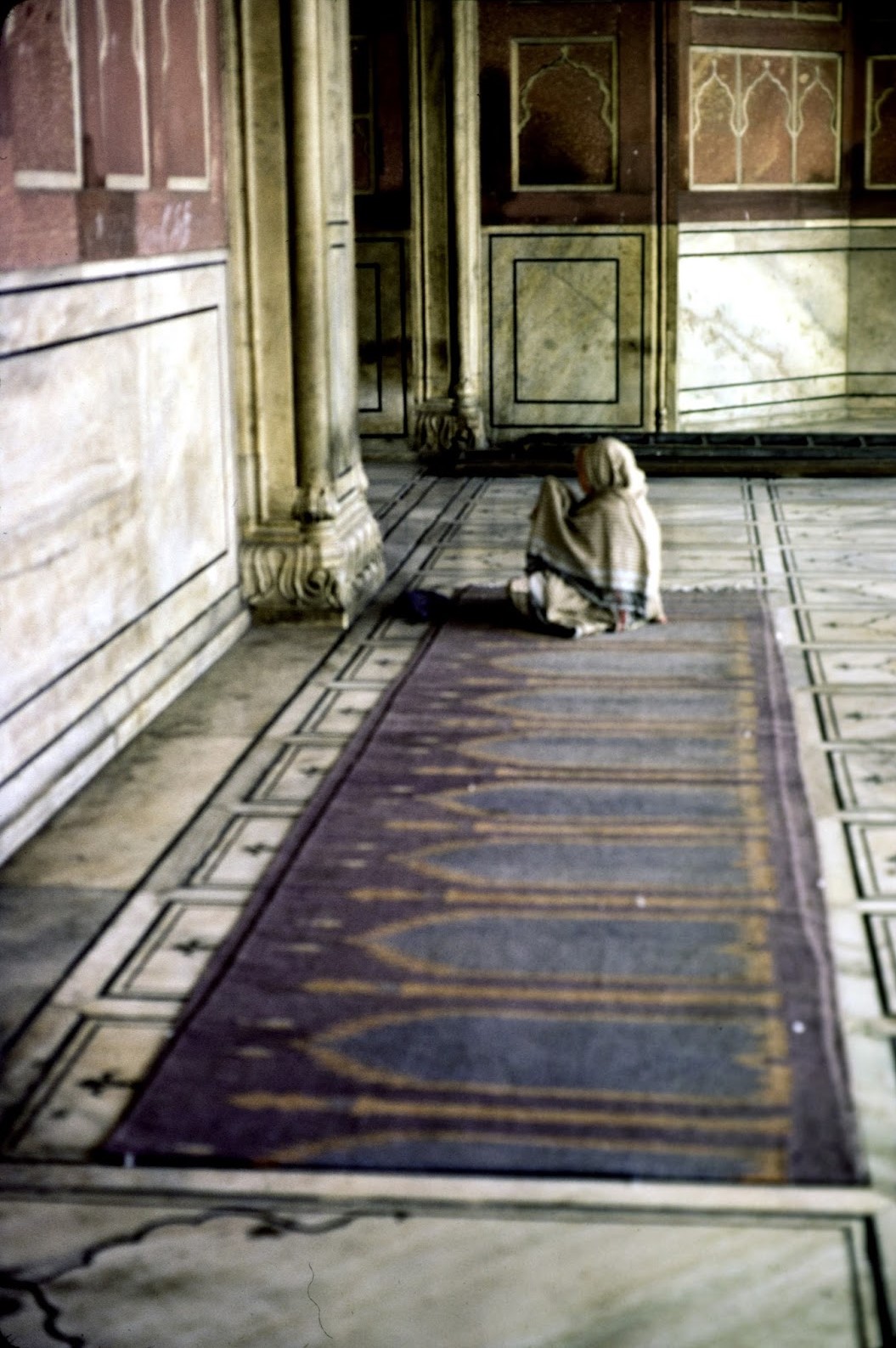
India, January 1983

Once upon a time, respectable members of a respectable church decided to perform a Christmas pageant, and congregants were vying for parts. The big competition was around the roles of the Magi, the Eastern religious scholars bearing gold and frankincense and myrrh. Many were taken with their absolutely fa-bu-lous costumes, reeking of wealth and privilege and prestige.

But there were also many who wanted to demonstrate their own humility by playing the poor shepherds watching their flocks by night, knowing that they’d get to see a sky full of angels singing of peace on earth, goodwill toward all, as well as visit the baby Jesus lying in a manger with a halo for a hanging playtoy.

Others wanted to be those high and mighty angels, who, in our contemporary, secular times seem to represent only themselves, cutely and cherubically and all-too-benignly making guest appearances on wrapping paper, greeting cards, and Christmas films, instead of being the fierce and frightful presence of God they are in the Bible—so terrible, they often had to say “fear not!”—awesomely calling individuals to radical action rather than offering sentimental appeasement.

For the manger scene itself, as you may have guessed, it was easy among the staid and high-end church members to cast the roles of the ox and of the ass and of the many docile sheep. Easy also to cast the unwelcoming innkeeper and King Herod frightened of losing power and the indifferent Caesar Augustus only interested in the bottom line, the church budget.

A few were at least willing to play one of the pageant’s two leading characters, Joseph, who at first wanted to put his pregnant betrothed away in a closet somewhere to avoid public disgrace. You will recall that Joseph had a change of heart after having his own vision of an angel, then choosing to serve as a kind of behind-the-scenes partner to the inevitably unfolding will of God, a ferocious will contrary to decency and order, a decency and order Joseph wanted to at least appear to uphold by his outward compliance.

But nobody wanted to play the role of Mary in the Christmas pageant. “Somebody’s gotta play Mary!” the stage manager Gabriel shouted out, sounding very much like the gravelly voice of Harvey Fierstein. “No Mary, no Jesus!” he cried bluntly.

You see, nobody respectable wanted to play Mary because of the shame of her unwed pregnancy. And absolutely no one wanted to go through the bloody and painful job of giving birth to a new thing.

Mary’s fidelity to God, her willingness to say, “Here I am the servant of the Lord; let it be with me according to your word”—all of this counted for naught in the eyes of these good people. The Holy Spirit was knitting together in her womb the new thing for which the prophets hoped, yet, like all nativities of the Spirit, “the powers that be” trembled, including these dignified religious types. Mary’s birthing this child would be an unsettling and unclean act, embarrassing rather than admirable.

“Mary is not a good role model for our children,” someone said.

Stage manager Gabriel again implored the crowd, “C’mon! As Mary, you get to magnify and rejoice in the Lord and be called blessed by generations to come, though admittedly not this generation. You get to serve as God’s instrument to scatter the proud in their presumptuous imaginations, lifting the downtrodden even as the powerful are taken off their high horse. Your mission is to fill the hungry with good things, and to remind the privileged of their own poverty. This is a good thing. Really.”

Visiting the church for the first time, a timid and small young girl came forward, a recent immigrant with olive skin and dark brown eyes and thick black hair, and simply said, “Here am I.” Gabriel, exasperated by everyone else’s resistance, asked, “So—ya wanna be Mary?” And because his language was new to her, she simply quoted Mary’s line, “Let it be with me according to your word.”

And so the respectable church filled with respectable members was able to put on its pageant, reliving the Christmas story, but they did not live happily ever after. For the nature of all nativities of the Spirit humbles those with privilege and uplifts the underprivileged, shaming the proud and bringing mercy and justice to the oppressed.

But that can’t happen unless someone is willing to be Mary.


I posted this on December 7, 2016 and thought new blog followers might like to read it. Have a meaningful Advent and Christmas!

Progressive Christian Reflections is entirely supported by reader donations. To support this blog: https://mccchurch.org/ministries/progressive-christian-reflections/
Scroll down to the donate link below its description. Thank you!

Copyright © 2016 by Chris R. Glaser. Permission granted for non-profit use with attribution of author and blogsite. Other rights reserved.