Showing posts with label the closet. Show all posts

Wednesday, December 16, 2020

Go Toward the Dark

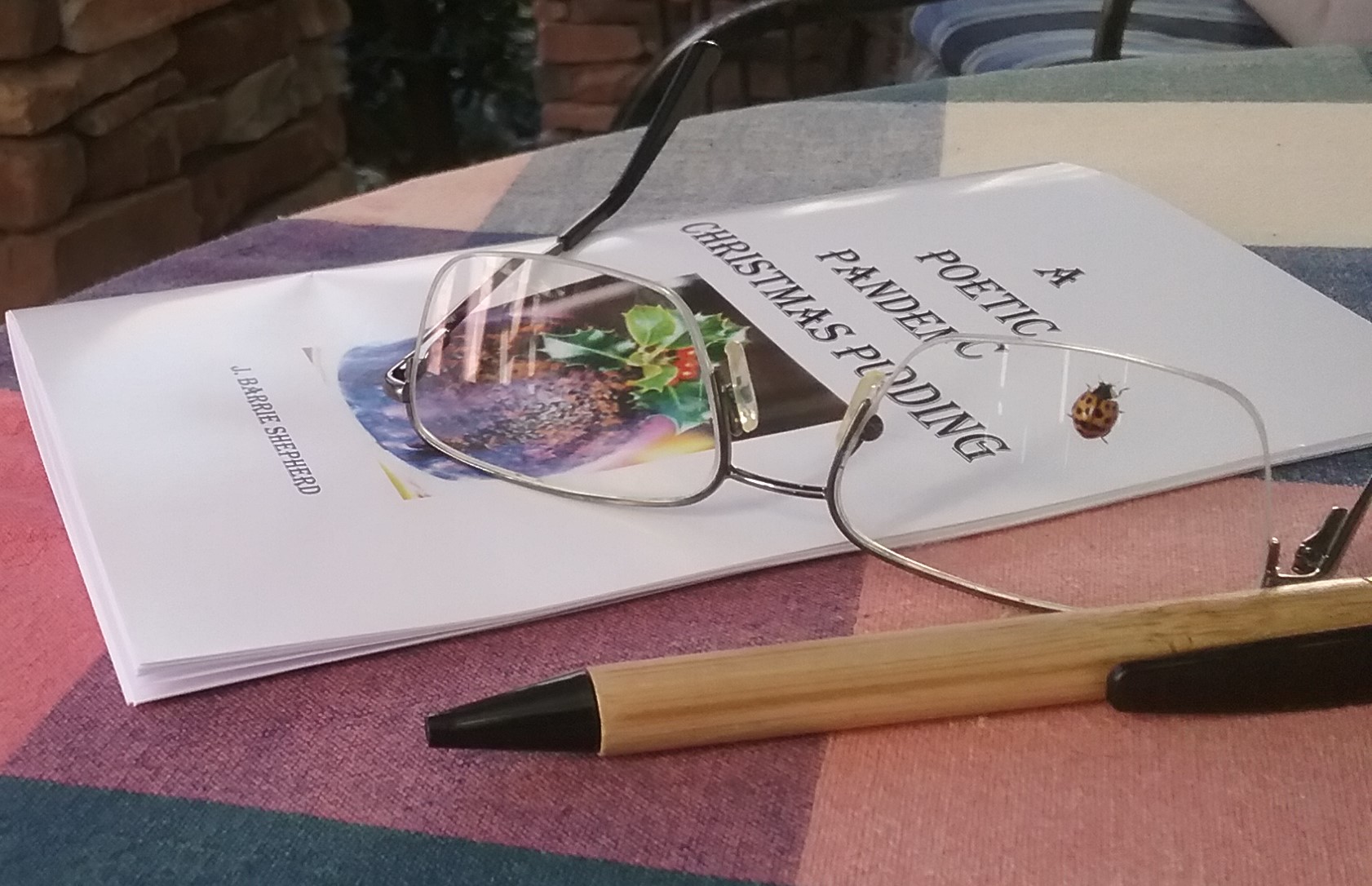
Ladybug season again at our place. 
This one crawled along the book, the pen and then my glasses.

Spiritual gurus admonish us to “go toward the light,” and especially in this winter season of a pandemic, that seems preferable to wallowing in darkness. But a line in a poem entitled “Lux et Veritas” in J. Barrie Shepherd’s latest chapbook, A Poetic Pandemic Christmas Pudding, reminds me of the vitality of darkness.

Contrasting our light displays during this season with the humble lighting of Jesus’ stable cave that allowed “the clear radiance that streamed above, around, beyond that battered-blessed manger,” poet and pastor Shepherd recalls introducing his first granddaughter to “the black-velvet-spread celestial of The Milky Way” “one sparkling island night in Maine”:

Her sheer astonishment made clear that we must

claim our darkness too, if we would glimpse

the glory of the elemental light.

Sunday over Zoom, Ormewood Church had a glimpse of the glory that may come when we “claim our darkness too.” Preaching on Mary’s Magnificat, Rev. Jenelle Holmes shared a recent dark moment in her life and offered her own “Magnificat,” and she has graciously allowed me to share it with you: 

My soul deepens and broadens the Lord’s presence and my spirit rejoices with God who saves me each and every day. God has looked with eyes of mercy on me, when some in the world have looked on me with disdain. God has seen the ways I am held back by others and has handed me support. People call me blessed because God has walked with me on hard roads of rejection, depression and anxiety and anger, and God has carried me through. God’s name is holy and God is a holy space for me. When I could have turned around and cursed God, I took God’s presence seriously and God has honored that with a strong arm of confidence and love.  

Those who wish me harm through rejection or fear or ignorance, God has dealt with in the privacy of their hearts. Those who have sought to harm me by using their voices of privilege, even in the church and in my family, God has shouted over them that I am loved and that I am who I was created to be.  

And as I look to my neighbors who are without homes, I have seen God’s people provide shelter. As I look to my neighbors who have lost their jobs, I have seen God’s people write checks. As I look to my neighbors who are lonely and isolated, I have seen God’s presence ignite ideas and rhythms of faith. As I look to my neighbors who have experienced one setback after another, I have seen God provide one day after another.  

And the rich, the powerful, the ignorant: God will show them the emptiness of their greed. They will be hungry for the good work of God.  

And as I think of how God helped ancient Israel escape Pharaoh, how God has helped the barren experience new life and the dead come back to life, and the marginalized be handed a voice, I remember God’s mercy forever, in every generation, even my own, even in 2020. My soul magnifies the Lord and my spirit rejoices with God who saves me each and every day.                                                                                    –Rev. Jenelle Holmes

Having lived in a metaphoric dark closet during my childhood and youth as a gay kid, I knew where the light was—it was outside my protective, defensive, even necessary shell. The glory of God and my own glory lay beyond my captive, seductive defenses and others’ captive, destructive offenses. Remember Jung’s suggestion that religion is a kind of defense against God? My closet—my and others’ rigid conceptions of God—kept me from God’s glory. 

My most recent “aha” about who God is, is that God is the glory at the climax of the prayer Jesus taught us: “For thine is the kingdom and the power and the glory.” That glory is unknowable but visible in the infinite wonders of the universe, in myriad forms of life, and in human compassion and imagination. This is the prophet Isaiah’s “light that shines in darkness.” It is the “shekinah” of Yahweh’s divine presence. It is the glory that brightened Moses’ face and lifted Mary’s soul, as well as our own souls through Immanuel, God-with-us.

I pray this glory for you as you approach this Christmas: 

God bless you and keep you;

God make God’s face to shine upon you,

and be gracious to you;

God lift up God’s countenance upon you,

            and give you peace.  Numbers 6:24-26

Then we may attend to this summons in another of Barrie’s poems, “The Coming of the Light”: “Look deep into this gentle fire, and then go forth to bear it, far and tender, to wherever infants, cold and frightened, tremble in the dark with no bright star, no kings to greet.”


For your own copy of poet and pastor J. Barrie Shepherd’s holiday chapbook: A Poetic Pandemic Christmas Pudding, please send a check to J. Barrie Shepherd at 15 Piper Road – K325, Scarborough ME 04074. Copies will be signed and can be inscribed by request. Or order though his email: barrieshep@aol.com. $10 per copy plus $2 postage. Proceeds go to food pantries in his area of Maine.

Donations to Progressive Christian Reflections may be given safely by clicking here and scrolling down to the donate link below its description. Thank you!

Contemporary Magnificat © 2020 by Rev. Jenelle Holmes, used by permission. 

Copyright © 2020 by Chris R. Glaser. Permission granted for non-profit use with attribution of author and blogsite. Other rights reserved.  


Wednesday, October 18, 2017

The Monasticism of the Closet

Free-standing closet from an art exhibit 
in the Berkeley Center of Yale Divinity School, 1973.

“But thou, when thou prayest, enter into thy closet…,”Jesus advised in the KJV translation of Matthew 6:6. The NJB renders this “your private room.” I am told that this was a pantry, which would be at the center of a house of Jesus’ time. Like pantries today, it had no windows, so to keep stored food fresh and protected from critters, outside temperatures, and sunlight.

In his book, Contemplative Prayer, Thomas Merton wrote: “Some people may doubtless have a spontaneous gift for meditative prayer.” Beside it I wrote, “I think I do.”

This is more happenstance or grace than achievement on my part. I can go into a meditative state at will. I use it to begin my morning prayers, or as I approach a tense situation. I even use it when my blood pressure is being checked at the doctor’s office.

I once wrote that it may be sheer laziness on my part: I enjoy having to achieve nothing, to be at rest and at peace, given my busyness, schedule and work ethic. I also have described as difficult sitting with Henri Nouwen meditating on the Host for an hour, but I realize not because of the silence, rather because of the focus and the restless companionship of Henri. Centering Prayer has always seemed busy to me, having to return to one sacred word or phrase over and over again. I have found lectio divina helpful, though, but for the purpose of elucidating a text.

Merton writes that meditation is less about “method” and “system” than cultivating an “attitude,” an “outlook”: “faith, openness, attention, reverence, expectation, supplication, trust and joy.”

He warns against going simply by feelings, declaring, “A hard and apparently fruitless meditation may in fact be much more valuable than one that is easy, happy, enlightened and apparently a big success.” He suggests the movement of meditation follows the “rhythm of the Christian life, the passage from death to life in Christ. Sometimes prayer, meditation and contemplation are ‘death’—a kind of descent into our own nothingness, a recognition of helplessness, frustration, infidelity, confusion, ignorance.”

Thinking of my own contemplative proclivities, I have realized that my version of the monasticism of the desert is my monasticism of the closet, a version of Jesus’ pantry. It was the one place I was “safe” from shaming and bullying, as well as from the demanding and distracting world. I was carefully taught that God loved me; so my closet served as a retreat where I could rest in that love, a love that prompted my coming out in ministry with others. I feel for those who instead got the message that God was a God of wrath and hate that preferred they stay in the closet.

I felt safe enough in God’s love that God and Jesus were the first ones I came out to as gay. That did not mean our “conversations” were not filled with angst and fear and doubt and wrangling. But, thanks to my parents and my church and my Christian elementary and junior high school teachers and my love of scriptures, I grew in trust of God’s love. “When one is simply obeying God, a little effort goes a long way,” Merton writes.

He says that in meditative prayer, God “draws us out of darkness into light—[God] hears us, answers our prayers, recognizes our need, and grants us the help we require—if only by giving us more faith to believe that [God] can and will help us in [God’s] own time. This is already a sufficient answer. … A new realm opens up, that cannot be discovered otherwise: call it the ‘Kingdom of God.’ … But effort is necessary, enlightened, well-directed, and sustained.” (Emphasis Merton’s)

I was blessed with good spiritual directors, from my parents to my teachers, some of whom I only met through their writings.


Today’s quotes may be found in section III of Contemplative Prayer, pages 34-37.

Thank you for your support of this blog ministry: 
Be sure to scroll down to the donate link below its description.

Or mail to MCC, P.O. Box 50488, Sarasota FL 34232 USA, designating “Progressive Christian Reflections” in the memo area of your check or money order. Thank you!

Copyright © 2017 by Chris R. Glaser. Permission granted for non-profit use with attribution of author and blogsite. Other rights reserved.  

Wednesday, May 18, 2016

Out of the Closets and into the Kingdom

Forty years ago this coming fall I wrote a paper for liberation theologian and feminist Dr. Letty Russell, for her course “Issues in Liberation Theology.” I had forgotten its title until decades after, when I returned to speak on the campus of Yale Divinity School and Letty introduced me.

She proudly held up the paper, still in her files, “Out of the Closets and into the Kingdom: The Call of the Kingdom for Gay Christians within Liberation Theology.” Some of you will know the title is a play on a rallying cry for the nascent LGBT movement, “out of the closets and into the streets!”

What follows is the introduction to my paper. I’ve only changed spacing, bolded some sentences, and included references in text rather than as footnotes. At the end I’ve also added a sentence from the paper’s concluding paragraph, quoting Letty.

There is a knock at the door of my closet. I tremble with fear. It is the persistent Jesus again, asking that the door be opened, asking to be given hospitality, asking me to remove the walls between us and between me and the rest of the Kingdom.

“I don’t want any!” I shout, in my desire to live in peace. But the possible joy, despite my initial denial, eventually overcomes my fear, as it has in the past and will again in the future, and I open the door. Jesus comes in, smiling, hugs me. He sometimes chastens me for taking so long to answer the door. As we drink the new wine which he brings, in my ecstasy I see the walls of another closet disappear. And I inevitably think with surprise, “He’s done it again,” and smile at my lack of faith.

For gay people and indeed for everyone, the Kingdom of God is somewhere outside the closet.  A closet is a cramped place in which to hide, with little room to breathe and the inevitable storeroom for unwanted items and unsightly clutter which one also wishes to hide.

It has similarities to a box, and for some, a box belonging to one Pandora, which has been forbidden to be opened. Humans prefer boxes in which to live, travel, file, categorize, love, find entertainment, worship, pray, etc. At their worst these boxes symbolize death (coffins); at their best they symbolize the Kingdom which is yet to come (churches), though they are never to be confused with that Kingdom.

As Letty Russell speaks of the constantly changing horizon of freedom, in the same way it is possible to speak of the constant opening of each of our successive closet doors. Sometimes we who are inside open the door to the Kingdom outside (conversion); sometimes the Kingdom “breaks in” (incarnation); and sometimes the door rots and simply falls off its hinges (novelty, chance, serendipity, time).

But the nature of the Kingdom, from this perspective, is that it is always outside of the closet, waiting to enter or waiting to be entered. It is the Kingdom which inspires movement or moves itself; it is above all a moving event. It is “the driving force of salvific history,” and as such is “the very key to understanding the Christian faith.” [Gustavo Gutierrez, A Theology of Liberation, 162.]

As a fundamentalist I identified the Kingdom with a literal understanding of God setting up the Kingdom on earth at the end of time—sort of a heaven on earth. As James Cone, however, aptly points out, to the oppressed with whom I began to identify, the “eschatological promise of heaven is insufficient.” [James H. Cone, A Black Theology of Liberation, 44.]

As a social activist I identified the Kingdom with a kingdom on earth which we “liberals” were going to bring into existence—the old social gospel. Here Gustavo Gutierrez’s differentiation between promises and the Promise proves helpful. [Gutierrez, 162.] Though the in-breakings of the Kingdom may occur in the process of social activism, they cannot be understood as the Kingdom itself, or the fullness of the Promise, but rather only as promises of the future fulfillment of God’s Promise of the Kingdom.

As Günther Bornkamm puts it, “the Kingdom of God cannot be described as can an earthly thing or distant wonderland—every attempt to ‘define’ it can thus only come to grief—for it is a happening, an event, the gracious action of God.” [Günther Bornkamm, Jesus of Nazareth, 77.]

The Kingdom of God is not a static reality, but a movement. Bornkamm also states “all the beatitudes are directed towards the coming Kingdom of God and are embraced in one idea, that God wills to be present with us and will be with us all, in as manifold and individual a way as our needs are manifold and individual.” [Bornkamm, 77.]

God wills to be present with gay persons and all who wish to be free in their movement from their closets of humiliation, despair, loneliness, isolation and secrecy to the kingdom of exaltation, exultation, companionship, community and openness (which includes freedom and responsibility).

As the experience of many gay persons will testify, “coming out” is not a once-and-for-all experience, but a continuing process. So the movement towards the Kingdom, somewhere outside the closet, or the Kingdom’s movement toward the closeted, is one which continues until the final Promise is fulfilled: God’s gift of God’s own future, the Kingdom.

As the Church, as people who wish to be free in the Body of Christ, whether female, male, black, brown, red, yellow, white, gay, straight, and so on, we must respond to our “calling to be a community that lives, not by the standards of the world, nor of the past, but by the memory of hope.” [Letty Russell, Human Liberation in a Feminist Perspective, 162.]


Please support this blog ministry by clicking here and scrolling down to the donate link below its description or by mailing to MCC, P.O. Box 50488, Sarasota FL 34232 USA, designating “Progressive Christian Reflections” in the memo area of your check or money order. Thank you!

Copyright © 1976 and 2016 by Chris R. Glaser. Permission granted for non-profit use with attribution of author and blogsite. Other rights reserved.