Showing posts with label Spiritual. Show all posts

Wednesday, June 16, 2021

Literalism vs Spirituality

St. John the Divine in rainbow colors, NYC.

Happy 90th birthday today to progressive Christian author Bishop John (Jack) Spong, who has helped Christians better understand our faith with the help and support of Christine Spong. 

The following post appeared on July 16, 2014. 

The trend of people identifying as “spiritual but not religious” is sometimes a rejection of biblical literalism, religious fundamentalism and official orthodoxy. To me that can be a good thing, and, in my reading of a recent translation from Middle English by Bernard Bangley of the book, The Cloud of Unknowing, very traditional. 

The anonymous author encourages readers to discard what’s not helpful in the book, and so I freely disagree with the writer’s rejection of physical and sensual experience as unspiritual, even ungodly.  This 14th century English monk must not have met the 14th century English nun, Julian of Norwich, who wrote, “In our sensuality, God is…” 

The beliefs of the church regarding creation, incarnation, and resurrection all support a hallowing of bodily experience. As James B. Nelson and a diverse group of other contemporary Christian body theologians have affirmed, we know God through our bodies or we don’t know God at all. Nelson goes so far as to add, “Pleasure is the strongest argument for the existence of God.” 

Yet I wholeheartedly embrace The Cloud author’s understanding that literalism interferes with our spirituality, and he offers many examples. I once wrote that we do a disservice to religion when we treat matters of faith as matters of fact. 

For example, the writer cautions against taking the ascension of Jesus literally. As a college professor of mine once said, “If Jesus had ascended at the speed of light, he still would not be out of the known universe.” 

The Cloud of Unknowing asserts that “the spatial references are only symbolic. … The spiritual realm is always near, enveloping us on every side. Whoever has a strong desire to be in heaven is already in heaven, spiritually. Measure the highway to heaven in terms of desire rather than miles. … Love determines a soul’s location.” 

Earlier the writer explained, “Similar in nature to heavenly bliss, divine contemplation already participates in eternity.” I once wrote that people we recognize as living saints are those who experience God’s commonwealth here and now. Spiritually they have found heaven in their desire to love and serve others. Heaven for me is where God’s will and human will coincide. Saying the Lord’s Prayer (“on earth as it is in heaven”) is a way of aligning ourselves with that greater purpose. That’s why Jesus could say, “Repent, for the kingdom of heaven is at hand” or “among us.” 

There are many pearls of wisdom about the spiritual life in The Cloud of Unknowing. Here are a few quotes I underlined in my copy: 

+ Remember your spiritual needs rather than your spiritual achievements.

+ Continue until your prayer life becomes enjoyable.

+ You only need a tiny scrap of time to move toward God.

+ Loving contemplation destroys our tendency to sin more effectively than any other practice.

+ The essence of contemplation is a simple and direct reaching out to God.

+ Judging others, pronouncing them good or bad, is God’s business. We may evaluate behavior, but not the person.

+ Christ taught us in Matthew’s Gospel that spoken prayers are best when they are not too long.

+ A little prayer of one syllable pierces heaven because we concentrate our entire spiritual energy into it.

+ The person in great distress will continue calling for help until someone hears and responds.

+ The little word “God” can flood your spirit with spiritual meaning without giving attention to particular activities of God.

+ I desire to help you tighten the spiritual knot of warm love that is between you and God, to lead you to spiritual unity with God.

+ Love functions as your guide in this world, and it will bring you to grace in the next.

+ [After meeting our physical needs,] sensuality urges us to take more than we need, encouraging lust.

+ The important consideration is not what you are, or what you have been, but what you want to be. 

Finally, this anonymous monk seems to echo the axiom that spiritual guides remind us of what we already know: 

Writers used to think that humility required them to say nothing out of their own heads, but to corroborate every idea with quotations from Scripture or the [Church] fathers [and mothers]. Today this practice demonstrates nothing but cleverness and education. … If God moves you to believe what I say, then accept my ideas on their own merits. (p 99-100) 

Given its encouragement to surrender certain knowledge of God for intimacy with God, I can’t help but think The Cloud of Unknowing would be a great text for the “spiritual but not religious” crowd. As they say in recovery programs, religion is for people afraid of going to hell; spirituality is for people who have already been there. 


My dear friend and longtime supporter of this blog, the Rev. Steve Pieters, will be featured as a character in a film about televangelist Tammy Faye Bakker due out in September of 2021. Her interview with him on national television opened many evangelical hearts to people living with AIDS and more broadly, the LGBTQ community. Watch the trailer.

My final post on my blog “Progressive Christian Reflections” will occur on June 30, 2021. More than ten years of posts will remain available to you on the blogsite, https://chrisglaser.blogspot.com and I encourage you to enjoy them. I regret that I never created an index of post titles, but the search engine in the upper left corner of my blog can help you find posts of interest by typing in a subject, topic, name, scripture reference, religious season or holy day. Or you may work through them by year and month listed in the right column. 

Though they may have been written with current events in mind, I intended them each to be read meaningfully at any point in time. You may continue to contact me at my email address used by the delivery service or by leaving a comment on a particular post. FeedBurner has announced it will discontinue all subscription services sometime in July, the occasion for my timing. It has been a pleasure writing this blog, but now, I believe, is a time for silence, something I considered when writing the Zen series. 

I assure you I am well, content, and thankful to God for this extension of my ministry. Thank you for your interest, comments, correspondence, and contributions. I am grateful to Metropolitan Community Churches for recognizing this blog as an “Emerging Ministry” and ProgressiveChristianity.org for reposting many of my reflections, as well as the dozens of Facebook pages that allowed me to provide links to particular posts. I am grateful for the free services of Blogspot, Google, Facebook, and the delivery service, FeedBurner. I am grateful for artist and friend Becki Jayne Harrelson and my husband Wade Jones for their technical and moral support. 

To date, the blog has had 511,000 visits, a count that does not include almost 500 free weekly subscribers. Once donations were possible, the highest annual income ever was $2,000. Subscriptions have always been free and the blog non-monetized (no ads). Permission has always been granted for non-profit use with attribution of author and blogsite. Donations may still be made through the links provided at the end of this post. Thank you! 

Copyright © 2014 Chris R. Glaser. Permission granted for non-profit use with attribution of author and blogsite. Other rights reserved. 

Tax-deductible donations may be made safely to the “Chris Glaser Archive” through the Tribute Gift section of The Center for LGBTQ and Gender Studies in Religion. 

Personal gifts may be made safely by clicking hereThank you! 

Learn about Chris Glaser’s life and gay activism in the church.


Wednesday, April 28, 2021

A Pragmatic Guide to Prayer

I took this photo in India.

Prayer is unfamiliar territory to many people, even those reared in spiritual communities. Many fear they’re not up to the task, having heard eloquent prayers of others. Some progressive Christians doubt the effectiveness of prayer. So I thought I’d jot down some simple guidelines from my reading and experience to prompt but not limit readers’ personal practice and experience of prayer. Take these suggestions less as prescriptive than descriptive. And if any sound too preachy, just go on to the next! 

Prayer takes you to another place. There are many ways of saying this. Prayer may lift you up, take you deep within, broaden your horizon, make you feel close to God and all that is, or all of the above. The vital thing is that, in your spiritual imagination, your perspective changes, enlarging or focusing, withdrawing or connecting, detaching or more deeply involving. And it brings us into proximity with our better selves. 

Prayer consists of words, silences, and actions.  Most of us know about words and silences in prayer and meditation, but actions may prove a new understanding. I believe that Martha in the kitchen preparing a meal could be praying as much as Mary sitting at Jesus’ feet and pondering his words. And I don’t mean Martha is saying the rosary while cooking, but that cooking itself may be a form of prayer when conscious intention is there, as is true of acts of justice and compassion. To stretch our imagination further, I believe lovemaking may be a form of prayer. 

Prayer is presence, mindfulness, and listening. Prayer is a time to be attentive to surroundings, people, feelings, the day’s expectations, God’s hope for you—listening for God and your inner voice in all of them. Repetition of short scriptures (such as “God is love.”) or meditative chants may help one’s focus. 

Readings are helpful to praying regularly. What helped me keep to a regular prayer time was the use of reading material that made me want to sit down and set aside time for reflection—that’s why half of the dozen books I’ve written consist of daily meditations. Scriptures, books of prayers or reflections, spiritual or theological or biblical treatises, and even op-ed opinion pieces have proven aids to meditation and prayer. Others may find poetry, art, or music helpful. 

Saying the Lord’s Prayer is sufficient. The prayer that Jesus taught his disciples has every ingredient needed in prayer. Having said it daily for most of my adult life, I still wonder at how new meaning comes to familiar phrases, given where I am and what my experience is. I see it less as a prayer asking for things like bread and forgiveness than as a way of aligning myself with the inbreaking commonwealth of God, in particular being gracious as I have received grace. As Thomas Keating has recommended, if one can’t pray anything else, say the Lord’s Prayer. 

Less is more. Too many words, too many “issues,” too many confessions, too many requests make prayer burdensome and more of a duty than an experience of God’s grace and love. An abundance of thanksgivings can lighten the load, as long as they are not simply obligatory. 

Prayer transforms you, not God. The Desert Fathers and Mothers held this view; prayer is about our transformation, not God’s. When we pray for someone who is ill or in prison or mistreated, I do not believe God “fixes” these things, but that we become better caregivers, liberators, and advocates. 

Enjoy being God’s beloved child. Join Adam and Eve walking naked with God unashamedly in the Garden, Isaiah comforted and dandled on Mother God’s knees, and Jesus hearing “You are my beloved on whom my favor rests.” Prayer is the pleasure of basking in the glory of God’s unconditional love, remembering God’s best hopes for us and the world.


Copyright © 2012 by Chris R. Glaser. All rights reserved. Permission granted for non-profit use with attribution of author and blogsite.

FYI- This post appeared November 14, 2012. I considered retiring from my blog on its tenth anniversary in February but didn’t want to “abandon” readers during the pandemic! My brother suggested I run “the best of” posts, and I decided to run past posts that speak to our current experience. This will also give me the opportunity to write a new post occasionally. Thanks for your continued interest!  

Tax-deductible donations may be made safely to the “Chris Glaser Archive” through the Tribute Gift section of The Center for LGBTQ and Gender Studies in Religion.

Personal gifts may be made safely by clicking hereThank you!


Wednesday, February 10, 2021

Mindful of the Gaps


Enjoy this blog more by going to the link provided in the first paragraph!

National Public Radio featured a report about why certain popular pieces of music spontaneously set people to dancing.  The occasion was Pharrell Willliams’s “Happy” going viral on the internet as people around the world videotaped themselves dancing to the music, even at risk to themselves, such as in Iran, where six teens were arrested for posting their video.

The neuroscientists interviewed have theorized that it’s the gaps between sounds in certain pieces of music that invite us to move, providing the “space” and motivation for our bodies to respond.  I think something similar happens spiritually in the gaps reciting liturgies or the Lord’s Prayer.

The mantra of the London subway, “Mind the gap,” could become in sacred music and liturgies, “Be mindful of the gap,” the silences out of which spiritual movement comes: the pauses in liturgies and psalms and eloquent scriptures (such as 1 Corinthians 13 or 1 John 4) as well as the intervals between notes and beats and rhythms and vocals in everything from Gregorian chants to Gospel songs. 

In my book, Communion of Life, I named it “the thoughtful pause,” the quiet and the calm required to absorb what has gone before (say, in a poetic or musical phrase) and to respond, anticipating what may come next. I believe prayer, contemplation, retreats, and (I’d like to believe) this blog may serve as “thoughtful pauses” that compel us to dance spiritually.

The lead neuroscientist, Maria Witek of Aarhus University in Denmark, explained during the NPR story that “Gaps in the rhythmic structure, gaps in the sort of underlying beat of the music—that sort of provides us with an opportunity to physically inhabit those gaps and fill in those gaps with our own bodies.”

Surveys found that the most effective drum patterns in getting people off their feet, she says, were “not the ones that have very little complexity and not the ones that had very, very high complexity, but the patterns that had a sort of a balance between predictability and complexity.” That balance of predictability and complexity may be needed in our own liturgies, readings, sacred songs, and sermons.

The anonymous fourteenth century author of the spiritual classic The Cloud of Unknowing could be considered among the world’s first bloggers, given the brevity of its chapters. Written for English monks, this mystic observed, “You only need a tiny scrap of time to move toward God. This brief moment produces the stirring that embodies the greatest work of your soul.” (Contemporary English translation by Bernard Bangley.)

Alongside music, the cadences of many preachers, the “call and response” of some African American worship, and the antiphonal responses of the Daily Office may all provide gaps that invite us to fill them with our spiritual dance—and by that I don’t mean “disembodied,” but one that moves our bodies as well as our souls.

When I was in college, the choir of our church sang a catchy Caribbean song. Our staid congregation stayed in their pews, smiling appreciatively, but resisting an urge to rise and sway and clap. To paraphrase Jesus, “If these Christians remain seated, the pews themselves will dance.” That didn’t happen, but when the choir finished, someone spontaneously cried out, “Do it again!”

And they did!


I recommend the current film on Netflix, Sound of Metal, about a heavy metal drummer losing his hearing, for its spiritual subtext. This post originally appeared June 11, 2014.

Tax-deductible donations may be made safely in Chris Glaser’s name to the LGBTQ Religious Archives Network. Personal gifts may be made safely by clicking hereThank you!

Copyright © 2014 by Chris R. Glaser. Permission granted for non-profit use with attribution of author and blogsite. Other rights reserved. 


Wednesday, December 16, 2020

Go Toward the Dark

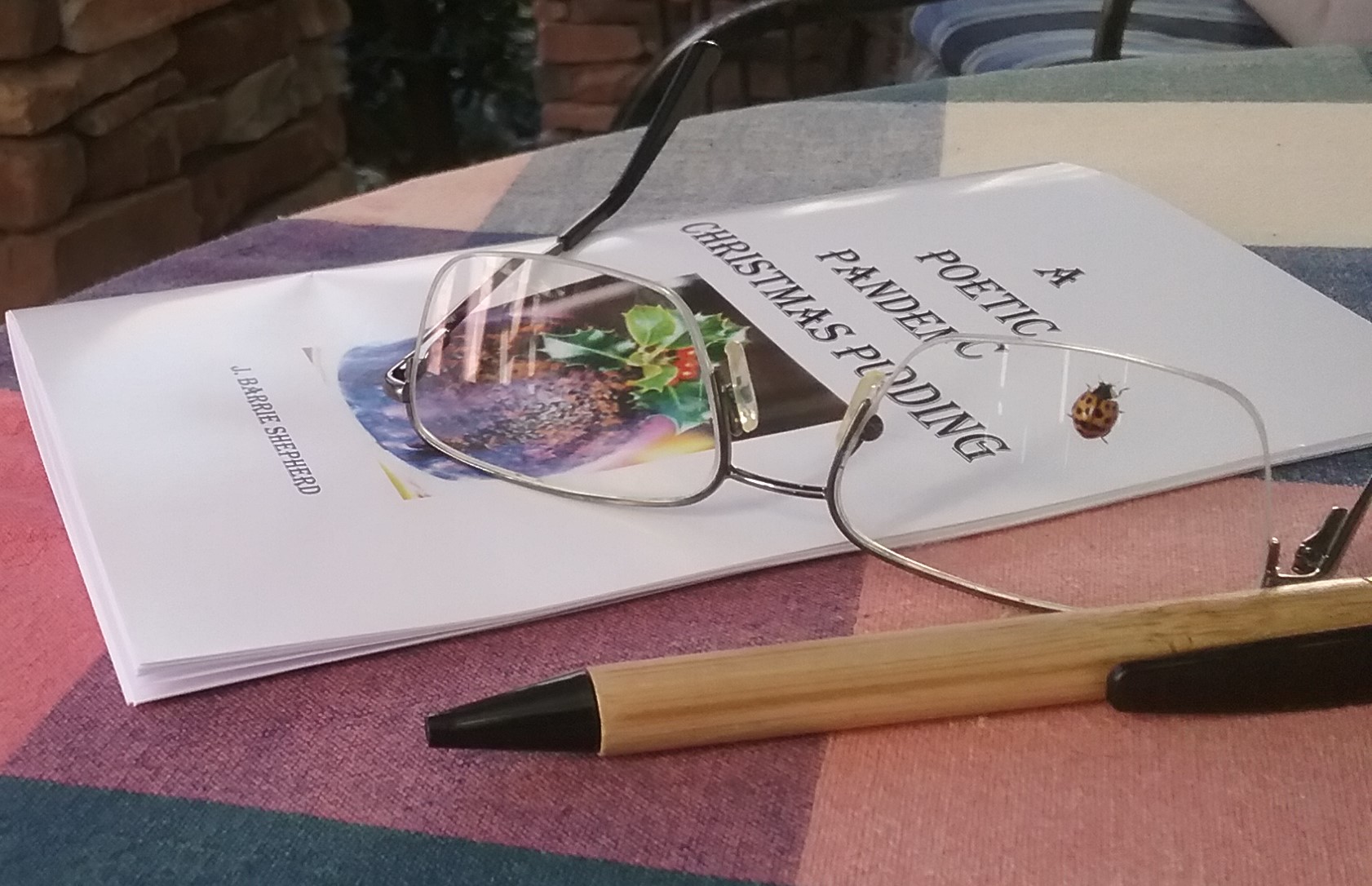
Ladybug season again at our place. 
This one crawled along the book, the pen and then my glasses.

Spiritual gurus admonish us to “go toward the light,” and especially in this winter season of a pandemic, that seems preferable to wallowing in darkness. But a line in a poem entitled “Lux et Veritas” in J. Barrie Shepherd’s latest chapbook, A Poetic Pandemic Christmas Pudding, reminds me of the vitality of darkness.

Contrasting our light displays during this season with the humble lighting of Jesus’ stable cave that allowed “the clear radiance that streamed above, around, beyond that battered-blessed manger,” poet and pastor Shepherd recalls introducing his first granddaughter to “the black-velvet-spread celestial of The Milky Way” “one sparkling island night in Maine”:

Her sheer astonishment made clear that we must

claim our darkness too, if we would glimpse

the glory of the elemental light.

Sunday over Zoom, Ormewood Church had a glimpse of the glory that may come when we “claim our darkness too.” Preaching on Mary’s Magnificat, Rev. Jenelle Holmes shared a recent dark moment in her life and offered her own “Magnificat,” and she has graciously allowed me to share it with you: 

My soul deepens and broadens the Lord’s presence and my spirit rejoices with God who saves me each and every day. God has looked with eyes of mercy on me, when some in the world have looked on me with disdain. God has seen the ways I am held back by others and has handed me support. People call me blessed because God has walked with me on hard roads of rejection, depression and anxiety and anger, and God has carried me through. God’s name is holy and God is a holy space for me. When I could have turned around and cursed God, I took God’s presence seriously and God has honored that with a strong arm of confidence and love.  

Those who wish me harm through rejection or fear or ignorance, God has dealt with in the privacy of their hearts. Those who have sought to harm me by using their voices of privilege, even in the church and in my family, God has shouted over them that I am loved and that I am who I was created to be.  

And as I look to my neighbors who are without homes, I have seen God’s people provide shelter. As I look to my neighbors who have lost their jobs, I have seen God’s people write checks. As I look to my neighbors who are lonely and isolated, I have seen God’s presence ignite ideas and rhythms of faith. As I look to my neighbors who have experienced one setback after another, I have seen God provide one day after another.  

And the rich, the powerful, the ignorant: God will show them the emptiness of their greed. They will be hungry for the good work of God.  

And as I think of how God helped ancient Israel escape Pharaoh, how God has helped the barren experience new life and the dead come back to life, and the marginalized be handed a voice, I remember God’s mercy forever, in every generation, even my own, even in 2020. My soul magnifies the Lord and my spirit rejoices with God who saves me each and every day.                                                                                    –Rev. Jenelle Holmes

Having lived in a metaphoric dark closet during my childhood and youth as a gay kid, I knew where the light was—it was outside my protective, defensive, even necessary shell. The glory of God and my own glory lay beyond my captive, seductive defenses and others’ captive, destructive offenses. Remember Jung’s suggestion that religion is a kind of defense against God? My closet—my and others’ rigid conceptions of God—kept me from God’s glory. 

My most recent “aha” about who God is, is that God is the glory at the climax of the prayer Jesus taught us: “For thine is the kingdom and the power and the glory.” That glory is unknowable but visible in the infinite wonders of the universe, in myriad forms of life, and in human compassion and imagination. This is the prophet Isaiah’s “light that shines in darkness.” It is the “shekinah” of Yahweh’s divine presence. It is the glory that brightened Moses’ face and lifted Mary’s soul, as well as our own souls through Immanuel, God-with-us.

I pray this glory for you as you approach this Christmas: 

God bless you and keep you;

God make God’s face to shine upon you,

and be gracious to you;

God lift up God’s countenance upon you,

            and give you peace.  Numbers 6:24-26

Then we may attend to this summons in another of Barrie’s poems, “The Coming of the Light”: “Look deep into this gentle fire, and then go forth to bear it, far and tender, to wherever infants, cold and frightened, tremble in the dark with no bright star, no kings to greet.”


For your own copy of poet and pastor J. Barrie Shepherd’s holiday chapbook: A Poetic Pandemic Christmas Pudding, please send a check to J. Barrie Shepherd at 15 Piper Road – K325, Scarborough ME 04074. Copies will be signed and can be inscribed by request. Or order though his email: barrieshep@aol.com. $10 per copy plus $2 postage. Proceeds go to food pantries in his area of Maine.

Donations to Progressive Christian Reflections may be given safely by clicking here and scrolling down to the donate link below its description. Thank you!

Contemporary Magnificat © 2020 by Rev. Jenelle Holmes, used by permission. 

Copyright © 2020 by Chris R. Glaser. Permission granted for non-profit use with attribution of author and blogsite. Other rights reserved.  


Wednesday, November 18, 2020

Thanksgivings


As we huddle in our homes, alone or with immediate family and/or pets, fearful of the usual gatherings that Thanksgiving, Christmas, and New Year’s bring because of the coronavirus, it may be more of a challenge to feel gratitude this year.

Whenever I feel cause to complain, as happened in the calamity described in last week’s post, I immediately think of all those people who have far more to complain about throughout the world. It makes me feel that I have no right even to mention my “suffering,” as if I am whining like a child in a grocery store denied a treat.

The spiritual writer Henri Nouwen declared that we should not compare sufferings, saying, “Your suffering is your own.” I am not so sure, but in the moment of loss and deprivation and pain, the focus is on your suffering or my suffering or the suffering we witness daily in the news. Our individual experience of suffering opens us to understanding the suffering of others.

Many of us believe that to be a spiritual person is to practice compassion, literally “suffering with” one another. It is a practice, not always a feeling, though the practice may lead to feelings as well as actions to assuage the suffering.

Jesus was the first spiritual founder to teach me this. But it’s also true of the Talmud and the Buddha and the Quran and the Vedas, to mention a few spiritual paths that sensitively deal with suffering.

Our sufferings could be, as I’ve written in other contexts, our “wounds with a view,” our opportunities to be thankful for the people and things, events and opportunities we are missing for now as well as our window onto others’ suffering.

Some of us are missing people who will never return, but we can yet be grateful that they have touched our lives, our bodies, our dreams, our hopes. I am the sum of all who have touched me, and I celebrate them whenever I think of them with love and joy and gratitude and whenever I touch others with love and joy and gratitude.

Despite our loss of five wondrous trees at the end of October, two from our neighbors’ yards and three from our own, the month began rather well observing Wade’s and my birthdays, our anniversary, and the anniversary of my lifelong-sought-for ordination. Our pastor Jenelle and her husband Chris (also a pastor) secretly hung the banner above on our front porch as a surprise from our Ormewood Church friends. (Their daughter tried to help, but she kept giggling, I am told.)

Our friends and neighbors Sonja and Jody and Cathie and CJ gathered with us for a socially-distanced outdoor dinner celebration under colorful parasols in Sonja and Jody’s yard. People driving by thought it was a fabulously festive new restaurant opening. (See photo below.) They also rescued us and Wade’s chili when we lost power on Halloween.

We received cards and calls and messages from family and friends. For all our “cloistered” experience, we never felt absolutely alone. And in a day and age of cellphones and flatscreens and tablets and laptops, we had Zoom church and conversations and plenty of programs to watch. Think of historic pandemics with none of these outlets (or maybe I should call them “inlets”)!

I had my blog to write and readers to correspond with while Wade worked online from home. I also led an online retreat on Henri Nouwen for Columbia Seminary’s Spirituality Program, synchronistically based on his book Reaching Out.

And God was always to be found as I daily prayed for humanity’s deliverance from this virus as well as for the election of compassionate leaders.

My hope is that we all make the most of our Thanksgivings!

That's Wade to the right.

Donations to Progressive Christian Reflections may be given safely by clicking here and scrolling down to the donate link below its description. Thank you!

Copyright © 2020 by Chris R. Glaser. Permission granted for non-profit use with attribution of author and blogsite. Other rights reserved.  


Wednesday, September 16, 2020

Henri Joins the Circus


Henri catching the wing of a windmill.

To give us a break in the midst of our pandemic and political drama, as well as for my friends and family coping with fire and smoke on the West Coast of the U.S., I offer this to bring a smile to your face.

Attending an international Nouwen conference in Toronto in the summer of 2016, I was reminded of the research Henri Nouwen did for a book he never wrote about the Flying Rodleighs, trapeze artists in a German circus. He wanted it to say something about the spiritual life in more universal (rather than religious) language. So I wrote and posted this children’s story on August 10, 2016. I had fun drawing Henri on a windmill!  It alludes to his early book Clowning in Rome and his later fascination with the trapeze.

Once upon a time there was a wide-eyed boy named Henri. He lived in Holland during a great war. His hands were large, his ears were large, he was clumsy and awkward, and he felt like a clown.

And so he went to clown seminary. He devoted himself to learning all the gestures a clown must use, flapping his oversize hands like birds, extending them at arms’ length in welcome, clapping them rapidly together as if offering multiple expressions of gratitude for everything and everyone he encountered.

He stuck his neck out, squinted his eyes as if to see better, turned a big ear to hear clearly, bowed grandly but deferentially, and stood on tippy-toes to accentuate his already great height when making a point. And he had a huge, goofy grin that revealed his absolute delight at encountering you.

Henri found a costume that accentuated his vocation, and learned how to apply garish makeup that sometimes covered his true feelings.

So Henri joined the circus, following the poet e.e. cummings’ famous advice: “damn everything but the circus.” He travelled hither and yon, over hill and over dale, as the circus wagons kept rolling along.

He stumbled and fumbled and tumbled and somersaulted his way into people’s hearts. “He is just like us,” they said, sometimes smiling in recognition, sometimes deeply moved as his familiar foibles and limitations tugged at their heart strings. His disabilities mirrored our disabilities.

But Henri had a secret wish: to fly through the air with the greatest of ease. Sometimes his height allowed him to catch an arm of a windmill, common in Holland’s countryside, and the uplift took his breath away. He could see great distances and imagine himself flung to the heavens before crashing to earth in a pile of hay, cushioning his fall.

And then Henri met Rodney, a trapeze artist. Rodney was strong and graceful, beautiful and amazing. He was everything Henri wished to be, and  HE COULD FLY! Boy, could he fly, doing doubles and triples midair without a care in the world.

“How do you do that?” Henri asked Rodney, appreciatively. “Being absolutely present in the moment,” Rodney explained. “I let go of everything that can hold me down: my cares, my doubts, my fears, even yesterday’s mistakes. And I trust. I trust the Catcher, and I trust the net. Gravity is not my enemy; it is the friend that brings me home. I can go up toward the skies knowing I will come home. I surrender to the moment and soar, knowing gravity will keep me down to earth.”

Then Rodney added, “It’s the same thing you do when you stumble and fumble and tumble and somersault into people’s hearts—except you do it grounded. Your gravity is compassion. Your home is the heart.”

Henri was stunned. He had never thought of his work in this way. Rodney’s words lifted him up, and Henri felt like this man on the flying trapeze.


My book about Henri:

Donations to Progressive Christian Reflections may be given safely by clicking here and scrolling down to the donate link below its description. Thank you!

Copyright © 2016 by Chris R. Glaser. Permission granted for non-profit use with attribution of author and blogsite. Other rights reserved.

Wednesday, August 26, 2020

House Arrest


On my office file cabinet I have a magnet that scolds, “You’ve been bad. Go to your office!”

Of course this echoes what some of us heard as children, “You’ve been bad. Go to your room!” The isolation, the confinement, and the implied restrictions served as punishment to dissuade us from bad behavior. In more recent times it was called a “time out.”

In the olden days, when I was growing up, it meant no television, no telephone, no play, and for some, no dinner—this in the days when there was only one TV and one phone in the house, and no devices on which to play games or watch something in your room. Do we mistake our present isolation as a kind of punishment?

This is how those most privileged among us might experience the “stay-at-home” confinement of our worldwide pandemic. A slight inconvenience, but a nagging reminder of the dangers of our footloose-and-fancy-free days when we could do just about anything we wanted.

It reminds me of when I was once shushed by a favored aunt as a little boy. Me, trying to be the best-little-boy-in-the-world, an offender?! How could this be?

Now, don’t get me wrong. As an introvert, I appreciate time alone or time with a few. As a spiritual person, I know I am not alone, but surrounded by a great cloud of witnesses before God. As a reader, I enjoy hearing from all kinds of people. As a writer, I am gratified to have people read my stuff. Even this post I feared would sound like whining!

But I’m writing this because I know I am not the only one who feels discombobulated by the necessity of social distancing, limited physical contact, and fearful interactions. When I go to buy our groceries, I feel as if I’m on a risky venture. When I don my mask and sometimes gloves, I feel like I’m getting ready for a walk in space.  

I couldn’t bring myself to watch the prison drama series, Orange Is the New Black, because I find the idea of imprisonment depressing. The earlier prison drama series, Oz, also didn’t appeal to me, despite its erotic male content.

Long ago I had a dream in which I found myself in prison, cut off from all those people I cared about and cared about me. I thought, well, with so much time on my hands, I could get a lot of reading done! But, in the dream, I was too depressed to pick up a book.

Maybe all this reminds me of my years in the closet as a gay youth. Maybe it’s reminiscent of the limitations of an early adolescent political conservatism that was transformed by education and compassion and maturity. Undoubtedly it smacks of the confining Christian fundamentalism that held me down and held me back from truly enjoying the world and even enjoying myself until I was in college.

The apostle Paul had his own fundamentalism to overcome, one that prompted his initial persecution of liberalizing Christians. And he purportedly produced one of his finest epistles while under house arrest in Rome: Ephesians. Concerned with the partisanship within the early church, he eloquently argued that now, in following Jesus, Christians were one, overcoming any “dividing wall of hostility.” 

I pray those who believe in a fair and just representative democracy may share such a vision of unity in our present state of house arrest.


Related posts:

I will be leading a virtual, at-home retreat open to the public for Columbia Seminary’s Spiritual Formation Program with Zoom sessions September 17-19, 2020 entitled 
You are invited! The site’s dates include “reading weeks” beginning August 31st in which you are invited to comment on the texts for the retreat and a final day “Sabbath” for rest and reflection on September 20th.

Donations to this blog ministry may be given safely by clicking here and scrolling down to the donate link below its description or by mailing to MCC, P.O. Box 50488, Sarasota FL 34232 USA, designating “Progressive Christian Reflections” in the memo area of your check or money order. Thank you!

Copyright © 2020 by Chris R. Glaser. Permission granted for non-profit use with attribution of author and blogsite. Other rights reserved.

Wednesday, August 19, 2020

I Can't Say It Better


My title is a confession that there are times when scripture needs direct absorption without the filter or interpretation of a writer or speaker or “official” biblical scholar, let alone a blogger like me. I don’t think readers of this blog will believe I’m shirking my duties if I share directly with you a psalm that has grabbed my attention and contemplation this week as I, like you, cope with the challenges of a pandemic and a charged political atmosphere.

Those who know me directly or through my work will not need me to point out how and to whom I believe the following verses may apply. You know my mind and my heart and my passion and compassion well enough without need of explicit comparisons to current events and public figures. And both those who don’t know me and those who do have their own counsel at hand to find the following verses comforting and encouraging and applicable to our current situation.

Carl Jung’s synchronicity or the Holy Spirit or both would have it that when I turned to my NRSV last week for solace, I found stuck in its pages a slip from a notepad from St. Jude Children’s Research Hospital whose very name welcomes the blessings of both faith and science. Saint Jude is the patron saint of hopeless causes and is often depicted with a flame around his head, reflecting his presence at Pentecost to receive the Holy Spirit.

As I write this, I glance at Ganesha sitting on the bookshelf beside my desk. Ganesha is the Hindu god of arts and sciences and fresh beginnings, one who removes obstacles (one of the reasons I keep it close to my computer!) and so strikes me as a complement to Saint Jude’s desire to help the hopeless.  

On the side of the slip of paper that bears the logo and name of St. Jude Hospital, I long ago wrote down the lectionary readings for a particular Sunday, but on the back I wrote Psalm 37:1-11, 39-40. So last week I turned to Psalm 37 and ruminated on it during my morning prayers on the days since. I encourage you to read the entire psalm, but here are some of its verses with few and minor inclusive language changes. If the title “Lord” troubles you, feel free to substitute another metaphor, such as “Holy One.”

Do not fret because of the wicked;
  do not be envious of wrongdoers,
for they will soon fade like the grass,
  and wither like the green herb.

Trust in the Lord, and do good;
  so you will live in the land, and enjoy security.
Take delight in the Lord,
  and you will be given the desires of your hearts.

Commit your way to the Lord;
  trust in God, and God will act.
Yahweh will make your vindication shine like the light,
  and the justice of your cause like the noonday.

Be still before the Lord, and wait patiently for God;
   do not fret over those who prosper in their way,
   over those who carry out evil devices.

Refrain from anger, and forsake wrath.
  Do not fret—it leads only to evil.
For the wicked shall be cut off,
  but those who wait for the Lord shall inherit the land.

The wicked plot against the righteous,
  and gnash their teeth at them;
but the Lord laughs at the wicked,
  knowing that their day is coming.

The wicked draw the sword and bend their bows
  to bring down the poor and needy,
  to kill those who walk uprightly;
their sword shall enter their own heart,
  and their bows shall be broken.

Better is a little that the righteous person has
  than the abundance of many wicked.
The wicked borrow, and do not pay back,
  but the righteous are generous and keep giving.

Though we stumble, we shall not fall headlong,
  for the Lord holds us by the hand.
For the Lord loves justice
  and will not forsake God’s faithful ones.

The salvation of the righteous is from the Lord,
  who is their refuge in time of trouble.


I will be leading a virtual, at-home retreat open to the public for Columbia Seminary’s Spiritual Formation Program September 17-19, 2020 entitled An Open Receptive Place: Henri Nouwen’s Spirituality. You are invited!

Donations to this blog ministry may be given securely by clicking here and scrolling down to the donate link below its description or by mailing to MCC, P.O. Box 50488, Sarasota FL 34232 USA, designating “Progressive Christian Reflections” in the memo area of your check or money order. Thank you!

Copyright © 2020 by Chris R. Glaser. Permission granted for non-profit use with attribution of author and blogsite. Other rights reserved. Scripture copyright © 2010 by Oxford University Press, Inc.

Wednesday, August 5, 2020

Wonder


Yesterday’s New York Times editorial about human endeavors reminded me of my post of July 12, 2017 about “Wonder.” As I work this week preparing a schedule for a virtual spiritual formation at-home retreat I thought it would give me a respite timewise and offer you a respite from our challenging political and pandemical times. Enjoy!

Others have come to the same conclusion, but in the sixty-six years that I have been given, I believe the essential ingredient of a spiritual life is wonder.

It can be found and expressed in many ways: worship, contemplation, compassion, activism, lovemaking, the beloved community, science, art, nature, and the recognition of the commonwealth of God, to name a few.

But the farther away any of these get from wonder, they can become tablets of stone, stumbling blocks, millstones round our necks, a dutiful obligation rather than a pleasurable joy.

As I write this, Luna, our neighbor’s cat, is chasing something in our back yard. I have spent happy moments watching Luna from my home office windows as she approaches our yard with wonder, leaping up the tall, central Bradford pear tree, slinking beneath our hedge of privet shrubs, luxuriating in rubbing her back on our weedy grass.

From our front porch, I’ve enjoyed watching her go on morning walks with her family (yes, really!): a dog named Lexi, children with a literary and a biblical name, Darcy and Micah, their father Chris, a New Testament professor at Mercer University, and mother Jenelle, who is the organizing pastor of the newly-forming Ormewood Church.

Luna runs ahead and lingers behind, depending on what catches her attention in the moment. She exemplifies wonder. And I realize that we human beings know only a little more than she does about the nature of things.

The morning I write this, I greeted them again from our front porch during my prayers, after reading a couple of psalms and Matthew 18, which includes Jesus’ counsel to enter the kingdom as a child, remove their stumbling blocks, find the lost sheep, confront wrongdoing in yourself and in the community, and finally, forgive from the heart, even as we have been forgiven.

In silence I contemplated the very tall and old leafy trees before me, the tiny bird chirping on the railing, the runner going by, the found stones that line our gardens, only a little distracted by the passing cars, some of which take the stop sign at the intersection as a mere “suggestion.”

The week I write this, I awoke each morning to NPR reporting on various catastrophes, a high rise fire, several bombings and mass shootings, the investigation of the administration.

Despite all that, I found myself marveling (yes, I realize how antiquated the gerund) that all I saw before me, including me, has evolved.  What impetus organizes seemingly inert matter into living things, thinking beings, and seems to call for beauty and compassion and wonder?

A couple of days ago, I read how the liver regenerates itself daily as it carries out so many mysteries that ancients thought it was the seat of the soul.  And not long ago I read how disparate parts of the brain organize the various signals from our eyes into what we “see.”

No wonder the psalmist sang this morning, “The earth is full of the steadfast love of the Lord. By the word of the Lord the heavens were made, and all their host by the breath of God’s mouth” (33:5b-6).

“Breathe on me, breath of God,” sings the old hymn.  What a sensual yet spiritual request!

“The glory of God is the human being fully alive.”  This popular quote from Irenaeus of Lyons hangs in our hallway, written by the hand of the calligrapher who once graced Mt. Calvary Retreat House in the hills above Santa Barbara before its destruction in the 2008 Montecito fire.

From dust to dust, ashes to ashes, our brief flicker in between is a cause for wonder.


For several photos of Luna, see the original post.

To support this blog ministry: 
Be sure to scroll down to the donate link below its description.

Or mail to MCC, P.O. Box 50488, Sarasota FL 34232 USA, designating “Progressive Christian Reflections” in the memo area of your check or money order. Thank you!

Copyright © 2017 by Chris R. Glaser. Permission granted for non-profit use with attribution of author and blogsite. Other rights reserved. 

Wednesday, January 22, 2020

Spiritual Stretching

Our neighbor, Luna, stretching against the edge of our driveway.

Put your hands over your head and stretch. Take a deep breath.

Doesn’t that feel good?

And don’t you vicariously feel good when you see your dog or cat or another person stretch and perhaps yawn?

Many years ago I learned that, to prevent my back from seizing up on me, I needed to do a simple stretching exercise before getting out of bed in the morning.  I also do a coordination exercise a holistic chiropractor once taught me that’s supposed to help me think more clearly. And then I’m ready to, as the camp song goes, “Rise and shine and give God my glory…”

A few summers ago, Wade and I attended a yoga class that was all about stretching and breathing, led by our friend and neighbor José Blanco. It was surprising how challenging and tiring stretching and breathing can be, as well as how wonderful it can feel. Yoga, of course, is a spiritual discipline developed in Hinduism to focus body, mind, and spirit.

A lot of Christians don’t like to stretch. Orthodox literally means “straight thinking,” and many Christians like to keep to the straight and narrow, within the confines of what they consider proper belief and behavior.

Progressive Christians like to stretch our minds. That means we can stay in our heads way too much. That’s preferable to not going there at all. As they say, many people are lost in thought because it’s such unfamiliar territory.

Thankfully, stretching our mind may stretch our hearts as well, especially if we can catch our breaths.

Stretching is an antidote to confinement, an answer to tension, a solution for paralysis that is not permanent. It helps tissue lubricants flow, as well as the life-giving, oxygenating, vitality-inducing blood that we need to be nurtured and grow. 

Our spirits and our spirituality need stretching too.

Jesus did not teach yoga positions, but he was still a kind of yoga instructor, because he taught spiritual stretching. His spirituality stretched the religion of those around him to move out of ossification—which means to be make rigid, callous, or unprogressive—to move beyond laws written in stone and temples made of stone.

Anyone who has endured an obnoxious neighbor will know that “loving your neighbor” is a stretch. Anyone who has struggled with an image of an angry or distant God knows that “loving God with all your heart, soul, and mind” is a stretch. Those raised on negative self-images know that “loving your self” is a stretch. Those taught to fear or hate a stranger realize that Jesus’ urging to greet even those we don’t know is a stretch.  And “loving your enemies” is obviously a stretch!

By stretching, a spiritual community becomes expansive and inclusive and nimble. A breath is a stretch, and Jesus was said to have breathed on his disciples his Spirit. That Spirit stretched their ability to share his story in the languages of strangers. That same Spirit has, throughout history, stretched at least parts of the church to welcome those it formerly resisted, excluded, marginalized, or persecuted.

And God’s mystery stretches our spiritual imaginations. In the apostle Paul’s words to the Athenians, God “does not live in shrines made by human hands” but causes us “to search for God and perhaps grope for God.”

Breathe. Stretch.

Doesn’t that feel good?


This was my post on March 12, 2014, and I thought current blog readers might like to read it.

Progressive Christian Reflections is an authorized Emerging Ministry of MCC supported solely by readers. Please click here for more information or to make a tax-deductible donation. Thank you!

Consider using a post or quotes in personal reflection, worship, newsletters, and classes, referencing the blog address when possible: http://chrisglaser.blogspot.com.
Check out past posts in the right rail on the blogsite.

Copyright © 2014 by Chris R. Glaser. Permission granted for non-profit use with attribution of author and blogsite. Other rights reserved.