Showing posts with label baby Jesus. Show all posts

Wednesday, December 16, 2020

Go Toward the Dark

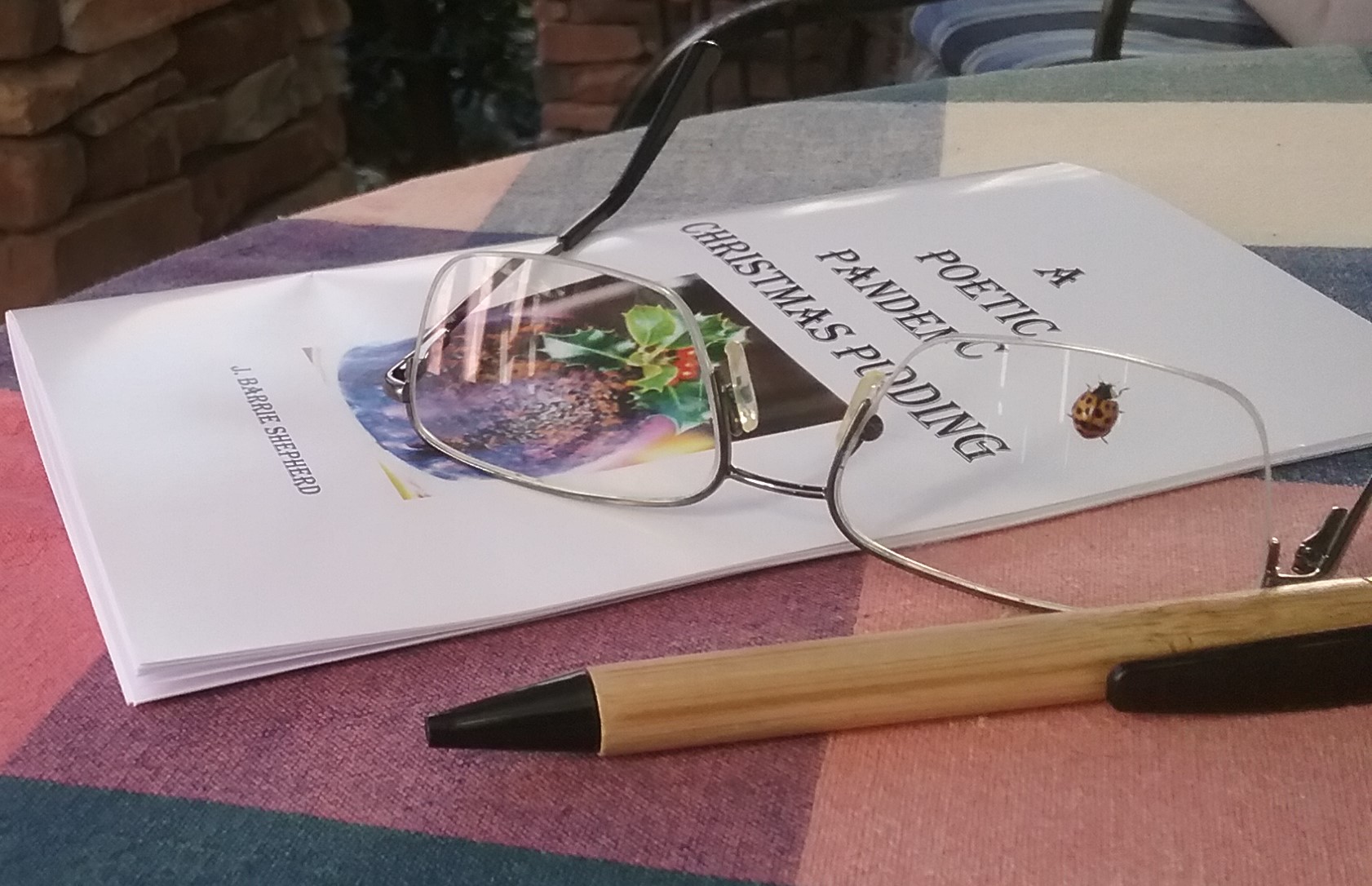
Ladybug season again at our place. 
This one crawled along the book, the pen and then my glasses.

Spiritual gurus admonish us to “go toward the light,” and especially in this winter season of a pandemic, that seems preferable to wallowing in darkness. But a line in a poem entitled “Lux et Veritas” in J. Barrie Shepherd’s latest chapbook, A Poetic Pandemic Christmas Pudding, reminds me of the vitality of darkness.

Contrasting our light displays during this season with the humble lighting of Jesus’ stable cave that allowed “the clear radiance that streamed above, around, beyond that battered-blessed manger,” poet and pastor Shepherd recalls introducing his first granddaughter to “the black-velvet-spread celestial of The Milky Way” “one sparkling island night in Maine”:

Her sheer astonishment made clear that we must

claim our darkness too, if we would glimpse

the glory of the elemental light.

Sunday over Zoom, Ormewood Church had a glimpse of the glory that may come when we “claim our darkness too.” Preaching on Mary’s Magnificat, Rev. Jenelle Holmes shared a recent dark moment in her life and offered her own “Magnificat,” and she has graciously allowed me to share it with you: 

My soul deepens and broadens the Lord’s presence and my spirit rejoices with God who saves me each and every day. God has looked with eyes of mercy on me, when some in the world have looked on me with disdain. God has seen the ways I am held back by others and has handed me support. People call me blessed because God has walked with me on hard roads of rejection, depression and anxiety and anger, and God has carried me through. God’s name is holy and God is a holy space for me. When I could have turned around and cursed God, I took God’s presence seriously and God has honored that with a strong arm of confidence and love.  

Those who wish me harm through rejection or fear or ignorance, God has dealt with in the privacy of their hearts. Those who have sought to harm me by using their voices of privilege, even in the church and in my family, God has shouted over them that I am loved and that I am who I was created to be.  

And as I look to my neighbors who are without homes, I have seen God’s people provide shelter. As I look to my neighbors who have lost their jobs, I have seen God’s people write checks. As I look to my neighbors who are lonely and isolated, I have seen God’s presence ignite ideas and rhythms of faith. As I look to my neighbors who have experienced one setback after another, I have seen God provide one day after another.  

And the rich, the powerful, the ignorant: God will show them the emptiness of their greed. They will be hungry for the good work of God.  

And as I think of how God helped ancient Israel escape Pharaoh, how God has helped the barren experience new life and the dead come back to life, and the marginalized be handed a voice, I remember God’s mercy forever, in every generation, even my own, even in 2020. My soul magnifies the Lord and my spirit rejoices with God who saves me each and every day.                                                                                    –Rev. Jenelle Holmes

Having lived in a metaphoric dark closet during my childhood and youth as a gay kid, I knew where the light was—it was outside my protective, defensive, even necessary shell. The glory of God and my own glory lay beyond my captive, seductive defenses and others’ captive, destructive offenses. Remember Jung’s suggestion that religion is a kind of defense against God? My closet—my and others’ rigid conceptions of God—kept me from God’s glory. 

My most recent “aha” about who God is, is that God is the glory at the climax of the prayer Jesus taught us: “For thine is the kingdom and the power and the glory.” That glory is unknowable but visible in the infinite wonders of the universe, in myriad forms of life, and in human compassion and imagination. This is the prophet Isaiah’s “light that shines in darkness.” It is the “shekinah” of Yahweh’s divine presence. It is the glory that brightened Moses’ face and lifted Mary’s soul, as well as our own souls through Immanuel, God-with-us.

I pray this glory for you as you approach this Christmas: 

God bless you and keep you;

God make God’s face to shine upon you,

and be gracious to you;

God lift up God’s countenance upon you,

            and give you peace.  Numbers 6:24-26

Then we may attend to this summons in another of Barrie’s poems, “The Coming of the Light”: “Look deep into this gentle fire, and then go forth to bear it, far and tender, to wherever infants, cold and frightened, tremble in the dark with no bright star, no kings to greet.”


For your own copy of poet and pastor J. Barrie Shepherd’s holiday chapbook: A Poetic Pandemic Christmas Pudding, please send a check to J. Barrie Shepherd at 15 Piper Road – K325, Scarborough ME 04074. Copies will be signed and can be inscribed by request. Or order though his email: barrieshep@aol.com. $10 per copy plus $2 postage. Proceeds go to food pantries in his area of Maine.

Donations to Progressive Christian Reflections may be given safely by clicking here and scrolling down to the donate link below its description. Thank you!

Contemporary Magnificat © 2020 by Rev. Jenelle Holmes, used by permission. 

Copyright © 2020 by Chris R. Glaser. Permission granted for non-profit use with attribution of author and blogsite. Other rights reserved.  


Wednesday, January 1, 2020

Why Must Politics Intrude on Our Faith?

Photo by Bassam Khabieh for Reuters and The New York Times.

A few days after Christmas [2014] I picked up our morning paper and, before I put on my reading glasses, I saw on the front page a child on a sled in the snow, confirmed by the caption that began, “Heavy sledding…” I wondered where in the world the photograph was taken.

As I drew the paper closer and put on my reading glasses I was stunned by my mistake. This was no child laughing as he rode a sled through snow—no, this was a child crying out in pain, being carried on a stretcher over a caption that read not “heavy sledding” but “Heavy Shelling…” as in “Heavy Shelling Reported Near Damascus.” What I imagined was snow on the boy’s clothing must have been debris from the blast.

I felt much the same way when I read the Gospel lesson for the Sunday following Christmas. After spending Christmas Eve hearing and singing about the holy infant Jesus, so tender and mild, enjoying a silent and holy night in which all is calm, all is bright, I found Matthew’s text about the slaughter of the innocents disturbing and violent (2:13-23).

Here Jesus had just been born to Mary and Joseph, and was lying in a manger, sleeping in heavenly peace, visited in Matthew by three spiritual sages from another country who brought gold and frankincense and myrrh and, in the Christmas carol, Silent Night, visited by shepherds enjoying the “radiant beams from his holy face” that meant “the dawn of redeeming grace.” The only thing that had disturbed their silent night earlier had been angels in the heavens singing “alleluia to our King; Christ the Savior is born.”

Why, oh why, must this beatific image be shattered by political realities? Escaping from King Herod, who, if he can’t find this baby that threatens his political power, chooses to slaughter all the innocents—infants the age of Jesus, causing wailing and lamenting in his birthplace of Bethlehem. And why, upon their return from Egypt, must Mary, Joseph, and Jesus go into hiding once more, this time in Galilee, to escape the even more heinous son of Herod, Archelaus, who had ascended the throne upon his father’s death?

Why can’t we just have a nice little Christmas? Why can’t we all just get along? And why must politics intrude on our faith, disturb our praise and worship, interrupt our contemplative mantra of “peace on earth, goodwill to all”? Why must we read of slaughtered innocents and wailing mothers? Why must I pick up a newspaper and see such a disturbing scene as a terrified child in pain after the president of Syria has bombed his hometown?

If we learn nothing else from the subsequent life of Jesus, it is that spirituality is never an escape—it is always an engagement with reality. Jesus’ prayer “forgive us our debts” meant a lot to his poor, impoverished fellow Israelites. “Thy kingdom come” meant the end of the Roman Empire. If a Roman soldier compels you to carry his gear one mile, carry it two miles, because “Loving your enemies” is a revolutionary act.

“Give unto Caesar that which is Caesar’s, but give to God that which is God’s.” “Don’t be like these Pharisees…,” rather, “consider the lilies of the field.” Whether waiting for the bridegroom or your master or the owner of the vineyard, be strategic in your preparations. “Be wise as serpents and gentle as doves.” “If a town (or church) does not welcome you, shake its dust from your feet.” “Sell your possessions and give to the poor, and come follow me.”

“Go and learn what this means: I desire mercy and not sacrifice.” “Let the one without sin cast the first stone.” God’s “house shall be called a house of prayer for all peoples, but you have made it a market place!” All of these quotes bring to mind real world applications of Jesus’ gospel.

And then there’s the cross: a political execution awaiting our “holy infant, so tender and mild.”

So I wrote this prayer for the children of the world:

In the name of Jesus who lifted children to his lap
and said “of such is the kingdom of heaven,”
we pray for the children of the world:

We pray for those who live in poverty,
            from our own neighborhood to those in hidden corners of the world.
We pray for those who live in danger
            of abuse, exploitation, violence, war, and disaster.
We pray for those who live in hunger and thirst,
            those who starve and those who are malnourished,
those enduring droughts and those whose water is polluted.
We pray for those who suffer illiteracy or disease, those who are refugees,
those who are illegal immigrants, those with disabilities,
those who are oppressed, those whose religion, culture, tribe, or nation distort their view of themselves and the world.

Your child, Jesus, suffered with all the children of the world
“because all are precious in his sight.”
In the name of Jesus who lifted children to his lap
and said “of such is the kingdom of heaven,”
we pray for the children of the world. Amen.


I posted this on January 15, 2014 and thought new blog followers might like to read it. Have a meaningful and hopeful new year!

Progressive Christian Reflections is entirely supported by reader donations. To support this blog: https://www.mccchurch.org/ministries/progressive-christian-reflections/
Scroll down to the donate link below its description. Thank you!

Consider using a post or quotes in personal reflection, worship, newsletters, and classes, referencing the blog address and author when possible: http://chrisglaser.blogspot.com.
Check out past posts in the right rail on the blogsite.

Copyright © 2014 by Chris R. Glaser. Permission granted for non-profit use with attribution of author and blogsite. Other rights reserved.

Wednesday, December 11, 2019

"Somebody's Gotta Be Mary!"

India, January 1983

Once upon a time, respectable members of a respectable church decided to perform a Christmas pageant, and congregants were vying for parts. The big competition was around the roles of the Magi, the Eastern religious scholars bearing gold and frankincense and myrrh. Many were taken with their absolutely fa-bu-lous costumes, reeking of wealth and privilege and prestige.

But there were also many who wanted to demonstrate their own humility by playing the poor shepherds watching their flocks by night, knowing that they’d get to see a sky full of angels singing of peace on earth, goodwill toward all, as well as visit the baby Jesus lying in a manger with a halo for a hanging playtoy.

Others wanted to be those high and mighty angels, who, in our contemporary, secular times seem to represent only themselves, cutely and cherubically and all-too-benignly making guest appearances on wrapping paper, greeting cards, and Christmas films, instead of being the fierce and frightful presence of God they are in the Bible—so terrible, they often had to say “fear not!”—awesomely calling individuals to radical action rather than offering sentimental appeasement.

For the manger scene itself, as you may have guessed, it was easy among the staid and high-end church members to cast the roles of the ox and of the ass and of the many docile sheep. Easy also to cast the unwelcoming innkeeper and King Herod frightened of losing power and the indifferent Caesar Augustus only interested in the bottom line, the church budget.

A few were at least willing to play one of the pageant’s two leading characters, Joseph, who at first wanted to put his pregnant betrothed away in a closet somewhere to avoid public disgrace. You will recall that Joseph had a change of heart after having his own vision of an angel, then choosing to serve as a kind of behind-the-scenes partner to the inevitably unfolding will of God, a ferocious will contrary to decency and order, a decency and order Joseph wanted to at least appear to uphold by his outward compliance.

But nobody wanted to play the role of Mary in the Christmas pageant. “Somebody’s gotta play Mary!” the stage manager Gabriel shouted out, sounding very much like the gravelly voice of Harvey Fierstein. “No Mary, no Jesus!” he cried bluntly.

You see, nobody respectable wanted to play Mary because of the shame of her unwed pregnancy. And absolutely no one wanted to go through the bloody and painful job of giving birth to a new thing.

Mary’s fidelity to God, her willingness to say, “Here I am the servant of the Lord; let it be with me according to your word”—all of this counted for naught in the eyes of these good people. The Holy Spirit was knitting together in her womb the new thing for which the prophets hoped, yet, like all nativities of the Spirit, “the powers that be” trembled, including these dignified religious types. Mary’s birthing this child would be an unsettling and unclean act, embarrassing rather than admirable.

“Mary is not a good role model for our children,” someone said.

Stage manager Gabriel again implored the crowd, “C’mon! As Mary, you get to magnify and rejoice in the Lord and be called blessed by generations to come, though admittedly not this generation. You get to serve as God’s instrument to scatter the proud in their presumptuous imaginations, lifting the downtrodden even as the powerful are taken off their high horse. Your mission is to fill the hungry with good things, and to remind the privileged of their own poverty. This is a good thing. Really.”

Visiting the church for the first time, a timid and small young girl came forward, a recent immigrant with olive skin and dark brown eyes and thick black hair, and simply said, “Here am I.” Gabriel, exasperated by everyone else’s resistance, asked, “So—ya wanna be Mary?” And because his language was new to her, she simply quoted Mary’s line, “Let it be with me according to your word.”

And so the respectable church filled with respectable members was able to put on its pageant, reliving the Christmas story, but they did not live happily ever after. For the nature of all nativities of the Spirit humbles those with privilege and uplifts the underprivileged, shaming the proud and bringing mercy and justice to the oppressed.

But that can’t happen unless someone is willing to be Mary.


I posted this on December 7, 2016 and thought new blog followers might like to read it. Have a meaningful Advent and Christmas!

Progressive Christian Reflections is entirely supported by reader donations. To support this blog: https://mccchurch.org/ministries/progressive-christian-reflections/
Scroll down to the donate link below its description. Thank you!

Copyright © 2016 by Chris R. Glaser. Permission granted for non-profit use with attribution of author and blogsite. Other rights reserved. 

Wednesday, December 4, 2019

Put Yourself in the Nativity Story

Hobbes, Calvin and Chris join the
Ormewood Park Presbyterian Church nativity scene, early 2000's.
Photo by Wade Jones.

In his autobiography, Confessions of a Parish Priest, novelist and sociologist Andrew Greeley writes that most Roman Catholics in the U.S. are not “propositional” Catholics who assent to a number of “propositions” or doctrines. For example, a majority of American Catholics do not agree with the Vatican’s teaching on sexual ethics, dismissing its teaching on contraception altogether and questioning its positions on other reproductive choices, premarital sex, and homosexuality.

Greeley concludes from his research that they are not drawn to their church by dogma, but by the story—the biblical narrative, particularly the narrative about Jesus. I think that’s true of Protestants as well. We wonder why many Christians only come to church around this time of Advent and Christmas, but I believe it’s because we love the story of the baby Jesus born to Mary and Joseph, cradled in a manger, endangered by Herod, visited by shepherds and kings.

In the words of Kathleen Norris, “Human beings, it seems to me, require myth as one of the basic necessities of life. Once we have our air and water and a bit of food, we turn to metaphor and myth-making.” To me, myth is not a story that is untrue, but a story that carries a deeper truth that draws us in. As a 5-year-old once said, a myth is a story that is true on the inside. (Gertrud Mueller Nelson tells this in Here All Dwell Free.) Within the words is a Word.

In Care of the Soul, Thomas Moore suggests that imagination is one of the most underutilized and undervalued spiritual gifts. So I invite you to put yourself in the story of Jesus’ nativity. Jesus is not simply born to Mary. He is born to us, if only we use our imagination!

Are you King Herod, fearful of losing power or privilege as God is doing a “new thing”? Or an Eastern sage enduring academic malaise, seeking a star of inspiration? A shepherd routinely going about your business when the skies seem to open up? A prophet crying in the wilderness?

Are you a religious leader holding on to tradition at all costs? An empire’s bureaucrat missing the unfolding human drama? Or one whose life is too full to welcome a homeless, unwed mother-to-be? Joseph, serving quietly on the periphery of sacred drama? Mary, with an unsought calling to do the dirty and painful and lonely work of birthing a new movement? Or a vulnerable child born into a vicious and violent world?

Truth is, over a lifetime, we may play all of these roles in this story. Good to remember, at this time of year, that we hinder or help, blink or behold this nativity of God’s Word to us.


I posted this on December 11, 2011, and thought new blog followers might like to read it. Have a meaningful Advent and Christmas!

Progressive Christian Reflections is entirely supported by reader donations. To support this blog: https://mccchurch.org/ministries/progressive-christian-reflections/
Scroll down to the donate link below its description. Thank you!

Copyright © 2011 by Chris R. Glaser. All rights reserved. Permission granted for non-profit use with attribution of author and blogsite.