Showing posts with label Lord's Prayer. Show all posts

Wednesday, April 28, 2021

A Pragmatic Guide to Prayer

I took this photo in India.

Prayer is unfamiliar territory to many people, even those reared in spiritual communities. Many fear they’re not up to the task, having heard eloquent prayers of others. Some progressive Christians doubt the effectiveness of prayer. So I thought I’d jot down some simple guidelines from my reading and experience to prompt but not limit readers’ personal practice and experience of prayer. Take these suggestions less as prescriptive than descriptive. And if any sound too preachy, just go on to the next! 

Prayer takes you to another place. There are many ways of saying this. Prayer may lift you up, take you deep within, broaden your horizon, make you feel close to God and all that is, or all of the above. The vital thing is that, in your spiritual imagination, your perspective changes, enlarging or focusing, withdrawing or connecting, detaching or more deeply involving. And it brings us into proximity with our better selves. 

Prayer consists of words, silences, and actions.  Most of us know about words and silences in prayer and meditation, but actions may prove a new understanding. I believe that Martha in the kitchen preparing a meal could be praying as much as Mary sitting at Jesus’ feet and pondering his words. And I don’t mean Martha is saying the rosary while cooking, but that cooking itself may be a form of prayer when conscious intention is there, as is true of acts of justice and compassion. To stretch our imagination further, I believe lovemaking may be a form of prayer. 

Prayer is presence, mindfulness, and listening. Prayer is a time to be attentive to surroundings, people, feelings, the day’s expectations, God’s hope for you—listening for God and your inner voice in all of them. Repetition of short scriptures (such as “God is love.”) or meditative chants may help one’s focus. 

Readings are helpful to praying regularly. What helped me keep to a regular prayer time was the use of reading material that made me want to sit down and set aside time for reflection—that’s why half of the dozen books I’ve written consist of daily meditations. Scriptures, books of prayers or reflections, spiritual or theological or biblical treatises, and even op-ed opinion pieces have proven aids to meditation and prayer. Others may find poetry, art, or music helpful. 

Saying the Lord’s Prayer is sufficient. The prayer that Jesus taught his disciples has every ingredient needed in prayer. Having said it daily for most of my adult life, I still wonder at how new meaning comes to familiar phrases, given where I am and what my experience is. I see it less as a prayer asking for things like bread and forgiveness than as a way of aligning myself with the inbreaking commonwealth of God, in particular being gracious as I have received grace. As Thomas Keating has recommended, if one can’t pray anything else, say the Lord’s Prayer. 

Less is more. Too many words, too many “issues,” too many confessions, too many requests make prayer burdensome and more of a duty than an experience of God’s grace and love. An abundance of thanksgivings can lighten the load, as long as they are not simply obligatory. 

Prayer transforms you, not God. The Desert Fathers and Mothers held this view; prayer is about our transformation, not God’s. When we pray for someone who is ill or in prison or mistreated, I do not believe God “fixes” these things, but that we become better caregivers, liberators, and advocates. 

Enjoy being God’s beloved child. Join Adam and Eve walking naked with God unashamedly in the Garden, Isaiah comforted and dandled on Mother God’s knees, and Jesus hearing “You are my beloved on whom my favor rests.” Prayer is the pleasure of basking in the glory of God’s unconditional love, remembering God’s best hopes for us and the world.


Copyright © 2012 by Chris R. Glaser. All rights reserved. Permission granted for non-profit use with attribution of author and blogsite.

FYI- This post appeared November 14, 2012. I considered retiring from my blog on its tenth anniversary in February but didn’t want to “abandon” readers during the pandemic! My brother suggested I run “the best of” posts, and I decided to run past posts that speak to our current experience. This will also give me the opportunity to write a new post occasionally. Thanks for your continued interest!  

Tax-deductible donations may be made safely to the “Chris Glaser Archive” through the Tribute Gift section of The Center for LGBTQ and Gender Studies in Religion.

Personal gifts may be made safely by clicking here.  Thank you!


Wednesday, February 10, 2021

Mindful of the Gaps


Enjoy this blog more by going to the link provided in the first paragraph!

National Public Radio featured a report about why certain popular pieces of music spontaneously set people to dancing.  The occasion was Pharrell Willliams’s “Happy” going viral on the internet as people around the world videotaped themselves dancing to the music, even at risk to themselves, such as in Iran, where six teens were arrested for posting their video.

The neuroscientists interviewed have theorized that it’s the gaps between sounds in certain pieces of music that invite us to move, providing the “space” and motivation for our bodies to respond.  I think something similar happens spiritually in the gaps reciting liturgies or the Lord’s Prayer.

The mantra of the London subway, “Mind the gap,” could become in sacred music and liturgies, “Be mindful of the gap,” the silences out of which spiritual movement comes: the pauses in liturgies and psalms and eloquent scriptures (such as 1 Corinthians 13 or 1 John 4) as well as the intervals between notes and beats and rhythms and vocals in everything from Gregorian chants to Gospel songs. 

In my book, Communion of Life, I named it “the thoughtful pause,” the quiet and the calm required to absorb what has gone before (say, in a poetic or musical phrase) and to respond, anticipating what may come next. I believe prayer, contemplation, retreats, and (I’d like to believe) this blog may serve as “thoughtful pauses” that compel us to dance spiritually.

The lead neuroscientist, Maria Witek of Aarhus University in Denmark, explained during the NPR story that “Gaps in the rhythmic structure, gaps in the sort of underlying beat of the music—that sort of provides us with an opportunity to physically inhabit those gaps and fill in those gaps with our own bodies.”

Surveys found that the most effective drum patterns in getting people off their feet, she says, were “not the ones that have very little complexity and not the ones that had very, very high complexity, but the patterns that had a sort of a balance between predictability and complexity.” That balance of predictability and complexity may be needed in our own liturgies, readings, sacred songs, and sermons.

The anonymous fourteenth century author of the spiritual classic The Cloud of Unknowing could be considered among the world’s first bloggers, given the brevity of its chapters. Written for English monks, this mystic observed, “You only need a tiny scrap of time to move toward God. This brief moment produces the stirring that embodies the greatest work of your soul.” (Contemporary English translation by Bernard Bangley.)

Alongside music, the cadences of many preachers, the “call and response” of some African American worship, and the antiphonal responses of the Daily Office may all provide gaps that invite us to fill them with our spiritual dance—and by that I don’t mean “disembodied,” but one that moves our bodies as well as our souls.

When I was in college, the choir of our church sang a catchy Caribbean song. Our staid congregation stayed in their pews, smiling appreciatively, but resisting an urge to rise and sway and clap. To paraphrase Jesus, “If these Christians remain seated, the pews themselves will dance.” That didn’t happen, but when the choir finished, someone spontaneously cried out, “Do it again!”

And they did!


I recommend the current film on Netflix, Sound of Metal, about a heavy metal drummer losing his hearing, for its spiritual subtext. This post originally appeared June 11, 2014.

Tax-deductible donations may be made safely in Chris Glaser’s name to the LGBTQ Religious Archives Network. Personal gifts may be made safely by clicking here.  Thank you!

Copyright © 2014 by Chris R. Glaser. Permission granted for non-profit use with attribution of author and blogsite. Other rights reserved. 


Wednesday, December 16, 2020

Go Toward the Dark

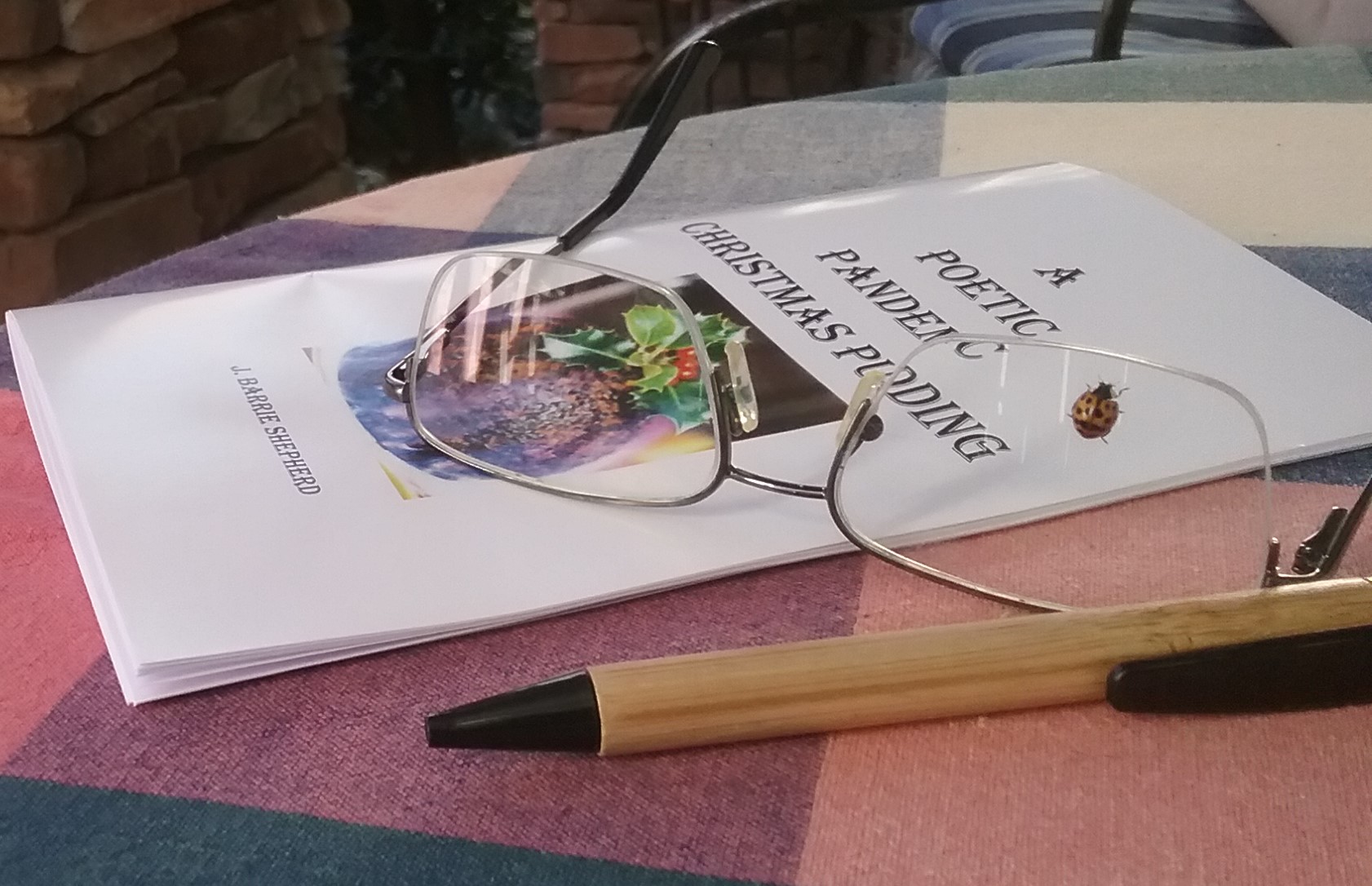
Ladybug season again at our place. 
This one crawled along the book, the pen and then my glasses.

Spiritual gurus admonish us to “go toward the light,” and especially in this winter season of a pandemic, that seems preferable to wallowing in darkness. But a line in a poem entitled “Lux et Veritas” in J. Barrie Shepherd’s latest chapbook, A Poetic Pandemic Christmas Pudding, reminds me of the vitality of darkness.

Contrasting our light displays during this season with the humble lighting of Jesus’ stable cave that allowed “the clear radiance that streamed above, around, beyond that battered-blessed manger,” poet and pastor Shepherd recalls introducing his first granddaughter to “the black-velvet-spread celestial of The Milky Way” “one sparkling island night in Maine”:

Her sheer astonishment made clear that we must

claim our darkness too, if we would glimpse

the glory of the elemental light.

Sunday over Zoom, Ormewood Church had a glimpse of the glory that may come when we “claim our darkness too.” Preaching on Mary’s Magnificat, Rev. Jenelle Holmes shared a recent dark moment in her life and offered her own “Magnificat,” and she has graciously allowed me to share it with you: 

My soul deepens and broadens the Lord’s presence and my spirit rejoices with God who saves me each and every day. God has looked with eyes of mercy on me, when some in the world have looked on me with disdain. God has seen the ways I am held back by others and has handed me support. People call me blessed because God has walked with me on hard roads of rejection, depression and anxiety and anger, and God has carried me through. God’s name is holy and God is a holy space for me. When I could have turned around and cursed God, I took God’s presence seriously and God has honored that with a strong arm of confidence and love.  

Those who wish me harm through rejection or fear or ignorance, God has dealt with in the privacy of their hearts. Those who have sought to harm me by using their voices of privilege, even in the church and in my family, God has shouted over them that I am loved and that I am who I was created to be.  

And as I look to my neighbors who are without homes, I have seen God’s people provide shelter. As I look to my neighbors who have lost their jobs, I have seen God’s people write checks. As I look to my neighbors who are lonely and isolated, I have seen God’s presence ignite ideas and rhythms of faith. As I look to my neighbors who have experienced one setback after another, I have seen God provide one day after another.  

And the rich, the powerful, the ignorant: God will show them the emptiness of their greed. They will be hungry for the good work of God.  

And as I think of how God helped ancient Israel escape Pharaoh, how God has helped the barren experience new life and the dead come back to life, and the marginalized be handed a voice, I remember God’s mercy forever, in every generation, even my own, even in 2020. My soul magnifies the Lord and my spirit rejoices with God who saves me each and every day.                                                                                    –Rev. Jenelle Holmes

Having lived in a metaphoric dark closet during my childhood and youth as a gay kid, I knew where the light was—it was outside my protective, defensive, even necessary shell. The glory of God and my own glory lay beyond my captive, seductive defenses and others’ captive, destructive offenses. Remember Jung’s suggestion that religion is a kind of defense against God? My closet—my and others’ rigid conceptions of God—kept me from God’s glory. 

My most recent “aha” about who God is, is that God is the glory at the climax of the prayer Jesus taught us: “For thine is the kingdom and the power and the glory.” That glory is unknowable but visible in the infinite wonders of the universe, in myriad forms of life, and in human compassion and imagination. This is the prophet Isaiah’s “light that shines in darkness.” It is the “shekinah” of Yahweh’s divine presence. It is the glory that brightened Moses’ face and lifted Mary’s soul, as well as our own souls through Immanuel, God-with-us.

I pray this glory for you as you approach this Christmas: 

God bless you and keep you;

God make God’s face to shine upon you,

and be gracious to you;

God lift up God’s countenance upon you,

            and give you peace.  Numbers 6:24-26

Then we may attend to this summons in another of Barrie’s poems, “The Coming of the Light”: “Look deep into this gentle fire, and then go forth to bear it, far and tender, to wherever infants, cold and frightened, tremble in the dark with no bright star, no kings to greet.”


For your own copy of poet and pastor J. Barrie Shepherd’s holiday chapbook: A Poetic Pandemic Christmas Pudding, please send a check to J. Barrie Shepherd at 15 Piper Road – K325, Scarborough ME 04074. Copies will be signed and can be inscribed by request. Or order though his email: barrieshep@aol.com. $10 per copy plus $2 postage. Proceeds go to food pantries in his area of Maine.

Donations to Progressive Christian Reflections may be given safely by clicking here and scrolling down to the donate link below its description. Thank you!

Contemporary Magnificat © 2020 by Rev. Jenelle Holmes, used by permission. 

Copyright © 2020 by Chris R. Glaser. Permission granted for non-profit use with attribution of author and blogsite. Other rights reserved.  


Wednesday, October 14, 2020

Forgiveness and Neighborliness

Our neighbor Mary took this slip from
her rosebush and rooted it for us.
Reminds me of The Little Prince.

In recent weeks I’ve been writing about the relationship of community and compassion. Last week I summed up my post, “Loving our neighbors as ourselves requires first recognizing them as neighbors.”  That post also explained the role of confrontation on behalf of our neighbors. This post from October 22, 2014 talks about how forgiveness plays into neighborliness.

I recite the Lord’s Prayer daily, and often the most challenging phrase for me is the second part of “Forgive us our debts, as we forgive our debtors.”

Though I’ve received everything I have from a generous and gracious God, it’s hard to let go of grudges and wrongs and the feeling that others owe me something or that somehow I have unfairly missed out.

Or if I pray, “Forgive us our trespasses, as we forgive those who trespass against us,” I think about how often I impinge on God’s territory by profaning the sacred, by judging or pre-judging others, by invading the space of one of God’s creatures, by polluting God’s property: earth, water, and air; or by playing God—a role which, in all modesty, I play rather well. 

To the poor who followed Jesus, “forgive us our debts,” must’ve sounded pretty good. It sounds pretty good to us today, weighed down as we are with loans, credit cards, church pledges, expectations from elderly parents or children of any age or our beloved pets, not to mention Comcast bills.

To the sinners who followed Jesus, “forgive us our trespasses” or “sins” must’ve sounded pretty good. It also sounds pretty good to us today, burdened by moral failings, hurt we’ve inflicted on those we love most, toes we’ve stepped on or boundaries we’ve crossed, injustice we’ve ignored.

Thank God, there’s a lot of forgiveness in the Bible, and, according to Old Testament professor Walter Brueggemann, longtime oracle of Columbia Theological Seminary, forgiveness may involve money, land, power, politics, morality, and religious pretensions.

Religious scruples are what the late-converted apostle Paul often addressed. Paul when he was Saul was a Torah fundamentalist who followed every jot and tittle of the Law of Moses, not simply the Ten Commandments on which it’s based, but all the interpretations, applications, court rulings, and explications of Mosaic Law.

As we know from our own Christian tradition, no one can claim the moral high ground better than a self-righteous legalist, traditionalist, or fundamentalist. As an aside, Brueggemann also points out that no one can claim the moral high ground better than a self-righteous liberal, progressive, non-literalist such as myself. All of us tend to equate God’s views with our own, what Brueggemann calls “the cunning little secret of certitude.”

And that’s the tension in the early church—legalists wanting other Christians to follow the Laws of Moses, including dietary restrictions and Sabbath observance, and others who experience freedom in Christ as to such spiritual beliefs and practices. Paul comes down on the side of freedom in Christ, but urges all Christians to respect and regard one another’s positions. Paul is truly a recovered fundamentalist, but doesn’t twist others’ arms to come to 12-step meetings of Legalists Anonymous.

“Who are you to pass judgment on servants of another?” Paul rhetorically questions the Romans, and then observes, “It is before their own lord that they stand or fall. And they will be upheld, for the Lord is able to make them stand.”

Christians have entered into a covenant with Jesus and with one another that requires the interweaving of our lives, beliefs, and practices. Every strand is needed to create the fabric of our spiritual community, one that hopefully reflects Jesus’ meaning for our neighborhood and for the world.

Discussing the Ten Commandments in his book of essays, The Covenanted Self, Brueggemann affirms that the first three commandments about Yahweh give rise to the other seven, which all have to do with living in community, being good neighbors, and loving the neighbor as oneself.

In awe of God, we are called to, in a sense, privilege the neighbor to be truly neighborly and faithful to God. We are to consider their needs, their beliefs, their practices above our own needs, beliefs, and practices. It’s like what is said about marriage, each partner must give 150%. 50% doesn’t cut it, not even 100%. But if we strive to give 150% we are more likely to make a marriage or a spiritual community work.

That requires forgiveness—forgiving that the other is not all we expected, forgiving mistakes and ignorance and insensitivity, forgiving wrongs and inabilities and limitations. And forgiving ourselves these things as well. We are not perfect people. We are forgiven people.

Our model is Jesus, of whom our Christian tradition says that he emptied himself to be a servant. Jesus emptied himself into the neighbor, Brueggemann asserts, and urges us to “imagine that neighborliness is more important than good economics or good politics or good morality or good orthodoxy.” While accepting that challenge, I would add that truly good economics, politics, morality, or orthodoxy must be based in neighborliness.

In Living Buddha, Living Christ, the Vietnamese monk Thich Nhat Hanh tells the story of a woman who invoked the name of the Buddha hundreds of times a day for ten years, but “was still filled with anger and irritation.” Noticing this over the years, a neighbor knocked on her door and called to her. Annoyed, she struck her meditation bell hard to make it clear she was chanting. The neighbor called again and again, and finally the woman shouted, “Can’t you see I’m invoking the name of the Buddha? Why are you bothering me now?”

The neighbor responded, “I only called your name twelve times, and look at how angry you have become. Imagine how angry the Buddha must be after you have been calling his name for ten years!”


Related posts:

Recovering Compassion

Compassion and Community

Donations to Progressive Christian Reflections may be given safely by clicking here and scrolling down to the donate link below its description. Thank you!

Copyright © 2014 by Chris R. Glaser. Permission granted for non-profit use with attribution of author and blogsite. Other rights reserved. 


Wednesday, July 24, 2019

No One Should "Have to" Say the Lord's Prayer

A Nouwen retreatant fashioned this
crucifix from dried cactus at Ghost Ranch.

No one should “have to” say the Lord’s Prayer. Anymore than anyone should “have to” savor quality chocolate, bite into a freshly ripened peach, or make love.

I’ve been made aware that some folk associate the prayer Jesus taught us with all those “have to’s” of formal worship, an accessory to a spiritual straitjacket of liturgical conformity that was required wear in some Christian traditions. I guess my largely optional Baptist worship experience as a child and youth prompts me to see it as a choice rather than a requirement, on a par with the stiff reciting of the Apostles’ Creed or a self-abasing Prayer of Confession. (To be clear, though, in my better moments I try to value all liturgies and their parts as opportunities for spiritual expansion.)

But for me, the prayer Jesus taught is my favorite part of my morning prayer time. Sometimes I save it for last, like dessert. And sometimes I say it first, like a child unwilling to wait.

I write this to say I do not recite the prayer Jesus taught his disciples because God somehow “requires” it, but for selfish reasons that I can only hope become altruistic in the transformation the words may bring me.

It is a way of transcending my self, even as it connects me to my past and future selves. It connects me to Jesus, who first recommended it, and all those disciples and saints, sinners and saviors who followed, are following, and will follow in our spiritual tradition. It connects me to God—I believe, Jesus’ intent—without the “in Jesus’ name” sign-off to prayer we use as an imprimatur / notary stamp / access code / password to let God know our legitimacy as Christians.

The prayer reminds me of the permanent familial relationship we all have with God AND with each other. For me, it’s not simply a Christian prayer, but a Universalist prayer, even a Unitarian prayer for those who believe “the Lord our God is one.” When we pray “thy kingdom come” or the variation “thy kindom come” we are praying for the world a commonwealth in which everyone is a citizen, a beneficiary, and an heir—including those who do not subscribe to any faith or religious tradition. This is the grace of God at work that excludes NO ONE.

And it doesn’t ask of us any less than it asks of God: forgiveness. As synchronicity would have it, the day of writing this post I read Benedictine monk John Main’s words, “Perhaps the gift our violent and fear-filled world needs most is forgiveness…in an age so dissatisfied with its own shallowness—a dissatisfaction that produces so much confusion and violence.”

Finally, it lifts us up to God’s glory, the transformative power of God’s love, and the divine value of all that is.


Other posts on The Lord’s Prayer:


I will again be co-leading a 5-day contemplative retreat April 27-May 1, 2020 in Cullman, Alabama, through the Spiritual Formation Program of Columbia Theological Seminary. It is open to the public.

Progressive Christian Reflections is entirely supported by reader donations. To support this blog: https://mccchurch.org/ministries/progressive-christian-reflections/
Scroll down to the donate link below its description. Thank you!

Copyright © 2019 by Chris R. Glaser. Permission granted for non-profit use with attribution of author and blogsite. Other rights reserved.

Wednesday, May 29, 2019

"Listen Up!"

For fun, I asked Wade to take this staged photo 
of me "meditating" in South Africa last August!

Benedictine monk John Main has reminded me of something I first learned reading one of Gore Vidal’s historical novels. Reading silently to oneself became a thing only in recent centuries. “The spoken word is the essential medium for the communication of the gospel,” Main wrote in 1982, the year he died. He explains:

…To meditate is to listen to the word. In the early days of our literate culture, the link between the book and the spoken word was not broken—St. Benedict warns his monks not too read too loudly while at their private lectio; and St. Augustine was reading aloud from his Bible when his great awakening occurred. Today our books are too private experiences that rarely communicate themselves to others. --Letters from the Heart: Christian Monasticism and the Renewal of Community, p 19.

I did not intend to offer two spiritual imperatives in a row on this blog. Last week’s “Be Still!” was a reflection on another book of Main’s. I ran across both books on my shelves, having no idea how I came by them and why I haven’t read them till now. This second one has a bookmark from Newman Bookstore in Baltimore, so maybe I purchased them on a speaking trip there, one of my favorite cities. If someone gave them to me, I thank them!

In a conversation about speed reading with fellow English majors in college, I remember now retired Episcopal priest Gary Hall commenting how we needed to “hear” literature at least in our heads to get the full effect intended by an author, as we were not reading simply for information. Tom Boomershine has argued the same for scripture, coaching readers in the art of re-telling rather than simply reading a text. Oral transmission was the original way many of these stories and teachings were “traditioned,” or passed on, after all.

John Main suggests “that tradition becomes just a historical memory when it is not one with personal experience.” That’s why I often invite listeners to hear a biblical text as personally addressed to them.

One of my novice mistakes was asking the brothers at Mt. Calvary Retreat House not to read to retreatants from my then congregation during mealtimes, explaining that one of the reasons church members go on retreat is a chance to talk among themselves. I had no idea I was denying those church members the monastic experience of listening.

I’ve written that the most challenging monastic vow for me would be that of “obedience,” thinking little of how the word obedience comes from a word meaning “to listen,” to attend to what another is saying.

We use the phrase “listen up” when we want to convey something vital, something important, possibly urgent. How true this is also of things spiritual.

For Main, in his other book, Word into Silence, silence is needed to catch the deepest cries, ahas, and awes of our hearts, of our world, of our universe. He writes, “The qualities we need in this fundamental encounter between ourselves and the ground of our being are attentiveness and receptivity.” [p 34] Main later adds:

The understanding of prayer that makes it merely a matter of telling God what we want or need and reminding God of our sins of omission only compounds our alienation from reality. For this was the liberating message Jesus came to bring: “I bid you put away anxious thought about food and drink to keep you alive and clothes to cover your body. Surely life is more than food, the body more than clothes (Matthew 6:25).” [p 65]

Main writes that the Lord’s Prayer was “a series of rhythmic phrases in the original Aramaic,” thus memorable. I have found each phrase can serve as a centering word, a mantra. Mine lately has been “Thy kingdom come.”

Along with other centering prayer advocates, Main believes such a mantra can quiet the mind and welcome a “reverential silence.”


Please check out the related posts, “Be Still!” and “Be Careful!”

I will again be co-leading a 5-day contemplative retreat: April 27-May 1, 2020 in Cullman, Alabama, through the Spiritual Formation Program of Columbia Theological Seminary. It is open to the public.

Progressive Christian Reflections is entirely supported by reader donations. To support this blog: https://mccchurch.org/ministries/progressive-christian-reflections/
Scroll down to the donate link below its description. Thank you!

Copyright © 2019 by Chris R. Glaser. Permission granted for non-profit use with attribution of author and blogsite. Other rights reserved.

Wednesday, May 22, 2019

"Be Still!"

Seattle waterfront. (crg)

Our mothers’ admonition to us as children is the first step of contemplation.

During my prayers the morning I write this, it occurred to me that, if we are still enough, we can sense the world breathe.

Doesn’t matter if we are under trees or skyscrapers, raining skies or starry nights. We can see or hear or feel the world breathe, and that breath is the breath of God.

God is not on a faraway planet, but within this planet, offering the breath of life to all creatures, to all creation. And to you, specifically and particularly.

Meditation aligns our breathing with God’s breathing.

To allow that, we need truly “free time.” Scholar comes from the Latin “schola” which means free time, or leisure time for learning. Free time allows us to become “scholars” of the spiritual.

Free time means letting go of all claims on us—in the words of the Lord’s Prayer, released from debts, trespasses, and sins, as well as those indebted to us, trespass our space and time, and sin against us. Also, we are free of obligations, expectations, and the day’s agenda. It requires an act of the imagination to do this, to offer the welcoming, existential prayer “thy kingdom come” and to believe Jesus’ words “the kingdom of heaven is at hand” and “this day you will be with me in Paradise.”

“It is because this kingdom is established and is present within us that we can be made free of the limitations of language and thought,” in the words of Benedictine monk John Main in his 1980 book, Word into Silence. He explains of most Westerners,

We tend either to be alert or relaxed; rarely are the two states combined in most of us. But in meditation we come to experience ourselves as at one and the same time totally relaxed and totally alert. This stillness is not the stillness of sleep but rather of totally awakened concentration. [p 8]

I can’t find what translation of Romans 5:2 that Main is using, but I love the turn of phrase, “we have been allowed to enter the sphere of God’s grace.” [pp. 2-3] (I did an internet search for this translation and only found this wording in interpretations of “we have obtained access to this grace in which we stand.” NRSV)

The “sphere of God’s grace” releases us into free time. It forgives the past, and, in a sense, “forgives” the future. It allows a truly existential moment to bask in God’s presence, which is not other-worldly but here and now. We are Adam and Eve naked in the garden. We are Jesus, children being about our “Father’s/Mother’s business” in the Temple and beyond. Holy Spirit inspires us, overcoming divisions and dualities with unity and harmony.

As such we know ourselves, even as we yet puzzle over knowledge of God.

“Monks are essentially people whose first priority is practice rather than theory,” Main writes, “Such a monasticism…will be an inclusive rather than an exclusive movement in the Church. It will know that the experience has only to be really lived to be communicated. … It is the silence of monks that is their true eloquence.” [xi]

Be still, and attend to God breathing in your world and in your life.


Please check out the follow-up posts, “Listen Up!” and “Be Careful!”

I will again be co-leading a 5-day contemplative retreat: April 27-May 1, 2020 in Cullman, Alabama, through the Spiritual Formation Program of Columbia Theological Seminary. It is open to the public.

Progressive Christian Reflections is entirely supported by reader donations. To support this blog: https://mccchurch.org/ministries/progressive-christian-reflections/
Scroll down to the donate link below its description. Thank you!

Copyright © 2019 by Chris R. Glaser. Permission granted for non-profit use with attribution of author and blogsite. Other rights reserved.

Wednesday, May 16, 2018

God, Mother of Us All

Ormewood Church on Easter

This is excerpted from my talk for Ormewood Church this past Mother’s Day. The complete scripture was Wisdom of Solomon 7:22b-30 (NRSV), a portion of which I’ve included here. The “her” is Wisdom, Sophia. Thanks to organizing pastor Jenelle Holmes for inviting me! 
There is in her a spirit that is intelligent, holy…loving the good…humane…steadfast, sure, free from anxiety, all-powerful, overseeing all, and penetrating through all spirits that are intelligent, pure, and altogether subtle. …For she is a breath of the power of God…in every generation she passes into holy souls and makes them friends of God, and prophets; for God loves nothing so much as the person who lives with Wisdom. 
If you saw all these qualities in a personal ad or on a resume, you just might want to meet this person! I say “might” because this is a list so awesome many of us would feel intimidated.

This is a description of Sophia, Greek for Wisdom, and in Jewish wisdom literature, you could say she was the feminine side of God, the counterpart to God the Father. This scripture was written by a Jewish mystic deeply influenced by Greek philosophy who lived around the time of Jesus. As I grow older and the world seems more and more stupid and ignorant, wisdom becomes a quality I pray for in all our leaders and all of us!

In another text it is said that Sophia was with God from the beginning—without Wisdom nothing was created that was created. If this sounds familiar, the mystical Gospel of John takes as its prologue a similar assertion, that the Word, or Jesus, was with God from the beginning, and without Jesus, nothing was made that was made.

On this Mother’s Day, I invite us to think of motherhood as sometimes biological and sometimes spiritual. Note the present tense in the following examples. We need to hear these words even today:

“As a mother comforts her child, so I will comfort you,” God declares through the prophet Isaiah (Is 66:13).  

Jesus laments over Jerusalem, “How often have I desired to gather your children together as a mother hen gathers her brood under her wings, and you were not willing” (Mt 23:37). 

And the Psalmist gives us that comforting goal of resting in God:
I hold myself in quiet and silence,
            like a little child in its mother’s arms,
            like a little child, so I keep myself.  (Ps 131:2, NJB)

One of our spiritual mothers, the 12th century Julian of Norwich, even prays to the founder of our faith as “Mother Jesus.” 

And, when told his mother and siblings have come to see him, Jesus himself famously says, “Who are my mother and brothers and sisters? Those who do the will of God in heaven.”

I say the Lord’s Prayer every morning. Early on, I changed the “Our Father” to “God, Mother and Father of us all.” I pray this way because my biological mother and father loved me in different ways and I returned that love in different ways, and so it is in our relationship with God, I believe. For many without a mother or a father, or who have an imperfect mother or father, God may serve as a spiritual foster mother or father.

The Christian faith grew from a handful of persecuted followers scattered throughout the Roman Empire in the first century after Christ to the equivalent of almost a state church by the fourth century, becoming culturally fashionable and politically advantageous. Even the Emperor claimed to be a Christian.

This mixing of church and state made some followers of Jesus nervous, anxious that his countercultural teachings, such as concern for the poor, the marginalized, the sick, the old, orphans, children, and those with disabilities would be lost in the collusion and confusion of church and state. They were also worried about the transformation of what had been a Christian movement into a religion and religious institution, the Church.

So, so-called spiritual mothers and fathers went out into the wildernesses of the Middle East to pray. They became known as the Desert Mothers and the Desert Fathers. They did not believe Jesus came to save only Christians—rather, they believed that Jesus could save the whole world from its excesses, its materialism, prejudices, hatred, self-absorption, violence, and cruelty.

They were concerned for the interior life that we in the 21st century would understand as the spiritual life.

But the spiritual life for them was as real as the exterior life in which they labored to be self-sustaining communities that could welcome and feed the stranger, the refugee, the pilgrim, and those escaping mistreatment and injustice, including women.

Paying attention to our “interior dwellings,” our souls, proves to be the beginning of an intentional spiritual life that will benefit our guests, whether young children or elderly parents, neighbors or strangers.

My mom and dad were role models of this spiritual life in different ways. My dad enjoyed studying scripture and teaching Sunday school. My mom was more of an adventurer in the spiritual life, reading the writings of mystics and contemplatives of various traditions. In this sermon, you can hear my father the teacher in my words, and my mother the contemplative-wannabe in my regard for the spiritual life.

But it was not until my mom was in her 80’s that she had what could be called an amazing epiphany. And, a surprise to me, it came at the hands of a Baptist preacher from Atlanta, the Rev. Charles Stanley, whose television broadcast she watched whenever she was unable to attend her Baptist church in Los Angeles. On one of her visits here I took her to First Baptist of Atlanta, by then moved to the suburbs, and she was thrilled to meet Rev. Stanley, though I had explained he was not affirming as she was of gay people like me.

Her “ah-hah” in the final year of her life, she explained with some glee, was that she had always known that God loved us generally, but for the first time in her life she had come to believe that God loved her personally, thanks to Rev. Stanley.

Surprised, I kidded her, “Mom, haven’t you been reading all my books?!”

The 19th century English poet and mystic William Blake summed it up well when he said, “We are put on earth for a little space that we may learn to bear the beams of love.”

The spiritual teacher Henri Nouwen added that our time on earth is a brief span to say to God, “I love you too.”


A related post: “Peace! Be Still!”

Find out how you can support this blog—thank you!
Be sure to scroll down to the donate link below its description.

Copyright © 2018 by Chris R. Glaser. Permission granted for non-profit use with attribution of author and blogsite. Other rights reserved. 

Wednesday, January 3, 2018

Fresh Takes on the Lord's Prayer

Early morning fog on the Ganges, January 1983.

Sitting in a literal fog out on our deck, reading of Darwin’s investigations into the propagation of flowers which attract different pollinating insects by using different colors or scents or shapes, somehow gave me fresh takes on the bits of the Lord’s Prayer, with which I concluded my morning prayer time.

The literal fog is still outside my windows, but the words I am writing now are coming out of a metaphorical fog of uncertainty and unclarity. I feel rather like Pooh trying to think really hard. Forgive me if you consider this exercise sophomoric, the blather of “a wise fool.”

“O God, mother and father of us all” (my modification of the prayer) now flashes as a primordial, unknowable kindling of life eons ago which we have colloquialized and anthropomorphized as “father” or “mother and father” to make our origin familiar and friendly and immediate.

“Who art in heaven” reinforces this unknowability both spatially and temporally. Heaven is a kind of heavy fog that neither lifts nor is penetrable, as inscrutable as a Zen koan.

“Hallowed”—but it is a sacred space, to be revered and remembered—“be thy name”—even if unnamable and unknowable.

“Thy kingdom come” has been a seeming eternity in the making, and will be a seeming eternity in the becoming, yet is instantly in our hearts as we believe it.

“Thy will be done” suggests agency and purpose, something (to me) more knowable than origins as we witness life and love, compassion and consciousness as pinnacles of experience.

“In earth / on earth” from the atom to the cosmos, from the cell to civilization, a driving and unstoppable force unites us. The Big Bang is still banging, like the reverberations of a Tibetan singing bowl.

“As it is in heaven”—not Plato’s realm of ideals, more like “harmonizing with the ultimately real” or true, the Tao (the way) as understood by Kung Tzu (Confucius), the way of life that gives “visible expression of the ultimate reality hidden in the universe.” (Merton quotes.)

“Give us this day our daily bread.” In the midst of this cosmic enterprise, we still need bread, and art, and wisdom.

“Forgive us our trespasses” when we overlook the larger picture or step on another’s property, holdings, or dignity.

“As we forgive those who trespass against us.” Help us let go of our sense of personal ownership of what we have been given, and share its grace.

“Lead us not into temptation.” Never for a second think we are not part of some cosmic dream that calls us to recognize our worth, the value of our time, and our call to add worth and act worthily.

“But deliver us from evil.” Save us from willful ignorance and from the “unquestioned self” in ourselves and in others, including our institutions.

“For thine is the kingdom and the power and the glory forever and ever.” Not mine, but ours to share, in memory and in hope of the greater good.

Where is God? you might ask. Why, in all of this, of course!


Thank you for donations to this blog ministry: 
Be sure to scroll down to the donate link below its description.

Or mail to MCC, P.O. Box 50488, Sarasota FL 34232 USA, designating “Progressive Christian Reflections” in the memo area of your check or money order. Thank you!

Copyright © 2018 by Chris R. Glaser. Permission granted for non-profit use with attribution of author and blogsite. Other rights reserved. Photo from a religious studies tour of India, Sri Lanka, and Nepal.

Wednesday, January 4, 2017

"In Earth"

On my way to Petra, 1981.

Thank you, Huston Smith, for widely sharing your lifelong spiritual quest.

The morning that I write this, I completed my re-reading of the Gospel texts of Jesus’ Nativity, a habit of Advent for me. As I have several posts already prepared, this will be published toward the end of Christmastide, a few days before Epiphany. Given that it’s a “Christmas epiphany” of sorts, that feels just about right. Epiphany and its season have come to mean for me a time to celebrate all glimpses of divinity, including spiritual and scientific, and this “glimpse” juxtaposes both categories.

The reading this morning was the Gospel of John’s famous prologue about the Word, the Word that called creation into being, the Word that became flesh and dwelt among us, full of grace and truth. My blogpost “The Word We Need This Christmas” reflected on this passage, and I had this in mind as I read again John’s very grand interpretation of Jesus’ birth.

But my “a-ha” came when I recited the prayer Jesus taught his disciples, as I do every morning. “Thy kingdom come, thy will be done, in earth”—and here I stopped, not adding my usual “on earth,” an alternate wording that suggests an alliance of human will. “Thy kingdom come…in earth.” “The Word made flesh.” The connection was obvious and inescapable. From the beginning, God’s “kingdom” and God’s “word” has been embodied, enfleshed, in earth, in matter and energy.

God’s kingdom and God’s will is the spark that began the universe in the eyes of people of faith. “Thy kingdom come in earth as in heaven” is as much about origins as it is about hoped-for destinations. Faith posits that the more we know of our origin—our reason for being who and what and where we are—the better we know our destination, our purpose, our meaning.

The scientific search for the origins of the universe is no less than an attempt to find our place in it, how and why and when we came to be. For most of human history, we have relied on our spiritual imaginations to speculate on our place: myth-making, ritual-performing, story-telling. Now that our scientific imaginations are given a freer reign, we have fact-oriented, experiment-performing, evidence-gathering methods of discerning something like what our spiritual imaginations have sought.

Martin Luther King Jr.’s “arc that bends toward justice” may be a way of recognizing that justice (God’s will, God’s kingdom) is built-in. This is a high-view of creation in general and humankind in particular, and would seem to belie the notion of “The Fall,” but to “fall” requires heighth. In my belief, “The Fall” is not built-in, though most Christians probably believe that to be so. As Matthew Fox and others have pointed out, it’s our “original blessing” that is built-in.

Genesis has us created in God’s image, thus in Jesus’ lineage the Gospel of Luke calls Adam “son of God.” The Gospel of John has the Word giving us “power to become children of God,” restoring us to our rightful heritage.

My reasoning will seem sophomoric to some, but the profound sense that matter and energy and we are also incarnations of God’s will and kingdom will not leave me.


Please support this blog ministry by clicking on or copying and pasting in your web browser:  http://mccchurch.org/ministries/progressive-christian-reflections/

Be sure to scroll down to the donate link below its description. Or mail to MCC, P.O. Box 50488, Sarasota FL 34232 USA, designating “Progressive Christian Reflections” in the memo area of your check or money order. Thank you!

Copyright © 2017 by Chris R. Glaser. Permission granted for non-profit use with attribution of author and blogsite. Other rights reserved.  

The intense beauty of colors in the stone of Petra 
brought involuntary tears to my eyes.

Wednesday, July 27, 2016

"Deliver Us from Evil"

My Facebook friends know that last week, during a political convention, I did not practice what I preached in a recent blog about avoiding making snarky comments on social media.

At one point, I apologized, but couldn’t resist making a few more. As one friend commented, though, snark can be a good way of asserting oneself when taken aback by what one witnesses.

Earlier on this blog I explained why I didn’t take to Facebook or this blog immediately after watching or reading the news: my reactionary self takes over when I would rather be reflective, at least in print or on the internet.

A few weeks back, I did write something passionate about the kind of presidential candidate I would be proud to have in the White House, which I viewed less as a political endorsement than a spiritual intervention. But you have been spared receiving that post today as I further deliberated, not afraid to be political but resisting being partisan. If you have read this blog for any length of time, my choice would not be news to you anyway.

The genius of the prayer Jesus taught his disciples is partly that each simple phrase can represent to the pray-er different things at different times in different contexts.

Such is true of “deliver us from evil.” Now I once surmised that the phrase, following hard on the heels of “lead us not into temptation,” must refer to the evil we ourselves might do, but in practice, I believe it also refers to the evil that others might do to us.

When I consider my own possible “evils” each morning that I pray those four words, all sorts come to mind. I may consider someone I’ve hurt, some malicious thought, feelings of envy, memories of past sins--or a snarky comment on Facebook! The list, unfortunately, goes on and on.

As a relevant aside, let me dare to disagree with Jesus about the thought being equal to the deed.

I agree with him that we cannot feel self-satisfied because we haven’t acted on our lust—whether it be economic, sexual, religious, violent and so on. But I think we do better when we don’t act on our evil or selfish desires. At least then the harm done is only to ourselves, but when we act them out, we harm others, obviously.

I believe those we recognize as saints are those best able to restrain their worst impulses, if only their worst is to ignore the needs of the poor, the sick, the hungry, the homeless, the stranger.

Other evils I confront in myself, given the day or context or condition, are enervating fear, failing to stand up for or take care of myself, believing myself unworthy, thinking I have nothing more to say, avoiding conflict at all costs.

Just as often I think of evils outside my control: someone who disrespects me, a health challenge for me or someone else, the death of someone I love, an injustice that affects me or someone I care about, etc. I don’t expect God to “deliver” me from these problems as much as show me the way to deliverance that befits a follower of Jesus.

But “deliver us from evil” includes the qualifier “us.”

It’s not all about me, but all about us, and that expands the possibilities of evil worldwide: war, poverty, ignorance, violence, inequality, disease, divisiveness, environmental destruction, and all the “isms” that divide us. Again, I don’t expect God to solve the problems as much as inspire a solution—in me, and in the spiritual communities collectively praying this prayer.

As you can imagine, I sometimes experience long pauses after reciting each phrase of the Lord’s Prayer.

“Deliver us from evil” particularly gives me pause, especially in this political season.


Related posts:

Please support this blog ministry by clicking here and scrolling down to the donate link below its description or by mailing to MCC, P.O. Box 50488, Sarasota FL 34232 USA, designating “Progressive Christian Reflections” in the memo area of your check or money order. Thank you!

Copyright © 2016 by Chris R. Glaser. Permission granted for non-profit use with attribution of author and blogsite. Other rights reserved.