Showing posts with label Christmas. Show all posts

Wednesday, December 30, 2020

Full of Grace and Truth


“Full of grace and truth” has stayed with me this Christmas 2020 season to dispel the gloom of unreformed Scrooges, unredeemed Grinches, and an unrelenting pandemic.

The Gospel writer John used “full of grace and truth” to describe God’s coming into this world through the beloved child and prophet Jesus. John gets credit as a theologian for his elevated prologue beginning “In the beginning was the Word…” but, in truth, we are all theologians, speculating in our own “Tiny Tim” ways about the nature of the universe, of humanity, and the nature of God.

In early Christianity, “theologia” was communion with God, so maybe it’s better to consider John a mystic, a contemplative whose vision revealed a thin place—Jesus—where God’s grace and truth could touch, heal, transform our confusions and delusions and self-elevating pride.

Blending grace and truth, to my very human perspective, is as challenging as mixing divinity and humanity. When I think of those among us full of grace, they seem able to be gracious because they hold their tongues when it comes to truth: “No, you don’t look fat.” “No, your profits are well-deserved.” “Yes, you are super.”

When I think of those among us full of truth, they come across as challenging, even judgmental, spoilers, disagreeable. Yes, they are prophets and whistleblowers and much needed in our self-deceptive, aggrandizing, fame- and wealth-driven world, but dinner with them? Heavens, please, no!

But one of the characteristics that makes divinity “divine” seems to me to be its ability to integrate both grace and truth. “Yes, you belong,” grace says. “Yes, you belong,” truth says. In the view of process theologian Daniel Day Williams, belonging is as vital (as in life-giving) as believing. Grace tells us we belong. Truth tells us we belong.

The belonging Jesus proclaimed confirms our place in creation and our citizenship in God’s common spiritual wealth, neither of which is to be taken lightly. That’s grace with a dose of truth.

Happy New Year!

Chris


Relevant New York Times columns by Peter Weimer:

The Forgotten Radicalism of Jesus Christ

The Uncommon Power of Grace

How Can I Possibly Believe that Faith is Better than Doubt?

Donations to Progressive Christian Reflections may be given safely by clicking here and scrolling down to the donate link below its description. Thank you!

Copyright © 2020 by Chris R. Glaser. Permission granted for non-profit use with attribution of author and blogsite. Other rights reserved.  


Wednesday, December 23, 2020

Tricked by Grace


This was my 200th post, published on December 10, 2014. I recently read that the opposite of faith is not doubt, but certainty. Merry Christmas!

A few weeks ago I was reading one of Southern writer Flannery O’Connor’s last short stories, entitled “Revelation,” published posthumously in her collection All That Rises Must Converge. She takes the book’s title from Teilhard de Chardin, whose writings as both a scientist and a mystic she greatly admired.

The story is written from the perspective of an older woman who finds herself in a doctor’s waiting room, looking from person to person, engaging in small talk. Her judgmentalism is in high gear as she silently evaluates their appearance, their interactions and lack thereof, as well as sharing aloud the foibles of people in general with another woman. I was especially put off by her frequent use of the “n-word.”  In that brief story I saw the unabbreviated word more often than I have seen it in recent decades.

Needless to say, I too was frothing with judgment (of the protagonist) as the story came to a surprising twist. Without giving the story away, something happens that upsets her certainty about things, and later, watching the sun set, she has an unsettling vision of what was to come: all the people she routinely judged marching nonetheless toward heaven, “battalions of freaks and lunatics shouting and clapping and leaping like frogs.” The story continues:

And bringing up the end of the procession was a tribe of people whom she recognized at once as those who, like herself and Claud, had always had a little of everything and the God-given wit to use it right. She leaned forward to observe them closer. They were marching behind the others with great dignity, accountable as they had always been for good order and common sense and respectable behavior. They alone were on key. Yet she could see by their shocked and altered faces that even their virtues were being burned away.

I cried with recognition. I was her. Flannery O’Connor tricked me, even as grace tricks us all. We think we will be saved by our many words—prayers, sermons, posts—or our many deeds—charitable, political, religious. But it’s grace that really saves us.

In the woods around her the invisible cricket choruses had struck up, but what she heard were the voices of the souls climbing upward into the starry field and shouting hallelujah.


Donations to Progressive Christian Reflections may be given safely by clicking here and scrolling down to the donate link below its description. Thank you!

Copyright © 2014 by Chris R. Glaser. Permission granted for non-profit use with attribution of author and blogsite. Other rights reserved. 


Wednesday, December 16, 2020

Go Toward the Dark

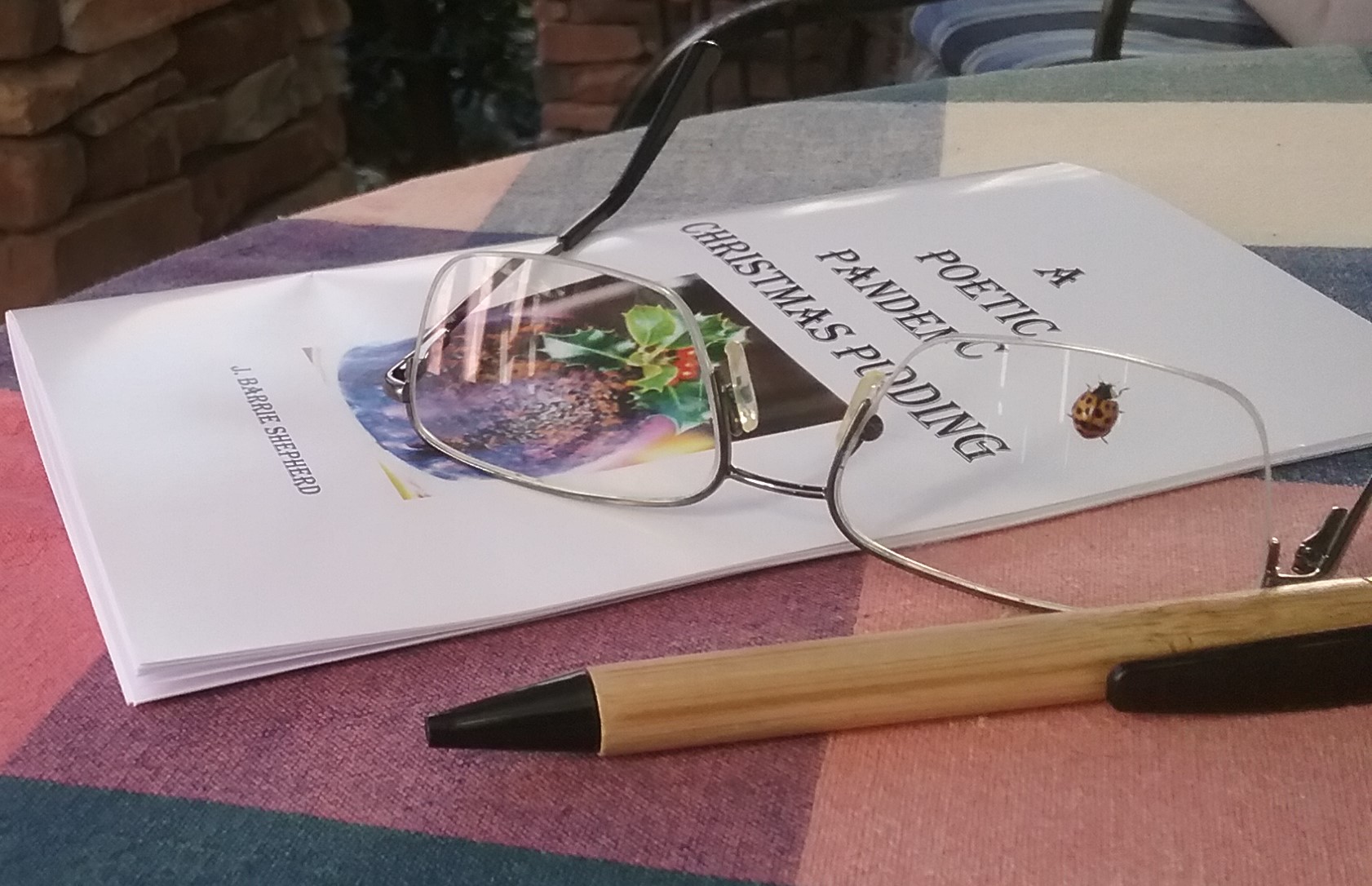
Ladybug season again at our place. 
This one crawled along the book, the pen and then my glasses.

Spiritual gurus admonish us to “go toward the light,” and especially in this winter season of a pandemic, that seems preferable to wallowing in darkness. But a line in a poem entitled “Lux et Veritas” in J. Barrie Shepherd’s latest chapbook, A Poetic Pandemic Christmas Pudding, reminds me of the vitality of darkness.

Contrasting our light displays during this season with the humble lighting of Jesus’ stable cave that allowed “the clear radiance that streamed above, around, beyond that battered-blessed manger,” poet and pastor Shepherd recalls introducing his first granddaughter to “the black-velvet-spread celestial of The Milky Way” “one sparkling island night in Maine”:

Her sheer astonishment made clear that we must

claim our darkness too, if we would glimpse

the glory of the elemental light.

Sunday over Zoom, Ormewood Church had a glimpse of the glory that may come when we “claim our darkness too.” Preaching on Mary’s Magnificat, Rev. Jenelle Holmes shared a recent dark moment in her life and offered her own “Magnificat,” and she has graciously allowed me to share it with you: 

My soul deepens and broadens the Lord’s presence and my spirit rejoices with God who saves me each and every day. God has looked with eyes of mercy on me, when some in the world have looked on me with disdain. God has seen the ways I am held back by others and has handed me support. People call me blessed because God has walked with me on hard roads of rejection, depression and anxiety and anger, and God has carried me through. God’s name is holy and God is a holy space for me. When I could have turned around and cursed God, I took God’s presence seriously and God has honored that with a strong arm of confidence and love.  

Those who wish me harm through rejection or fear or ignorance, God has dealt with in the privacy of their hearts. Those who have sought to harm me by using their voices of privilege, even in the church and in my family, God has shouted over them that I am loved and that I am who I was created to be.  

And as I look to my neighbors who are without homes, I have seen God’s people provide shelter. As I look to my neighbors who have lost their jobs, I have seen God’s people write checks. As I look to my neighbors who are lonely and isolated, I have seen God’s presence ignite ideas and rhythms of faith. As I look to my neighbors who have experienced one setback after another, I have seen God provide one day after another.  

And the rich, the powerful, the ignorant: God will show them the emptiness of their greed. They will be hungry for the good work of God.  

And as I think of how God helped ancient Israel escape Pharaoh, how God has helped the barren experience new life and the dead come back to life, and the marginalized be handed a voice, I remember God’s mercy forever, in every generation, even my own, even in 2020. My soul magnifies the Lord and my spirit rejoices with God who saves me each and every day.                                                                                    –Rev. Jenelle Holmes

Having lived in a metaphoric dark closet during my childhood and youth as a gay kid, I knew where the light was—it was outside my protective, defensive, even necessary shell. The glory of God and my own glory lay beyond my captive, seductive defenses and others’ captive, destructive offenses. Remember Jung’s suggestion that religion is a kind of defense against God? My closet—my and others’ rigid conceptions of God—kept me from God’s glory. 

My most recent “aha” about who God is, is that God is the glory at the climax of the prayer Jesus taught us: “For thine is the kingdom and the power and the glory.” That glory is unknowable but visible in the infinite wonders of the universe, in myriad forms of life, and in human compassion and imagination. This is the prophet Isaiah’s “light that shines in darkness.” It is the “shekinah” of Yahweh’s divine presence. It is the glory that brightened Moses’ face and lifted Mary’s soul, as well as our own souls through Immanuel, God-with-us.

I pray this glory for you as you approach this Christmas: 

God bless you and keep you;

God make God’s face to shine upon you,

and be gracious to you;

God lift up God’s countenance upon you,

            and give you peace.  Numbers 6:24-26

Then we may attend to this summons in another of Barrie’s poems, “The Coming of the Light”: “Look deep into this gentle fire, and then go forth to bear it, far and tender, to wherever infants, cold and frightened, tremble in the dark with no bright star, no kings to greet.”


For your own copy of poet and pastor J. Barrie Shepherd’s holiday chapbook: A Poetic Pandemic Christmas Pudding, please send a check to J. Barrie Shepherd at 15 Piper Road – K325, Scarborough ME 04074. Copies will be signed and can be inscribed by request. Or order though his email: barrieshep@aol.com. $10 per copy plus $2 postage. Proceeds go to food pantries in his area of Maine.

Donations to Progressive Christian Reflections may be given safely by clicking here and scrolling down to the donate link below its description. Thank you!

Contemporary Magnificat © 2020 by Rev. Jenelle Holmes, used by permission. 

Copyright © 2020 by Chris R. Glaser. Permission granted for non-profit use with attribution of author and blogsite. Other rights reserved.  


Wednesday, January 1, 2020

Why Must Politics Intrude on Our Faith?

Photo by Bassam Khabieh for Reuters and The New York Times.

A few days after Christmas [2014] I picked up our morning paper and, before I put on my reading glasses, I saw on the front page a child on a sled in the snow, confirmed by the caption that began, “Heavy sledding…” I wondered where in the world the photograph was taken.

As I drew the paper closer and put on my reading glasses I was stunned by my mistake. This was no child laughing as he rode a sled through snow—no, this was a child crying out in pain, being carried on a stretcher over a caption that read not “heavy sledding” but “Heavy Shelling…” as in “Heavy Shelling Reported Near Damascus.” What I imagined was snow on the boy’s clothing must have been debris from the blast.

I felt much the same way when I read the Gospel lesson for the Sunday following Christmas. After spending Christmas Eve hearing and singing about the holy infant Jesus, so tender and mild, enjoying a silent and holy night in which all is calm, all is bright, I found Matthew’s text about the slaughter of the innocents disturbing and violent (2:13-23).

Here Jesus had just been born to Mary and Joseph, and was lying in a manger, sleeping in heavenly peace, visited in Matthew by three spiritual sages from another country who brought gold and frankincense and myrrh and, in the Christmas carol, Silent Night, visited by shepherds enjoying the “radiant beams from his holy face” that meant “the dawn of redeeming grace.” The only thing that had disturbed their silent night earlier had been angels in the heavens singing “alleluia to our King; Christ the Savior is born.”

Why, oh why, must this beatific image be shattered by political realities? Escaping from King Herod, who, if he can’t find this baby that threatens his political power, chooses to slaughter all the innocents—infants the age of Jesus, causing wailing and lamenting in his birthplace of Bethlehem. And why, upon their return from Egypt, must Mary, Joseph, and Jesus go into hiding once more, this time in Galilee, to escape the even more heinous son of Herod, Archelaus, who had ascended the throne upon his father’s death?

Why can’t we just have a nice little Christmas? Why can’t we all just get along? And why must politics intrude on our faith, disturb our praise and worship, interrupt our contemplative mantra of “peace on earth, goodwill to all”? Why must we read of slaughtered innocents and wailing mothers? Why must I pick up a newspaper and see such a disturbing scene as a terrified child in pain after the president of Syria has bombed his hometown?

If we learn nothing else from the subsequent life of Jesus, it is that spirituality is never an escape—it is always an engagement with reality. Jesus’ prayer “forgive us our debts” meant a lot to his poor, impoverished fellow Israelites. “Thy kingdom come” meant the end of the Roman Empire. If a Roman soldier compels you to carry his gear one mile, carry it two miles, because “Loving your enemies” is a revolutionary act.

“Give unto Caesar that which is Caesar’s, but give to God that which is God’s.” “Don’t be like these Pharisees…,” rather, “consider the lilies of the field.” Whether waiting for the bridegroom or your master or the owner of the vineyard, be strategic in your preparations. “Be wise as serpents and gentle as doves.” “If a town (or church) does not welcome you, shake its dust from your feet.” “Sell your possessions and give to the poor, and come follow me.”

“Go and learn what this means: I desire mercy and not sacrifice.” “Let the one without sin cast the first stone.” God’s “house shall be called a house of prayer for all peoples, but you have made it a market place!” All of these quotes bring to mind real world applications of Jesus’ gospel.

And then there’s the cross: a political execution awaiting our “holy infant, so tender and mild.”

So I wrote this prayer for the children of the world:

In the name of Jesus who lifted children to his lap
and said “of such is the kingdom of heaven,”
we pray for the children of the world:

We pray for those who live in poverty,
            from our own neighborhood to those in hidden corners of the world.
We pray for those who live in danger
            of abuse, exploitation, violence, war, and disaster.
We pray for those who live in hunger and thirst,
            those who starve and those who are malnourished,
those enduring droughts and those whose water is polluted.
We pray for those who suffer illiteracy or disease, those who are refugees,
those who are illegal immigrants, those with disabilities,
those who are oppressed, those whose religion, culture, tribe, or nation distort their view of themselves and the world.

Your child, Jesus, suffered with all the children of the world
“because all are precious in his sight.”
In the name of Jesus who lifted children to his lap
and said “of such is the kingdom of heaven,”
we pray for the children of the world. Amen.


I posted this on January 15, 2014 and thought new blog followers might like to read it. Have a meaningful and hopeful new year!

Progressive Christian Reflections is entirely supported by reader donations. To support this blog: https://www.mccchurch.org/ministries/progressive-christian-reflections/
Scroll down to the donate link below its description. Thank you!

Consider using a post or quotes in personal reflection, worship, newsletters, and classes, referencing the blog address and author when possible: http://chrisglaser.blogspot.com.
Check out past posts in the right rail on the blogsite.

Copyright © 2014 by Chris R. Glaser. Permission granted for non-profit use with attribution of author and blogsite. Other rights reserved.

Wednesday, December 25, 2019

A Christmas Memory

"Tree of the Gods"


In thanksgiving for the life and pastoral and prophetic and priestly ministry of the Rev. Peter Denlea.

Christmas morning [2016] I awoke from an extremely pleasant dream. I was back in the home I grew up in, in Southern California, with my mom and dad, sister and brother. I looked out of our living room windows, and discovered it had begun to snow, a rarity in L.A. The window frames had a white dusting, as did our deodara outside, a tree that had been our Christmas tree one year. Only checking on its spelling for this post did I discover the term deodara’s mystical origin, meaning “tree of the gods” in Sanskrit, a sacred forest for Hindu sages.  And “dara” is related to the words Druid and truth!

In the weeks leading up to Christmas, I had read once more Truman Capote’s story, “A Christmas Memory.” Some months ago I rescued it from storage in my crawl space, a bit damp from its place of safekeeping. I allowed the boxed edition to dry, and now it has character: a bit warped, like its author and the true life characters he writes about.

I know the story well. For years I read it at Christmastime to a Wednesday night Bible study. I’ve also viewed two film versions, the most memorable having Geraldine Page as the doting and doughty elderly cousin who befriended the author as a boy, otherwise  abandoned until the age of ten.  

One day, late in the fall, she would announce, “Oh, my, it’s fruitcake weather,” and together they assembled the ingredients and prepared the Christmas fruitcakes that they sent to everyone from President & Mrs. Roosevelt to that nice California couple who spent an afternoon on their porch when their car broke down.

As I read the story once more, I was delighted by Capote’s turns of phrase, painting a portrait of a time long past—yes, harsh in its poverty and sad in its way, but with a kind and gentle lilt to its voice that uplifted my spirit.

What surprised me on this reading, however, was the glimpse of grace toward the end of the book, reminding me of another Southern writer, Flannery O’Connor, at the end of her story, “Revelation,” of which I wrote in a post entitled “Tricked by Grace.”

The boy and his cousin fashion kites as their Christmas gifts to one another, as they had done the year before, and the year before that.  They go out to fly them with their terrier Queenie in a neighbor’s meadow, when the old woman has a startling revelation, “like a woman remembering too late she has biscuits in the oven”:

“My, how foolish I am! You know what I’ve always thought? I’ve always thought a body would have to be sick and dying before they saw the Lord. And I imagined that when He came it would be like looking at the Baptist window: pretty as colored glass with the sun pouring through, such a shine you don’t know it’s getting dark. And it’s been a comfort: to think of that shine taking away all the spooky feeling. But I’ll wager it never happens. I’ll wager at the very end a body realizes that the Lord has already shown Himself. That things as they are”—her hand circles in a gesture that gathers clouds and kites and grass and Queenie pawing earth over her bone—“just what they’ve always seen, was seeing Him. As for me, I could leave the world with today in my eyes.”

“As for me, I could leave the world with today in my eyes.”

I thought back on their sacramental preparation of a communion of fruitcakes, and of the many, often women, who consecrated our kitchens with the incense of baking, the breaking of bread, the squeezing of juice. I thought of my mother baking Christmas cookies, red and green, and giving me the “failures,” the ones that didn’t look as good as they tasted, as she sorted them in tins for relatives and friends.

In her poem “Answers,” Mary Oliver envies her unlearned grandmother picking and canning fruits in the kitchen even as Mary “wakened / To books and music and circling philosophies” at the kitchen table, concluding:

My grandmother stood among her kettles and ladles.
Smiling, in faulty grammar,
She praised my fortune and urged my lofty career.
So to please her I studied—but I will remember always
How she poured confusion out, how she cooled and labeled
All the wild sauces of the brimming year.

This poem brings back the aroma of my maternal grandmother’s Swedish pancakes, the colors of my paternal grandmother’s jars of fruits and vegetables at the farm, the salty crunch of the batter on my mother’s fried chicken—and it honors them all as gods bringing order from chaos, as priests and poets and psalmists reminding us to “taste and see that the Lord is good,” even as we are, in Mary Oliver’s words, “sorting through volumes of answers / That could not solve the mystery of the trees.”

We didn’t have a Christmas tree this year, because we are downsizing, packing, and moving. But I had the mystery of home and our deodara in my dream. And, as I fixed breakfast for us, I heard Eugene Peterson (The Message) on the radio program “On Being” say, “Prayer matures into the practice of memory.”

I thought of a spiritual formation program paper I’d read earlier in the week by a minister who works with the elderly, and how those with dementia and Alzheimer’s seem to remember the ritual of Communion, even as they forget so much else.

The Lord has already shown herself.


Though the memorial line is new, I posted this on December 28, 2016 and thought new blog followers might like to read it. Have a meaningful and hopeful  Christmas!


Please make an end-of-the-year tax-deductible contribution to this blog ministry by clicking on or copying and pasting in your web browser:

Be sure to scroll down to the donate link below its description. Or mail to MCC, P.O. Box 50488, Sarasota FL 34232 USA, designating “Progressive Christian Reflections” in the memo area of your check or money order. Thank you!

Wednesday, December 18, 2019

Mohammad's Child

Photo by Andrea Bruce for the New York Times

On the cover of the February 9, 2012 New York Times I saw a familiar tableau, three robed figures with covered heads gazing at an infant in a manger beneath rough-hewn wooden beams. The darkness out of which the lighted figures emerged made me think, “Oh, a Nativity by Rembrandt. I wonder how many millions Sotheby’s auctioned this for? Will it go to a museum or a billionaire?”

But, as I looked closely and read the caption, I realized this moving portrait was a photograph by Andrea Bruce of a three-month old child who died of the cold at a refugee camp in Kabul, Afghanistan. The story by Rod Noland inside the paper gave context to this tragedy, deepening its pathos. “He was crying all night of the cold,” Sayid Mohammad explained of the eighth of his nine children to die, six of disease back home and now, two from the cold at the Nasaji Bagrami Camp, where a total of sixteen children 5 years of age or younger had died of the cold so far.

In a headline just below this “nativity,” “a wealthy backer” is betting on a presidential hopeful, pictured with pastors praying for the candidate, heads bowed with a laying on of hands.

But my eyes are drawn to the trinity of women above, contemplating the dead child whose unseeing face looks upward at them, one grandmotherly figure with a slight fond smile (or grimace?), the central somber mother, Lailuma Mohammad, and a younger woman, kneeling with her face slightly turned away, forehead cradled in hand in grief, perhaps his 10-year-old sister who, earlier that day, had foraged some paper and plastic to burn to keep him warm. 

It was not a nativity by Rembrandt, after all. Not the Christ child, but Mohammad’s child. And no less sacred.


I posted this on February 22, 2012 and thought new blog followers might like to read it. Have a meaningful Advent and Christmas!

Please make an end-of-the-year tax-deductible contribution to this blog ministry by clicking on or copying and pasting in your web browser:


Be sure to scroll down to the donate link below its description. Or mail to MCC, P.O. Box 50488, Sarasota FL 34232 USA, designating “Progressive Christian Reflections” in the memo area of your check or money order. Thank you! 

Copyright © 2012 by Chris R. Glaser. Permission granted for non-profit use with attribution of author and blogsite. Other rights reserved. 

Wednesday, December 11, 2019

"Somebody's Gotta Be Mary!"

India, January 1983

Once upon a time, respectable members of a respectable church decided to perform a Christmas pageant, and congregants were vying for parts. The big competition was around the roles of the Magi, the Eastern religious scholars bearing gold and frankincense and myrrh. Many were taken with their absolutely fa-bu-lous costumes, reeking of wealth and privilege and prestige.

But there were also many who wanted to demonstrate their own humility by playing the poor shepherds watching their flocks by night, knowing that they’d get to see a sky full of angels singing of peace on earth, goodwill toward all, as well as visit the baby Jesus lying in a manger with a halo for a hanging playtoy.

Others wanted to be those high and mighty angels, who, in our contemporary, secular times seem to represent only themselves, cutely and cherubically and all-too-benignly making guest appearances on wrapping paper, greeting cards, and Christmas films, instead of being the fierce and frightful presence of God they are in the Bible—so terrible, they often had to say “fear not!”—awesomely calling individuals to radical action rather than offering sentimental appeasement.

For the manger scene itself, as you may have guessed, it was easy among the staid and high-end church members to cast the roles of the ox and of the ass and of the many docile sheep. Easy also to cast the unwelcoming innkeeper and King Herod frightened of losing power and the indifferent Caesar Augustus only interested in the bottom line, the church budget.

A few were at least willing to play one of the pageant’s two leading characters, Joseph, who at first wanted to put his pregnant betrothed away in a closet somewhere to avoid public disgrace. You will recall that Joseph had a change of heart after having his own vision of an angel, then choosing to serve as a kind of behind-the-scenes partner to the inevitably unfolding will of God, a ferocious will contrary to decency and order, a decency and order Joseph wanted to at least appear to uphold by his outward compliance.

But nobody wanted to play the role of Mary in the Christmas pageant. “Somebody’s gotta play Mary!” the stage manager Gabriel shouted out, sounding very much like the gravelly voice of Harvey Fierstein. “No Mary, no Jesus!” he cried bluntly.

You see, nobody respectable wanted to play Mary because of the shame of her unwed pregnancy. And absolutely no one wanted to go through the bloody and painful job of giving birth to a new thing.

Mary’s fidelity to God, her willingness to say, “Here I am the servant of the Lord; let it be with me according to your word”—all of this counted for naught in the eyes of these good people. The Holy Spirit was knitting together in her womb the new thing for which the prophets hoped, yet, like all nativities of the Spirit, “the powers that be” trembled, including these dignified religious types. Mary’s birthing this child would be an unsettling and unclean act, embarrassing rather than admirable.

“Mary is not a good role model for our children,” someone said.

Stage manager Gabriel again implored the crowd, “C’mon! As Mary, you get to magnify and rejoice in the Lord and be called blessed by generations to come, though admittedly not this generation. You get to serve as God’s instrument to scatter the proud in their presumptuous imaginations, lifting the downtrodden even as the powerful are taken off their high horse. Your mission is to fill the hungry with good things, and to remind the privileged of their own poverty. This is a good thing. Really.”

Visiting the church for the first time, a timid and small young girl came forward, a recent immigrant with olive skin and dark brown eyes and thick black hair, and simply said, “Here am I.” Gabriel, exasperated by everyone else’s resistance, asked, “So—ya wanna be Mary?” And because his language was new to her, she simply quoted Mary’s line, “Let it be with me according to your word.”

And so the respectable church filled with respectable members was able to put on its pageant, reliving the Christmas story, but they did not live happily ever after. For the nature of all nativities of the Spirit humbles those with privilege and uplifts the underprivileged, shaming the proud and bringing mercy and justice to the oppressed.

But that can’t happen unless someone is willing to be Mary.


I posted this on December 7, 2016 and thought new blog followers might like to read it. Have a meaningful Advent and Christmas!

Progressive Christian Reflections is entirely supported by reader donations. To support this blog: https://mccchurch.org/ministries/progressive-christian-reflections/
Scroll down to the donate link below its description. Thank you!

Copyright © 2016 by Chris R. Glaser. Permission granted for non-profit use with attribution of author and blogsite. Other rights reserved. 
Wednesday, December 4, 2019

Put Yourself in the Nativity Story

Hobbes, Calvin and Chris join the
Ormewood Park Presbyterian Church nativity scene, early 2000's.
Photo by Wade Jones.

In his autobiography, Confessions of a Parish Priest, novelist and sociologist Andrew Greeley writes that most Roman Catholics in the U.S. are not “propositional” Catholics who assent to a number of “propositions” or doctrines. For example, a majority of American Catholics do not agree with the Vatican’s teaching on sexual ethics, dismissing its teaching on contraception altogether and questioning its positions on other reproductive choices, premarital sex, and homosexuality.

Greeley concludes from his research that they are not drawn to their church by dogma, but by the story—the biblical narrative, particularly the narrative about Jesus. I think that’s true of Protestants as well. We wonder why many Christians only come to church around this time of Advent and Christmas, but I believe it’s because we love the story of the baby Jesus born to Mary and Joseph, cradled in a manger, endangered by Herod, visited by shepherds and kings.

In the words of Kathleen Norris, “Human beings, it seems to me, require myth as one of the basic necessities of life. Once we have our air and water and a bit of food, we turn to metaphor and myth-making.” To me, myth is not a story that is untrue, but a story that carries a deeper truth that draws us in. As a 5-year-old once said, a myth is a story that is true on the inside. (Gertrud Mueller Nelson tells this in Here All Dwell Free.) Within the words is a Word.

In Care of the Soul, Thomas Moore suggests that imagination is one of the most underutilized and undervalued spiritual gifts. So I invite you to put yourself in the story of Jesus’ nativity. Jesus is not simply born to Mary. He is born to us, if only we use our imagination!

Are you King Herod, fearful of losing power or privilege as God is doing a “new thing”? Or an Eastern sage enduring academic malaise, seeking a star of inspiration? A shepherd routinely going about your business when the skies seem to open up? A prophet crying in the wilderness?

Are you a religious leader holding on to tradition at all costs? An empire’s bureaucrat missing the unfolding human drama? Or one whose life is too full to welcome a homeless, unwed mother-to-be? Joseph, serving quietly on the periphery of sacred drama? Mary, with an unsought calling to do the dirty and painful and lonely work of birthing a new movement? Or a vulnerable child born into a vicious and violent world?

Truth is, over a lifetime, we may play all of these roles in this story. Good to remember, at this time of year, that we hinder or help, blink or behold this nativity of God’s Word to us.


I posted this on December 11, 2011, and thought new blog followers might like to read it. Have a meaningful Advent and Christmas!

Progressive Christian Reflections is entirely supported by reader donations. To support this blog: https://mccchurch.org/ministries/progressive-christian-reflections/
Scroll down to the donate link below its description. Thank you!

Copyright © 2011 by Chris R. Glaser. All rights reserved. Permission granted for non-profit use with attribution of author and blogsite.

Wednesday, December 19, 2018

Jesus Returns!


The world tried to keep Jesus at bay.

Obscurity. Poverty. Illegitimacy. Dislocated. Refugee. Semitic. Subjugated by empire. Resisted by clerics. Blasphemer. Heretic. Unpatriotic. Treasonous. Arrested. Tried. Tortured. Executed. Buried.

Odds were against a comeback.

Then the church elevated Jesus beyond reach.

Born of a virgin. Sinless. Messiah. Christ. Son of God. Divinity. Savior. Ultimate sacrifice. King. Godhead. Heavenly. God’s right-hand-man. Supreme judge.

Way out of our league, beyond our capabilities, out of this world.

Sophisticates simply dismiss Jesus.

Myth. Fairy tale. Unrealistic. Idealistic. Impractical. Parochial. Unnecessary. Confining.

Yet Jesus returns.

Jesus returns again and again to every generation, to every nation, to every culture. We may fail to see him because of color, race, ethnicity, gender, sexuality, nationality, religion, and every other way Jesus is manifest in “the least of these” who are ignored by “the powers that be.”

The “second coming” has multiplied exponentially and yet we still miss out when we are distracted, literalistic, pessimistic, cynical, selfish, egotistical, xenophobic, or just plain stupid.

Jesus is as near to you as yourself. As near to you as another person and creature and landscape and horizon. As near to you as the deepest need, the greatest joy, the most passionate love, the most inspired art, the most enduring peace. Jesus is everywhere, if only we taste, touch, smell, listen, look, feel, think, contemplate, and breathe.

Jesus is as natural as we are. And we have as much potential to be his presence and recognize his presence in others when we make room for him in our schedules, provide for him in our economies, and allow his values to shape our policies and politics.

Move aside, headlines and headliners! Jesus returns.

According to the Gospel according to Zorba the Greek, Nikos Kazantzakis’ real life friend and fictionalized protagonist:

Christ is born, my wise Solomon, my wretched pen-pusher! Don’t go picking things over with a needle! Is He born or isn’t He? Of course He is born, don’t be daft. If you take a magnifying glass and look at your drinking water—an engineer told me this, one day—you’ll see, he said, the water’s full of little worms you couldn’t see with your naked eye. You’ll see the worms and you won’t drink. You won’t drink and you’ll curl up with thirst. Smash your glass, boss, and the little worms’ll vanish and you can drink and be refreshed! 


This post appeared December 24, 2014. Merry Christmas everyone!


Progressive Christian Reflections is entirely supported by readers’ donations. To support this blog: http://mccchurch.org/ministries/progressive-christian-reflections/
Scroll down to the donate link below its description. Thank you!

Copyright © 2014 by Chris R. Glaser. Permission granted for non-profit use with attribution of author and blogsite. Other rights reserved.

Wednesday, December 12, 2018

Christmas for the Spiritual but Not Religious


This is an excerpt of my sermon for Emerson Unitarian Universalist Congregation of Marietta, Georgia this past Sunday, December 9. Many thanks to my friend Jeffrey Jacoby and the worship committee for the invitation! I found the congregation vibrant and friendly. For the bulletin cover I created The Centering Thought: “What if everyone had told me I had a spark of divinity in me when I was born?” For the Chalice Lighting, I wrote:

Light comes into the world
through every baby born.
May we do everything possible
to let that light shine,
openly, honestly, imaginatively,
so other lights may be inspired
with wisdom, compassion, and awe,
bringing our world out of the shadows
and into the rainbow that is light’s spectrum.

You don’t have to listen to me to recognize over and over again how Christmas has become culturally relevant—just watch the Hallmark Channel and Netflix Christmas movies, Christmas mixes on radio stations, as well as media reports of compassion and kindness toward the under-appreciated and underprivileged that are more plentiful at this time of year to know that the spirit of Christmas can lift everyone’s boats, regardless of belief.

It’s believed that the observance of Christmas that we have come to experience in the West was expanded by Charles Dickens’ story, “A Christmas Carol,” a favorite of mine—so much so that last year a commercially well-received film about Dickens’ creation of the story was entitled, “The Man Who Invented Christmas.” In all his novels, Dickens promoted social justice and equality while casting a critical eye on the treatment of the poor in England. As a child, he himself had spent time in a poorhouse that incarcerated those without resources, and his writing of “A Christmas Carol” prevented him and his family from sharing a similar fate.

Every Christmas season there are some Christians who gnash their teeth at the “commercialism” of Christmas. “Let’s put Christ back in Christmas,” they say, verbally and on their bumper stickers, without realizing the success of Christmas marketing is that the story of Christmas is so universal. Its “good will to men and women” and “peace on earth” and “joy to the world” speak to people of every faith and of no religion at all.

Christmas has become about more than Jesus. It’s about the lifting of the human spirit. It’s about kindness and compassion and the glory of being alive!

Years ago, the late sociologist, novelist and Catholic priest Andrew Greeley reported from his scientific surveys that the reason Christians are more likely to attend church in this season is simply because they love the nativity story, not because they hold to the theological assertions of the church about who Jesus was.

This is a very important point—even Christians themselves are not necessarily drawn by theological propositions, but by how the Christmas narrative touches their hearts: an unwed pregnant Mary threatened with scandal, a reluctant Joseph, a sweet baby in a manger, whose life is threatened by the government and whose family has been displaced by governmental policies, a star of hope overhead drawing sages from afar, and more angels and dreams per cubic foot of any biblical story, influencing Mary and Joseph, shepherds and wise men, and still others. This was the original Christmas pageant!

Like all mythological stories, there are parts of the Christmas tale that are fanciful or exaggerated, unbelievable or unverifiable. Those who told these stories wanted to convey meaning rather than history. They were looking backward from their experience of what Jesus had achieved in his life and ministry, his extraordinary teachings, his healing touch, his compassion and grace, his humility and faithfulness. The Christmas narrative was devised in hindsight, what should have been the world’s welcome of one who would transform so much of the world.

Yet the few stories of Jesus’ birth are found in only two of the four gospels. Notably, the first gospel about Jesus written, Mark, included none of these stories—either because they were already well known or, more likely, because they were unknown to Mark or unnecessary to Mark’s story. The last gospel written, that of John, also contains none of these stories. John is the most mystical of the four gospels, and the author’s interest is in explaining the cosmic purpose and nature of Jesus. He grandly describes Jesus as God’s Word made flesh, an embodiment of God’s hope for the world.

It is the gospel writers of Matthew and Luke who give us the nativity stories of how Jesus was born. You will probably recognize parallels in this story to our world today.

Jesus was born in troubled times. As part of the Roman Empire, his people and his country of Palestine were not allowed control of their own land. His parents, though poor, had to deal with the unequal tax plan of a demanding ruler—Caesar Augustus—requiring their migration from the ghetto of Nazareth to Bethlehem, where his pregnant mother and doting father ended up homeless.

But they, like all parents, believed there was something special about the baby born to them in a cave used as a stable. Maybe he might be the one to deliver his people from bondage to Rome, like their ancestor Moses delivered them from Egypt in the exodus. Maybe he might be the one to unite his people from their partisanship, like their ancestor King David united the northern and southern kingdoms of Israel. Maybe he just might be the one to save the whole world. You know how parents dream!

So Mary sings of their vision for their child who might possibly transform life as they knew it:

Surely, from now on all generations will call me blessed;
[God] has scattered the proud in the imaginations of their hearts,
Bringing down the powerful from their thrones,
and lifting up the lowly,
filling the hungry with good things,
and sending the rich away empty.

Talk about ending income inequality! Talk about removing unjust, arrogant rulers! Talk about empowering the marginalized!

No wonder King Herod, a collaborator with their Roman oppressors, was terrified that he might be displaced, and tried to destroy the child. Joseph, Mary, and Jesus would have to flee for a while to Egypt, migrants fleeing the terror of their homeland.

No wonder that poor shepherds had a vision of an angel declaring, “I am bringing you good news of great joy for all the people: to you is born this day a Deliverer.” Then a vision of a multitude of angels singing, “Peace on earth, and good will among people!”

No wonder that astrologers from the East came from afar at the sight of a new star in the heavens! They believed the world’s fortunes were about to change.

No wonder that poor shepherds and privileged magi alike came to his crib to pay him homage, the latter with gold, frankincense and myrrh.

Ultimately, what the Christmas story affirms is the vital importance and necessity of spirituality in our world. Almost every founder of a spiritual path has such stories told about them, either of their birth or of their lives. Those we might name as saints from old or saints of our own time have wondrous stories told about them as well.

And I daresay that everyone here has stories of wonder to tell—how you came to be here, in this world and in this congregation. If only we all had been told when we were born of our divine spark, of our sacred worth, of how we participate in divinity, what a different world it would be!

That, I believe, is the Gospel of the Unitarian Universalist tradition. You value all spiritual paths and everyone’s spiritual life.

As Tiny Tim, the most vulnerable and marginalized character in Charles Dickens’ story, “A Christmas Carol,” might say in the spirit of Christmas, “Bless us, everyone!”


To support this blog:
Scroll down to the donate link below its description. Thank you!

Copyright © 2018 by Chris R. Glaser. Permission granted for non-profit use with attribution of author and blogsite. Other rights reserved. 

Wednesday, December 5, 2018

The Disruption of a Child


God has been imagined in a myriad of ways, but for me, one of the most profound images of the deity is fantasizing God as a child.

Almost any parent will tell you that having a child will disrupt your life, waking you at all hours, interrupting your plans for the day or your life, on occasion breaking your heart with their discoveries of human limitations and frailties—including your own—and their willfulness and resistance to your best of hopes.

All this, and yet a child has promise, promise of companionship, promise of an unbreakable bond, promise of a better future for the world.

That’s why the Christmas nativity stories speak to me.

And to think of God as vulnerable, weak, needing care and protection, so that the promises of God may be fulfilled! This is the spiritual life for the followers of Jesus: to be attentive to Jesus’ incarnation of God as compassionate, fatherly and motherly (think of the “Our Father” and the mother hen gathering her brood), creating and nurturing the birds of the air and the lilies of the field, feeding the multitudes, healing the sick, raising the dead, forgiving the crucifiers—remember, all these things Jesus asked of God in prayer. Jesus was the embodiment, God was the inspiration.

These thoughts came to me Sunday as I was part of a cluster of congregants (alongside similar clusters) creating Chrismons, symbols of the Christ, for our “Chrismon tree” at Ormewood Church: chalices, crowns, crosses, and more. Half of our cluster would be identified as “children,” but we were all children, both at heart and in reality: somebody’s children as well as children of God. We enjoyed the interruptive playfulness of creation in the midst of worship.

Children are welcome in our services, and though their drawing and coloring can sometimes distract from our pastor Jenelle’s or our seminary interns’ theological insights, many of us believe that their “disruptions” open our hearts to the serendipity, creativity, refreshing playfulness of God.

A dropped crayon rolling on the floor can be as much an occasion for joy as a spiritual insight.

And yet we did not miss a central message in Sunday’s sermon, that despite everything going on in our troubled world, we are to lift our heads in hope, in action, in resolve. “Stand up and raise your heads,” was the repeated sermonic refrain from Jesus in Luke 21:28, to which Jenelle would plaintively but rhetorically ask, “Really?” in a kind of litany contrasting the admonition with one trouble after another in our world.

Raising our heads in hope, in action, and in resolve is the ultimate disruption of the status quo, “the powers that be,” the way things are.

Jesus was the great Disruptor, challenging empire, income inequality, self-righteousness, political and religious authority, vengeance, and indifference.

May we follow his lead.


Photo courtesy of  The African American Lectionary.

This Sunday, December 9, 2018 I will be speaking for the 9:45 service of Emerson Unitarian Universalist Congregation in Marietta, Georgia, on “Christmas for the Spiritual but Not Religious.” The public is welcome!

To support this blog:
Scroll down to the donate link below its description. Thank you!

Copyright © 2018 by Chris R. Glaser. Permission granted for non-profit use with attribution of author and blogsite. Other rights reserved.