Showing posts with label God. Show all posts

Wednesday, August 5, 2020

Wonder


Yesterday’s New York Times editorial about human endeavors reminded me of my post of July 12, 2017 about “Wonder.” As I work this week preparing a schedule for a virtual spiritual formation at-home retreat I thought it would give me a respite timewise and offer you a respite from our challenging political and pandemical times. Enjoy!

Others have come to the same conclusion, but in the sixty-six years that I have been given, I believe the essential ingredient of a spiritual life is wonder.

It can be found and expressed in many ways: worship, contemplation, compassion, activism, lovemaking, the beloved community, science, art, nature, and the recognition of the commonwealth of God, to name a few.

But the farther away any of these get from wonder, they can become tablets of stone, stumbling blocks, millstones round our necks, a dutiful obligation rather than a pleasurable joy.

As I write this, Luna, our neighbor’s cat, is chasing something in our back yard. I have spent happy moments watching Luna from my home office windows as she approaches our yard with wonder, leaping up the tall, central Bradford pear tree, slinking beneath our hedge of privet shrubs, luxuriating in rubbing her back on our weedy grass.

From our front porch, I’ve enjoyed watching her go on morning walks with her family (yes, really!): a dog named Lexi, children with a literary and a biblical name, Darcy and Micah, their father Chris, a New Testament professor at Mercer University, and mother Jenelle, who is the organizing pastor of the newly-forming Ormewood Church.

Luna runs ahead and lingers behind, depending on what catches her attention in the moment. She exemplifies wonder. And I realize that we human beings know only a little more than she does about the nature of things.

The morning I write this, I greeted them again from our front porch during my prayers, after reading a couple of psalms and Matthew 18, which includes Jesus’ counsel to enter the kingdom as a child, remove their stumbling blocks, find the lost sheep, confront wrongdoing in yourself and in the community, and finally, forgive from the heart, even as we have been forgiven.

In silence I contemplated the very tall and old leafy trees before me, the tiny bird chirping on the railing, the runner going by, the found stones that line our gardens, only a little distracted by the passing cars, some of which take the stop sign at the intersection as a mere “suggestion.”

The week I write this, I awoke each morning to NPR reporting on various catastrophes, a high rise fire, several bombings and mass shootings, the investigation of the administration.

Despite all that, I found myself marveling (yes, I realize how antiquated the gerund) that all I saw before me, including me, has evolved.  What impetus organizes seemingly inert matter into living things, thinking beings, and seems to call for beauty and compassion and wonder?

A couple of days ago, I read how the liver regenerates itself daily as it carries out so many mysteries that ancients thought it was the seat of the soul.  And not long ago I read how disparate parts of the brain organize the various signals from our eyes into what we “see.”

No wonder the psalmist sang this morning, “The earth is full of the steadfast love of the Lord. By the word of the Lord the heavens were made, and all their host by the breath of God’s mouth” (33:5b-6).

“Breathe on me, breath of God,” sings the old hymn.  What a sensual yet spiritual request!

“The glory of God is the human being fully alive.”  This popular quote from Irenaeus of Lyons hangs in our hallway, written by the hand of the calligrapher who once graced Mt. Calvary Retreat House in the hills above Santa Barbara before its destruction in the 2008 Montecito fire.

From dust to dust, ashes to ashes, our brief flicker in between is a cause for wonder.


For several photos of Luna, see the original post.

To support this blog ministry: 
Be sure to scroll down to the donate link below its description.

Or mail to MCC, P.O. Box 50488, Sarasota FL 34232 USA, designating “Progressive Christian Reflections” in the memo area of your check or money order. Thank you!

Copyright © 2017 by Chris R. Glaser. Permission granted for non-profit use with attribution of author and blogsite. Other rights reserved. 

Wednesday, May 27, 2020

The God of Anticipation


“Waiting patiently in expectation is the foundation of the spiritual life,” Simone Weil famously said, a quote I have used several times in my writings. But I wonder if she would be satisfied with this translation. In her “Spiritual Autobiography,” a letter to a Roman Catholic priest, she declares that the Greek word for “steadfastness” is “more beautiful” than the Latin word for patience, derived from the word for suffering. And one of my favorite biblical descriptions of God highlights his/her/their “steadfast love.”

Perhaps “waiting steadfast* in expectation is the foundation of the spiritual life” is a better rendering of her insight. “Steadfast in expectation” sounds like “anticipation” to me.

I stretch this quote because of an “aha” I’ve recently experienced. God is a God of anticipation for me right now—anticipation of the end of the pandemic, but also anticipation of the end of my life.

We see this God of anticipation in our biblical tradition.

“I will be what I will be,” Moses hears from the blazing wilderness shrub as Yahweh commissions him to deliver a message to Pharaoh to “let my people go.”

“Behold I am doing a new thing,” Yahweh says through Isaiah.

“Follow me,” Jesus invited.

“I have many things to tell you, but you cannot bear them now. When the Spirit of truth comes, you will be guided into all the truth,” Jesus told his disciples at the Last Supper. “I go to prepare a place for you, that where I am, there you may be also.”

“You will receive power when the Holy Spirit has come upon you; and you will be my witnesses…to the ends of the earth,” Jesus said in his final parting.

“I saw a new heaven and a new earth,” the mystic John testified of God’s future. “See, the home of God is among mortals.”

The kingdom or commonwealth of God is even now revealing itself to us. I witness a parallel in the Tao of Taoism and the “thin places” between heaven and earth in Celtic spirituality.

Recently I was quite taken with an ending of a prayer of an MCC pastor and leader that went something like this, “in the names of how you have been experienced in the past and the names of how you will be experienced in the future.”

Anticipation lifts us up. Etty Hillesum, who died at Auschwitz, wrote in her diary that she thought of God as her best self. My own experience is that simply the thought of God lifts me to my better self.

Undoubtedly a spin from my Process theology view—as I reflect on the universe, I see a process that anticipates life, that anticipates sentient beings who make the universe aware of its very existence, how it came to be, its possible meanings, as well as its hope for deliverance from its own destructive elements, whether viral as in a pandemic, or human when we disregard one another and our environment.

That process is how I am thinking of God in these difficult days.


*I chose not to use the seemingly more appropriate word “steadfastly” because it applies to the following phrase “in expectation” rather than the previous word “waiting.”

Recent posts that offer hope during our pandemic:

You may support this blog by clicking here. Please scroll down to the donate link below its description. Thank you!

Copyright © 2020 by Chris R. Glaser. Permission granted for non-profit use with attribution of author and blogsite. 

Wednesday, July 10, 2019

My Monastery

A recent selfie!

The day I write this, I realized during my morning prayers that they are my entrance to “my” monastic community. I put “my” in quotes because the community in which I’ve been blessed to participate has never been mine alone, but that of generations of Christians, Jews, Muslims, Buddhists, Hindus, Native peoples, Celtic peoples, and more—past, present, and future, from every people and culture.

And, in my heart, I join you who read this or who have read anything I’ve written, because you are a part of me as I am a part of you. And you too enjoy the same contemplative community whenever possible.

I guess this all began yesterday afternoon as I went through “Mom’s box” of my life’s souvenirs. Mom saved things that I had forgotten I had written and published, as well as articles about my work and announcements about presentations I had forgotten. And she included a file of my stuff labelled “Chris” in Dad’s handwriting, indicating he had done likewise.

Reading and writing words has been my way into a spiritual community vaster than I ever imagined when I was a child. And it has been my way into discovering a God grander than could ever be “captured” by mere words, even those of the Bible.

As happened this morning, my morning prayers are often a means of continuing conversion and more comprehensive understanding, providing continuity to my (and our) disparate experiences. I continue reflection begun several weeks ago on Benedictine John Main’s Letters from the Heart. He writes of the monastic experience:

More and more it will fulfill its prophetic role by living in the cities where the experience of community and of spirit are all but lost. There, in these modern deserts, it will bloom by the proof of the power of faith and absolute generosity to achieve the impossible in liberty of spirit. “Let the wilderness and thirsty land be glad; Let the desert rejoice and burst into flower” (Isaiah 35:1). [ p 75]

I thought of the Desert Fathers and Mothers, the early Christian monastics who went off into the wilderness to pray. Now we, in our own “deserts,” may hear the call to take what I call in my retreats “monastic moments,” opportunities to look inward, to listen to our own hearts, undistracted.

Of visitors to his monastery, Main writes,

They think they will find God in the terms they have imagined until then. But instead they first find themselves—recognized, known, and inexplicably loved. And because of that experience their expectations begin to change. They no longer seek a God of their own imagining. Instead, they begin to expand in the presence of the God they know to be beyond thought or image. [p 72]

And, he adds, “They now realize that God is seeking them. They must simply be still and allow themselves to be found.” [p 72-73]

We are called, Main says, to shape a community where others may also find their way, at the same time recognizing it is not “ours” but God’s. He correctly cites Bonhoeffer’s warning that an idealistic view of community leads only to disappointment, either in God, in others, or in oneself. The Rule of Saint Benedict describes the essence of Christian community as loving people as they are.


I will again be co-leading a 5-day contemplative retreat April 27-May 1, 2020 in Cullman, Alabama, through the Spiritual Formation Program of Columbia Theological Seminary. It is open to the public.

Progressive Christian Reflections is entirely supported by reader donations. To support this blog: https://mccchurch.org/ministries/progressive-christian-reflections/
Scroll down to the donate link below its description. Thank you!

Copyright © 2019 by Chris R. Glaser. Permission granted for non-profit use with attribution of author and blogsite. Other rights reserved.

Wednesday, June 19, 2019

A Prayer Quartet for Pride


In celebration of the 50th anniversary of the Stonewall uprising

Mary,
you conceived more than a child.
You conceived a vision of God’s intentions:
scattering the proud,
putting down the mighty,
exalting those of low degree,
feeding the hungry.

Your vision led you through
the pain of giving it birth,
the anguish and joy of assisting its growth.
It led you to the cross,
and, finally, to an empty tomb.

Your vision has conceived more births,
more anguish and joy in growth,
more crosses,
and yet more empty tombs.

Your vision has
scattered the self-righteous,
brought down those who would judge,
exalted the marginalized,
and nourished us with hope.

As we conceive your vision in our own communities,
may we remember those who have gone before us in the dream,
and may we also be blessed with kin who greet us with joy,
and prophetic voices who offer thanks to God.

Our soul magnifies our God,
our spirit rejoices in God our deliverer,
for God has regarded our oppression.
Generations to come will call us blessed,
for God has done great things for us,
and holy is God’s name.


Holy Trinity,
divine and blessed relationship,
bless the ecstasy of these lovers
as their faces kiss,
as their bodies touch,
as in their lovemaking
they overcome the fear and the hatred
and the garbage heaped upon them
by the church and the culture.

Bless their adoration of each other
as they worship the holy imprint
of your divine beauty
and enjoy the communion
of a loving covenant.
May such sacrament
bring them ever closer to you,
Lover of us all.


 As you called the paralytic to walk,
lift us from the paralysis of low self-esteem
so we may walk into your commonwealth
with the power you have given us:
a power we do not need to prove
by lording it over others,
a power we do not have to sacrifice
to love you or others.

Resurrect us, God; call us to rise and carry our pallets,
and let religious and political leaders and friends alike
stand amazed at our healing,
and with those of long ago who witnessed the paralytic walk,
may they witness in us your power and glory:
a power which seeks not to dominate but to serve,
a glory which seeks not itself but others.

Then may they also glorify you, saying,
“We never saw anything like this.”


 From lack of trust and faith
in ourselves as individuals
and ourselves as community,
O God, deliver us.

From lack of commitment
to lover, to friends,
to our faith, to our community,
deliver us.

From denial of our integrity
as spiritual-sexual creations,
deliver us.

From rejection of others
because of their body-state,
whether gender, race, age,
sexual orientation,
appearance, or disability,
O God, deliver us.

Free us to live your commonwealth, O God.
Clarify our vision,
purify our motives,
renew our hope.
In the name of you who create us,
of the Christ who calls us,
of the Spirit who empowers us,
we pray, O God. Amen.


The foregoing prayers are excerpted from prayers for days 17, 24, 47, and 59 in my 1991 book, Coming Out to God: Prayers for Lesbians and Gay Men, Their Families and Friends. The graphic combining the Celtic cross with the rainbow flag was devised at my suggestion by cover designer Kathy York for my 2001 book, Reformation of the Heart: Seasonal Meditations by a Gay Christian.

See also: Three Meditations for Pride

Progressive Christian Reflections is entirely supported by reader donations. To support this blog: https://mccchurch.org/ministries/progressive-christian-reflections/
Scroll down to the donate link below its description. Thank you!

Copyright © 1991 and 2019 by Chris R. Glaser. Permission granted for non-profit use with attribution of author and blogsite. Other rights reserved.


Wednesday, March 20, 2019

Risking the Brokenness of the Body, Part 1

Mt. Calvary courtyard

I occasionally took personal retreats at an Episcopalian retreat house overlooking Santa Barbara. Mount Calvary was run by the Order of the Holy Cross. As one might suspect with names like that, there were many depictions of Jesus on the cross in sculptures, carvings, and paintings.

One stormy afternoon, sharing pizza and wine in front of a cozy fireplace, one of the brothers and I discussed the ramifications of the relatively recent decision of the Episcopal Church in the United States to ordain women. I was surprised that, despite his liberal views, he opposed women’s ordination. He did so not because he opposed it per se, but because it would interfere with any hope of reunion between the Anglican and Roman Catholic communions. “I’d have no problem with it if Rome ordained women,” he explained.

I considered the many similar objections to the ordination of lesbians and gays in my own Presbyterian Church. The impending reunion of the United Presbyterian Church in the U.S.A. and the Presbyterian Church, U.S., which had split over the abolition of slavery one hundred years earlier, might have been impeded if the more liberal northern congregations had approved ordination of homosexuals.

So the constant cry that ordaining homosexuals would split the church was sounded even more to muster our defeat. (I believe the church would do more to keep its dwindling fold if it banned ordination of boring preachers and belligerent clergy!)

Also fresh in my mind were the recent concerns expressed over the unity of the National Council of Churches in the United States, if it accepted the membership of the predominantly gay Universal Fellowship of Metropolitan Community Churches.

As I considered all these perceived threats to the church as the Body of Christ, I reflected on the many images of Jesus on the cross in the retreat center. Repeatedly reminded of the brokenness of our Lord, a response to the brother who opposed women’s ordination came to me. I rhetorically asked him, “When Jesus was faced with the choice of doing what was right or keeping his own body from being broken, which did he choose?”

Paul wrote to the church at Philippi that Jesus “did not count equality with God a thing to be grasped, but emptied himself, taking the form of a servant, being born in our likeness. And being found in human form he humbled himself and became obedient unto death, even death on a cross” (Phil. 2:6-8).

“He learned obedience through what he suffered,” affirms the epistle to the Hebrews, which some biblical scholars assert may be the only book in the Bible written by a woman (Heb. 5:8). But, she explains, “In the days of his flesh, Jesus offered up prayers and supplications, with loud cries and tears, to him who was able to save him from death, and he was heard for his godly fear” (Heb. 5:7).

This is clearly a different vision of God than the Almighty presented in the Old Testament. This is a God who, out of sacrificial love, leaves the closet of heaven to descend to earth and become like us, “tempted in every way as we are,” willingly living and working among us and dying at our hands—all to bring us God’s Word of love (Heb. 4:15). This is a deity who risks the brokenness of the body to call us home to God.

Many Christians feel uncomfortable with this image of God. They want to believe that God is all-powerful as well as all-loving. Our imperfect world belies the possibility that God is both. If God is both, God may be blamed for either causing or allowing human suffering.

In his book The Divine Relativity, process theologian Charles Hartshorne suggests that, facing a contradiction between an all-loving yet all-powerful God, it would be better to sacrifice our understanding of God as all-powerful than to sacrifice our understanding of God as all-loving. We conceive of God as the best possible entity, and when we think of the best possible person we know, we are more likely to choose the most loving over the most powerful. Even the Superman hero in comic books is not attractive because he is super powerful, but because he uses his super powers for good, in other words, lovingly.

For many years I found this reasoning worked for me. But then it occurred to me that perhaps our understanding of power was distorted, for we think of power in terms of possession and control. In my own loving experiences, I found that my attempts at possession and control had nothing to do with love, nor did they bear any resemblance to the spiritual power I witnessed in others whom I considered more mature in faith.

In his temptations in the wilderness, Jesus’ response to the Tempter’s offering him possession and control of all the kingdoms of every age on earth was, “Begone, Satan! For it is written, ‘You shall worship the Lord your God and God only you shall serve’” (Matt. 4:10). Possession and control do not characterize God’s power. Love is God’s power. Possession and control is worldly power, love is spiritual power.

Process theology understands God as one whose love is persuasive rather than controlling. Biblically there is much basis for that perception. God leads us as a shepherd, challenges us in a prophet, models human life for us in Jesus Christ, influences us as a teacher, empowers us like a counselor, and inspires us as the Spirit.


This and next week’s posts are excerpts from the chapter “Risking the Brokenness of the Body” from my 1990 book Come Home! Reclaiming Spirituality and Community as Gay Men and Lesbians, published by Harper & Row, with added chapters in its 1998 Second Edition, published by Chi Rho Press. These excerpts fit well the themes of the present season of Lent. Today, of course, I would add transgender, intersex, and bisexual people. 


Progressive Christian Reflections is entirely supported by reader donations. To support this blog: http://mccchurch.org/ministries/progressive-christian-reflections/
Scroll down to the donate link below its description. Thank you!

Copyright © 1990, 1998 and 2019 by Chris R. Glaser. Permission granted for non-profit use with attribution of author and blogsite. Other rights reserved.

Wednesday, November 21, 2018

When God Gets Too Big


As a child my parents told me not to take more on my plate than I could eat. When I did, I dawdled at our table after everyone left, expected to finish my meal. I won’t make that mistake tomorrow as we celebrate Thanksgiving in America.

I’m aware of a similar dynamic as I have paused reading The Tao of Physics. Not only the science got a little too detailed for me, but the God in the details got too large, too impersonal and even frightening, more than I could “eat”! My bookmark with excerpts from Psalm 139 kept tempting me to abandon God’s incarnation in reality to welcome God’s intimate presence, “you who formed my inmost being, knit me together in my mother’s womb.” “Comfort food” theology, so to speak.

Maybe that’s why the ancient Hebrews chose to follow one God out of the pantheon of gods polytheism offered. Maybe that’s why the first Christians chose to follow Jesus out of the panoply of prophetic voices in Judaism. It was a matter of focus, a matter of admitting, in the words of Psalm 131:

My heart is not lifted up,
my eyes are not raised too high;
I do not occupy myself with things
too great and too marvelous for me.

I am now contemplating the Psalms in the 130’s, their uplifting poetry a pleasant contrast to dispassionately documented subatomic and cosmic interactions, though still filled with “signs and wonders” (Ps 135:9). I’ve been yearning to walk naked with God in the cool of the day in the Garden of Eden, or to share “the sympathizing tear” with Jesus in the Garden of Gethsemane.

This coming Sunday is traditionally the end of the Christian calendar, “Christ the King” Sunday, when Jesus is celebrated and elevated as sovereign of the universe. By the following Sunday, the First Sunday of Advent, we once again await his nativity, a baby born in a barn. Thus I’m following a pattern, perhaps, of being overwhelmed theologically and then discerning divinity in something tiny as an infant. God is indeed in the small things.

The Tao of Physics informed me, in the words of astronomer Fred Hoyle:

Present-day developments in cosmology are coming to suggest rather insistently that everyday conditions could not persist but for the distant parts of the Universe, that all our ideas of space and geometry would become entirely invalid if the distant parts of the Universe were taken away. Our everyday experience even down to the smallest details seems to be so closely integrated to the grand-scale features of the Universe that it is well-nigh impossible to contemplate the two being separated. [p 195-6]

And, addressing Yahweh, Psalm 138:3 reminds me:

On the day I called, you answered me,
you increased my strength of soul.

I once wrote a piece entitled “Advent Is a Time to Look for a Star.” It should not surprise us that the star of Bethlehem may portend an answer to a prayer like the psalmist’s.


Dear Readers,

Recently my visitors per post dropped from a couple thousand to around a hundred. Because most come from Facebook, I gather it has something to do with Facebook algorithms. Facebook would probably like me to pay to boost my posts, but I’ve never done that—it feels like “cheating,” and I couldn’t afford it anyway.

You can help me—if you like a particular post, please share it with your friends and/or groups. Subscribers have an email option and a “share on Facebook” link and Facebook also provides a “share” option, or, if you are on the blogsite, https://chrisglaser.blogspot.com, you will find tiny icons at the bottom of a post for various ways to share it by clicking on one.

Finally, subscribers may now have to click on “show images and enable links” to see the photo(s) provided in each delivered post and to use links.

I am also aware that some of us have missed delivery of some posts, including me! Check spam filters and be sure your server allows delivery, though it may be a fault with the delivery system.

Thanks for your patience and support!

Chris

To support this blog:
Scroll down to the donate link below its description. Thank you!

Copyright © 2018 by Chris R. Glaser. Permission granted for non-profit use with attribution of author and blogsite. Other rights reserved. 

Wednesday, September 12, 2018

The Lion God


Nothing says a vacation is over like a spider bite immediately upon arriving home, a new nest of stinging bees to address, a tire blowout, a lingering case of jet lag after a 15-hour nonstop, and fresh reports of a White House in disarray.

One after-effect of our three-week trip though South Africa is that Wade forgot his work password and had to go into the office to reset it. He noted that’s the sign of a good vacation! Then he had to deal with 600 emails, despite his “away” response message.


Our South African friends, Elize and Andre, helped Wade arrange the many details of our trip and traveled with us the first two weeks. They are Afrikaners and twins. Elize lives in Pretoria and Andre lives in Atlanta, a bi-national whose encounter with a nativist rant at one of our local grocery stores was recorded in an earlier post.

Wade, Andre, Elize, and me. 
Photo taken by our guide, Biggie.

I brought along the recently released Prison Letters of Nelson Mandela and an unlikely companion book, The Tao of Physics. But I found myself wanting to take a vacation from words, so I only occasionally read them, and I wrote nothing.

Even my prayers sometimes needed to be abbreviated because of our early morning jaunts, and I found praying for “all those we hold dear in our hearts” sufficient and the Lord’s Prayer well-summarized in “thy kingdom come, thy will be done.”

Now I’m finding it a challenge to get back up on the writing horse, partly because I am still absorbing what I saw and experienced, both in South Africa’s natural surroundings and its cultural/historical story. I hope to unravel my complex impressions in the next few posts.

Wade's photos on Instagram are far better than mine!

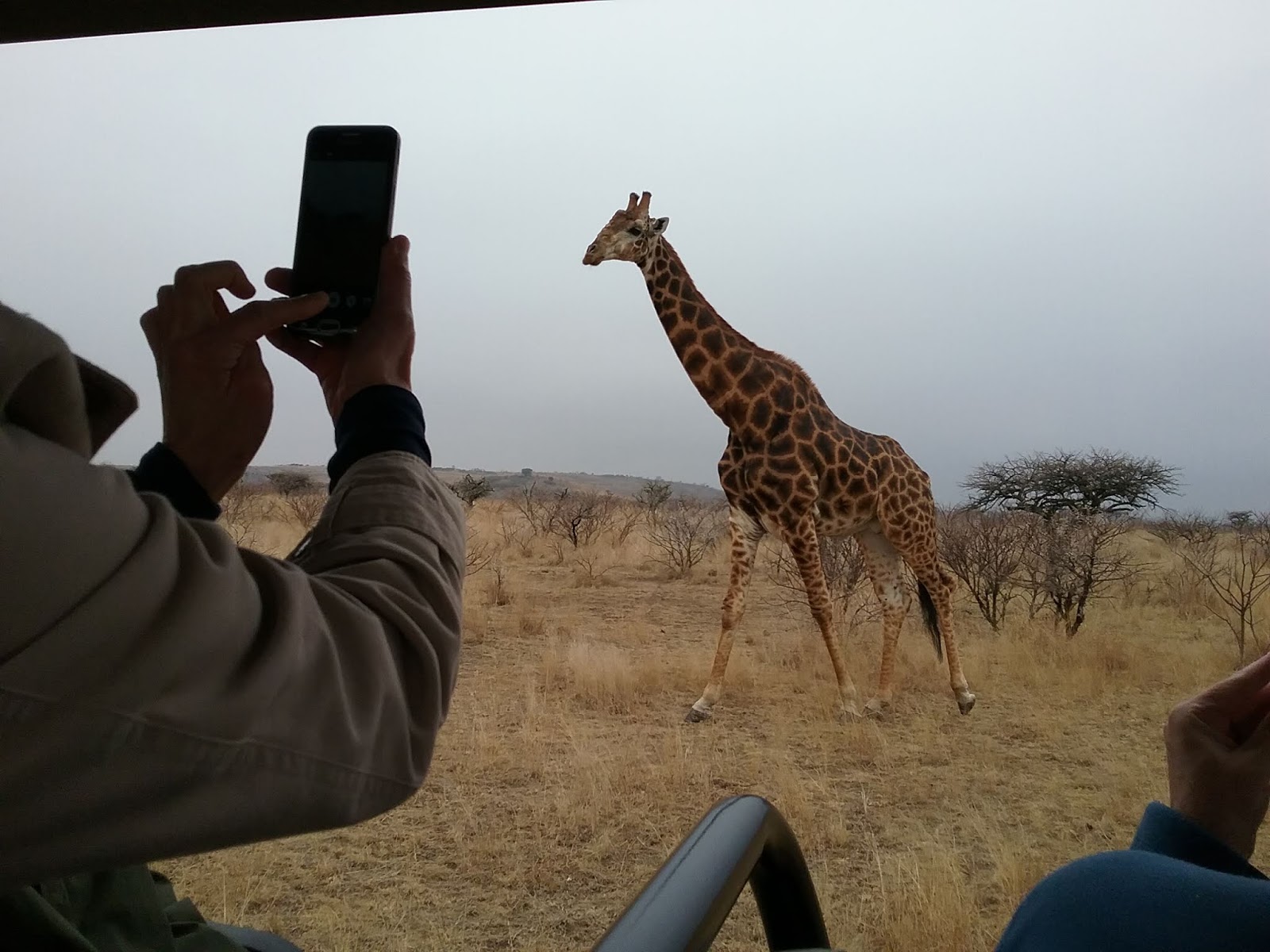
We spent three days in a game reserve at the Nambiti Hills Lodge that featured a schedule not unlike a monastery’s. We were awakened at 5 a.m. for “morning prayers”: coffee and snack before boarding an open-air Land Cruiser at 5:30 for a wild ride pilgrimage up and down hills and across plains as the sun rose, going to various points in the reserve where we were most likely to encounter animals, returning for breakfast at 9 a.m. “Vespers” began with tea and snacks at 3 p.m. followed by another safari that lasted till dinner at 8 p.m., featuring spectacular sunsets and a break for gin and tonics or wine.


Our “priest” for these services was “Biggie,” an experienced and informative and gregarious guide whose fearless approach to the animals matched his fearless driving over bumpy, winding, steeply descending and ascending dirt roads as we held on for dear life. We became kids again, enjoying the ride, while keeping our eyes peeled for wildlife. To Biggie’s credit, we never felt unsafe or in danger.


But there were moments when I felt nervous excitement—for instance, when an elephant came toward us, turning a one-lane road one-way, requiring us to back up as he lumbered toward us, not in attack mode but going about his daily business.


I have never been so close to giraffes, elephants, rhinos, hippos, impalas, wildebeests, springbok, wart hogs, ostriches, huge and little birds and more in their natural habitats. One morning we woke a sleeping herd of Cape (or African) buffalo on the road, prompting them to reluctantly rise and saunter out of our way as we inched forward.

Photo by Wade Jones

One outing, a tingle of dangerous pleasure came up my spine as a male lion and three female lions padded toward us and then right beside our stopped vehicle, as did three cheetahs a day or so later. There were no doors or windows or any barrier between us, and you will roll your eyes, but I thought at the time it was like a defenseless encounter with God, powerful enough to devour you yet docilely and peaceably passing by.


You can see why this became a vacation from words, and why they fail even now to capture the wonder we experienced.

A Cape Town art museum featuring African artists displayed this quote from Middlemarch by George Eliot:

If we had a keen vision and feeling of all ordinary life, it would be like hearing the grass grow and the squirrel’s heart beat, and we should die of that roar which lies on the other side of silence.

Grazing rhino.

Your donations are this blog’s only means of support. Please follow this link to make your gift: http://mccchurch.org/ministries/progressive-christian-reflections/
Be sure to scroll down to the donate link below its description. Thank you!

Text and photos copyright © 2018 by Chris R. Glaser. Permission granted for non-profit use with attribution of author and blogsite. Other rights reserved. 

Wednesday, July 12, 2017

Wonder

Luna enjoying our porch swing.

Others have come to the same conclusion, but in the sixty-six years that I have been given, I believe the essential ingredient of a spiritual life is wonder.

It can be found and expressed in many ways: worship, contemplation, compassion, activism, lovemaking, the beloved community, science, art, nature, and the recognition of the commonwealth of God, to name a few.

But the further away any of these get from wonder, they can become tablets of stone, stumbling blocks, millstones round our necks, a dutiful obligation rather than a pleasurable joy.

As I write this, Luna, our neighbor’s cat, is chasing something in our back yard. I have spent happy moments watching Luna from my home office windows as she approaches our yard with wonder, leaping up the tall, central Bradford pear tree, slinking beneath our hedge of privet shrubs, luxuriating in rubbing her back on our weedy grass.

Curious Luna looking through our back screen door.

From our front porch, I’ve enjoyed watching her go on morning walks with her family (yes, really!): a dog named Lexi, children with a literary and a biblical name, Darcy and Micah, their father Chris, a New Testament professor at Mercer University, and mother Jenelle, who is the organizing pastor of the newly-forming Ormewood Church.

Luna runs ahead and lingers behind, depending on what catches her attention in the moment. She exemplifies wonder. And I realize that we human beings know only a little more than she does about the nature of things.

The morning I write this, I greeted them again from our front porch during my prayers, after reading a couple of psalms and Matthew 18, which includes Jesus’ counsel to enter the kingdom as a child, remove their stumbling blocks, find the lost sheep, confront wrongdoing in yourself and in the community, and finally, forgive from the heart, even as we have been forgiven.
Luna helps me with my bulb garden.
Photo by Wade Jones

In silence I contemplated the very tall and old leafy trees before me, the tiny bird chirping on the railing, the runner going by, the found stones that line our gardens, only a little distracted by the passing cars, some of which take the stop sign at the intersection as a mere “suggestion.”

The week I write this, I awoke each morning to NPR reporting on various catastrophes, a high rise fire, several bombings and mass shootings, the investigation of the administration.

Despite all that, I found myself marveling (yes, I realize how antiquated the gerund) that all I saw before me, including me, has evolved.  What impetus organizes seemingly inert matter into living things, thinking beings, and seems to call for beauty and compassion and wonder?

Luna poking her nose under our grill cover.

A couple of days ago, I read how the liver regenerates itself daily as it carries out so many mysteries that ancients thought it was the seat of the soul.  And not long ago I read how disparate parts of the brain organize the various signals from our eyes into what we “see.”

No wonder the psalmist sang this morning, “The earth is full of the steadfast love of the Lord. By the word of the Lord the heavens were made, and all their host by the breath of God’s mouth” (33:5b-6).

“Breathe on me, breath of God,” sings the old hymn.  What a sensual yet spiritual request!

“The glory of God is the human being fully alive.”  This popular quote from Irenaeus of Lyons hangs in our hallway, written by the hand of the calligrapher who once graced Mt. Calvary Retreat House in the hills above Santa Barbara before its destruction in the 2008 Montecito fire.

From dust to dust, ashes to ashes, our brief flicker in between is a cause for wonder.


A post in which I describe the “impetus” mentioned above as an “oomph”:

Please support this blog ministry: 
Be sure to scroll down to the donate link below its description.

Or mail to MCC, P.O. Box 50488, Sarasota FL 34232 USA, designating “Progressive Christian Reflections” in the memo area of your check or money order. Thank you!

Copyright © 2017 by Chris R. Glaser. Permission granted for non-profit use with attribution of author and blogsite. Other rights reserved.