Showing posts with label Morning prayers. Show all posts

Wednesday, May 26, 2021

Mosquito Consciousness


As we approach mosquito season, I thought you’d enjoy this post from August 3, 2013, reflecting on a story in Paramahansa Yogananda’s Autobiography of a Yogi, a book I set aside when it became “too magical” for me but have recently picked up again and finished reading with greater appreciation. Incidentally, this is the only book Steve Jobs had on his iPad when he died, and those attending his memorial service received a copy of it at his request.

Sometimes my spiritual life is just plain spooky. 

The morning I write this, my morning prayers on the deck were interrupted by the presence of what I thought to be a mosquito. Now I am considered quite juicy in the mosquito community, unlike my partner Wade, who never needs to use insect repellant as I do to keep the little vampires at bay. And though I had administered that sacred ointment, I thought it possible a missed spot might be too inviting. My heavy New Jerusalem Bible came in handy and dropping it on the pest proved fatal. 

Yet I immediately felt regret taking a life. I’m one of those people who take spiders and other critters (roaches excepted) outside where they belong and liberate flies and wasps from entrapment between windows and screens if I can, though the latter I do at some risk, for a sting sent me to the emergency room a few years back, in an ambulance no less.  

Examining the remains on the back cover of my Bible, I was no longer certain it was a mosquito, and the best I could do was hope that I had sent it on to its next and hopefully better life! Before you think what a gentle and kind person I must be, all of this is a little disingenuous because I am by no means a vegetarian. But though I can eat meat, I could never kill the animal who provided it. 

As you will remember from an earlier post, I am reading Paramahansa Yogananda’s autobiography, and today he finally found his primary guru, Sri Yukteswar. And here’s where it gets spooky, or synchronicitous or miraculous if you like. In answer to his devotee’s concern about mosquitos, the guru tells him, “Is the whole world going to change for you? Change yourself: be rid of the mosquito consciousness.” 

During one teaching session, however, the teenage Yogananda is distracted by a mosquito and, as it proceeded to dig “a poisonous ‘hypodermic needle’” into his thigh, he raised a hand to swat it, but then remembered ahimsa (non-violence). Yuksteswar  offered a puzzling response, “Why didn’t you finish the job?” 

When asked if he agreed with taking a life, the master replied, “No, but in your mind you had already struck the deathblow.” He went on to say that ahimsa means removal of the desire to kill, then explains, “This world is inconveniently arranged for a literal practice of ahimsa. Man may be compelled to exterminate harmful creatures. He is not under a similar compulsion to feel anger or animosity,” thus “overcoming the passion of destruction.” 

Of course the context verifies that “harmful creatures” applies only to dangerous insects or threatening wild animals. Yet even in that context, one is best not driven by anger or animosity. Jesus said something like this when he added to the commandment “You shall not murder” the more far reaching “if you are angry with a brother or sister, you will be liable to judgment.” Or added simple lust to “You shall not commit adultery.” 

If only I could achieve mosquito consciousness, realizing that they too, in the words of Yukteswar, “have an equal right to the air of maya,” I could leave them be and save money on bug spray. Maybe in my next and better life!


Copyright © 2013 Chris R. Glaser. Permission granted for non-profit use with attribution of author and blogsite. Other rights reserved. 

Tax-deductible donations may be made safely to the “Chris Glaser Archive” through the Tribute Gift section of The Center for LGBTQ and Gender Studies in Religion. 

Personal gifts may be made safely by clicking hereThank you!


Wednesday, May 19, 2021

Free Time


Our neighbor Luna enjoying our bird bath.

Perhaps nothing sounds better on a schedule than “free time.” But it can be a source of anxiety for many—how will I fill up that time? Will I be bored? Will the moments be wasted? What am I to do? 

To be honest, though I have no problem spending leisure time with friends, when alone I have difficulty with leisure time. I like to work, I like to be constructive, I like to do things, I like to grow. But the idea of free time does sound luxurious. I love the popular song by Bruno Mars, “Today I Don’t Feel Like Doing Anything.” I wish I could live its ideal! 

In a video I use during my retreats on Henri Nouwen, Henri talks about how proud we are of being “busy, busy, busy,” buzzing these words like a bee! We brag about it to others, “Oh yes, I’m very busy.” I’ve met clergy who needed to go into detail about how busy they were to counter the misconception that they only work one hour per week! Henri describes our need to be “occupied,” or if not occupied, “preoccupied,” which he jokes as “occupying a space before you even get there”! 

This tension between work and idleness is why I begin my workday with morning prayers. There’s a lazy part of me that is attracted to a time when I don’t have to accomplish anything, and so this is a seductive way to begin my workday. Sure, I read various things during that time, but the goal is to spend time in reflection, meditation, and prayer. It can last anywhere from five minutes to two hours, depending on the day’s agenda. 

A counseling professor in seminary told of being assigned a child by the courts for therapy. Each visit, the kid said nothing, but wandered around the office looking at things in silence. In frustration, the professor told the child that he would ask the courts to assign another therapist. The child cried, “But I like coming here!” Astonished, the therapist asked why. “You’re the only adult who leaves me alone,” the child replied. 

Free time is perhaps the only time that leaves us alone. One possible origin of “scholar” is a word that means “leisure, rest, or free time.” Though most of us worked our way through various schools, we understand that luxury of having been students. I’ve never stopped being a student, though I did not go into academia as a vocation. And maybe that’s partly why I didn’t—I didn’t want my “free time” regulated, occupied, or preoccupied.


This post appeared September 4, 2013. Copyright © 2013 by Chris R. Glaser. Permission granted for non-profit use with attribution of author and blogsite. Other rights reserved. 

Tax-deductible donations may be made safely to the “Chris Glaser Archive” through the Tribute Gift section of The Center for LGBTQ and Gender Studies in Religion. 

Personal gifts may be made safely by clicking hereThank you!

Wednesday, November 20, 2019

Thanks Be to God for All Who Made You!

Mystery of Faith, Ruby Swinney, South Africa.

Earlier this month my sister and brother and I remembered the 80th anniversary of our parents’ wedding! It reminded me of my 2012 post, “The Making of You”  and its gratitude for ways my parents shaped my character, attitudes, compassion, and interests.

As we approach the American observance of Thanksgiving this year, it occurred to me to present again a part of that reflection to encourage you to consider all who shaped you. At the end I encourage your participation, inviting you to share on this blog the kinds of people who made you into who you are today.

Here’s the excerpt and invitation from the earlier post:

During my morning prayers I thanked my parents and I thanked God for their having me, caring for me, nurturing me, and encouraging my independence. In my book, The Final Deadline: What Death Has Taught Me about Life, I pointed out that, despite their deaths decades ago, they continue to teach me. Some new experience or wisdom will come my way, and the proverbial light bulb will go on over my head, “Oh, that’s what Mom meant! Or that’s what Dad felt!” Many readers recognized that experience in their own lives.

I used to send Mom flowers on my birthday, following the practice I learned from a friend. After all, she was the one who did the labor that made it possible!

On my own birthday last fall, I began thanking God for my parents, siblings, cousins, nephews, grandparents, aunts and uncles, Jesus, God, faith, and so on, and then I continued, thinking of all the people who had shaped me—lovers, friends, neighbors, church members, clergy, political leaders, communities, movements, environments, etc. A morning meditation became a day-long and then week-long reverie remembering all who touched my life in meaningful ways. The list became REALLY long when I began naming teachers! And then, authors!

I can never claim to be a self-made man, thanks be to God!

Who all made you?

[To respond, click on “comments” on the blogsite and you’ll be given options of methods for doing so. For those of you wary of safely registering with Google you may simply respond as “anonymous.” For subscribers who receive this post in your e-mailbox, you would need to go first to the November 20, 2019 post on the blogsite, www.chrisglaser.blogspot.com.]

This Sunday, November 24, 2019 I’ve been invited to speak to Atlanta’s First Existentialist Congregation (UU) in the nearby neighborhood of Candler Park on something preparatory of Thanksgiving, November 28. I chose as my topic “Considering Gratitude for Things that Don’t Make us ‘Feel’ Grateful,” suggesting the value of setbacks, failures, losses, and opposition in our lives. I will offer an excerpt of that talk as next week’s post the day before Thanksgiving, encouraging similar feedback.


The Amazon link for The Final Deadline:

Progressive Christian Reflections is entirely supported by reader donations. To support this blog: https://mccchurch.org/ministries/progressive-christian-reflections/
Scroll down to the donate link below its description. Thank you!

Copyright © 2012 and 2019 by Chris R. Glaser. All rights reserved. Permission granted for non-profit use with attribution of author and blogsite.

Wednesday, July 10, 2019

My Monastery

A recent selfie!

The day I write this, I realized during my morning prayers that they are my entrance to “my” monastic community. I put “my” in quotes because the community in which I’ve been blessed to participate has never been mine alone, but that of generations of Christians, Jews, Muslims, Buddhists, Hindus, Native peoples, Celtic peoples, and more—past, present, and future, from every people and culture.

And, in my heart, I join you who read this or who have read anything I’ve written, because you are a part of me as I am a part of you. And you too enjoy the same contemplative community whenever possible.

I guess this all began yesterday afternoon as I went through “Mom’s box” of my life’s souvenirs. Mom saved things that I had forgotten I had written and published, as well as articles about my work and announcements about presentations I had forgotten. And she included a file of my stuff labelled “Chris” in Dad’s handwriting, indicating he had done likewise.

Reading and writing words has been my way into a spiritual community vaster than I ever imagined when I was a child. And it has been my way into discovering a God grander than could ever be “captured” by mere words, even those of the Bible.

As happened this morning, my morning prayers are often a means of continuing conversion and more comprehensive understanding, providing continuity to my (and our) disparate experiences. I continue reflection begun several weeks ago on Benedictine John Main’s Letters from the Heart. He writes of the monastic experience:

More and more it will fulfill its prophetic role by living in the cities where the experience of community and of spirit are all but lost. There, in these modern deserts, it will bloom by the proof of the power of faith and absolute generosity to achieve the impossible in liberty of spirit. “Let the wilderness and thirsty land be glad; Let the desert rejoice and burst into flower” (Isaiah 35:1). [ p 75]

I thought of the Desert Fathers and Mothers, the early Christian monastics who went off into the wilderness to pray. Now we, in our own “deserts,” may hear the call to take what I call in my retreats “monastic moments,” opportunities to look inward, to listen to our own hearts, undistracted.

Of visitors to his monastery, Main writes,

They think they will find God in the terms they have imagined until then. But instead they first find themselves—recognized, known, and inexplicably loved. And because of that experience their expectations begin to change. They no longer seek a God of their own imagining. Instead, they begin to expand in the presence of the God they know to be beyond thought or image. [p 72]

And, he adds, “They now realize that God is seeking them. They must simply be still and allow themselves to be found.” [p 72-73]

We are called, Main says, to shape a community where others may also find their way, at the same time recognizing it is not “ours” but God’s. He correctly cites Bonhoeffer’s warning that an idealistic view of community leads only to disappointment, either in God, in others, or in oneself. The Rule of Saint Benedict describes the essence of Christian community as loving people as they are.


I will again be co-leading a 5-day contemplative retreat April 27-May 1, 2020 in Cullman, Alabama, through the Spiritual Formation Program of Columbia Theological Seminary. It is open to the public.

Progressive Christian Reflections is entirely supported by reader donations. To support this blog: https://mccchurch.org/ministries/progressive-christian-reflections/
Scroll down to the donate link below its description. Thank you!

Copyright © 2019 by Chris R. Glaser. Permission granted for non-profit use with attribution of author and blogsite. Other rights reserved.

Wednesday, February 20, 2019

Front Porches

Luna takes her "sabbaticals" on our porch
when her porch gets too busy.

Wade and I spend a lot of time on our front porch. We each have fond memories of front porches. As a child in Indiana, Wade used to sit with his paternal grandmother on her front porch, munching saltines topped with butter while watching cars and people pass by. My Kansas relatives would apologize that there was nothing to do in their small town, but, as a youth, I loved just sitting on their front porch reading. “Nothing to do” was an invitation to enjoy the quiet, to relax.

My family porch in California was not large enough for chairs or a swing, but Mom used to enjoy sitting on its concrete steps, and that’s how I often remember her as I left for my own homes, whether in New Haven, Philadelphia, West Hollywood, or Atlanta. And it was there that a non-English speaking Asian neighbor left a vase of flowers on the day of her funeral, twenty years ago this week, in memory of their friendship around their gardens.

Wade and I recently had stonework put on our front porch columns followed by new handrails. Wade said it made it look like a new house. The skillful Mexican stone mason’s name is Javier, a variation of Xavier, which, I found in my friend Cleve Evans’ Unusual & Most Popular Baby Names, comes from a Basque word that means “new house”!

Historically, I’ve been told, front porches served to keep neighbors in touch. We too enjoy seeing the kids going to and from school, greeting neighbors walking their dogs (or, in the case of our pastor’s family two houses down from us, their dog and their cat, Luna, who follows along), watching runners and walkers, bicyclists and those riding the trendy scooters filling Atlanta neighborhoods.

Porches seem to be a particularly Southern thing, and so it seemed natural for our new church start, Ormewood Church, to organize “porch groups.” And, in worship, we sit in clusters as we might do on a porch, to facilitate discussion of the question for the day. Btw, I’ll be guest preaching there this Sunday.

I sometimes do my morning prayers on the porch, with coffee of course, and almost every late afternoon Wade or I find ourselves reading or watching something on our tablets, sipping wine and munching chips or crackers. We welcome the occasional neighbor or friend who might join us, most likely on weekends.

What surprises us is that more people don’t use their front porches. Nearby is a very toney neighborhood with fabulous and sometimes wrap-around porches, but when we walk that way, it feels like a ghost town. Maybe they have to work harder and longer to afford their pricey homes. I suggest this as a possible reality, not a critique.

Just as we apply what we learn in school or church or on the job to the rest of our lives, what we learn on our front porches may be helpful as we encounter people and pets elsewhere. Relax. Recreate. Remember. Reach out. Invite. Welcome. Listen. Pay attention. Appreciate our environment. Lift others in prayer. And thank God.

Our front porch, Winter 2019.

Please hold the United Methodist Church in your prayers as it meets in St. Louis this week to discern "The Way Forward" regarding the full welcome of LGBT Christians!

Progressive Christian Reflections is entirely supported by reader donations. To support this blog: http://mccchurch.org/ministries/progressive-christian-reflections/
Scroll down to the donate link below its description. Thank you!

Copyright © 2019 by Chris R. Glaser. Permission granted for non-profit use with attribution of author and blogsite. Other rights reserved.

Wednesday, September 12, 2018

The Lion God


Nothing says a vacation is over like a spider bite immediately upon arriving home, a new nest of stinging bees to address, a tire blowout, a lingering case of jet lag after a 15-hour nonstop, and fresh reports of a White House in disarray.

One after-effect of our three-week trip though South Africa is that Wade forgot his work password and had to go into the office to reset it. He noted that’s the sign of a good vacation! Then he had to deal with 600 emails, despite his “away” response message.


Our South African friends, Elize and Andre, helped Wade arrange the many details of our trip and traveled with us the first two weeks. They are Afrikaners and twins. Elize lives in Pretoria and Andre lives in Atlanta, a bi-national whose encounter with a nativist rant at one of our local grocery stores was recorded in an earlier post.

Wade, Andre, Elize, and me. 
Photo taken by our guide, Biggie.

I brought along the recently released Prison Letters of Nelson Mandela and an unlikely companion book, The Tao of Physics. But I found myself wanting to take a vacation from words, so I only occasionally read them, and I wrote nothing.

Even my prayers sometimes needed to be abbreviated because of our early morning jaunts, and I found praying for “all those we hold dear in our hearts” sufficient and the Lord’s Prayer well-summarized in “thy kingdom come, thy will be done.”

Now I’m finding it a challenge to get back up on the writing horse, partly because I am still absorbing what I saw and experienced, both in South Africa’s natural surroundings and its cultural/historical story. I hope to unravel my complex impressions in the next few posts.

Wade's photos on Instagram are far better than mine!

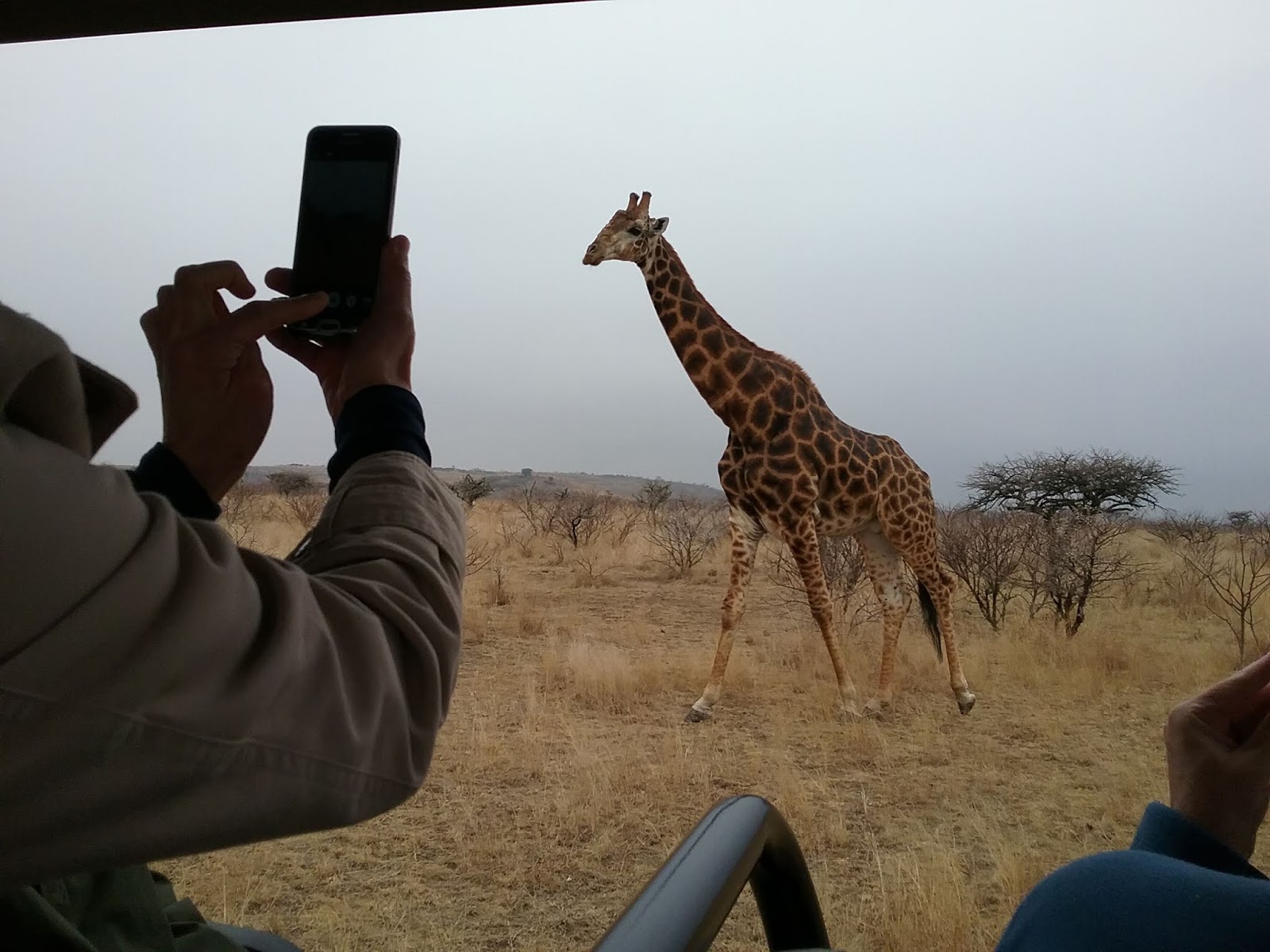
We spent three days in a game reserve at the Nambiti Hills Lodge that featured a schedule not unlike a monastery’s. We were awakened at 5 a.m. for “morning prayers”: coffee and snack before boarding an open-air Land Cruiser at 5:30 for a wild ride pilgrimage up and down hills and across plains as the sun rose, going to various points in the reserve where we were most likely to encounter animals, returning for breakfast at 9 a.m. “Vespers” began with tea and snacks at 3 p.m. followed by another safari that lasted till dinner at 8 p.m., featuring spectacular sunsets and a break for gin and tonics or wine.


Our “priest” for these services was “Biggie,” an experienced and informative and gregarious guide whose fearless approach to the animals matched his fearless driving over bumpy, winding, steeply descending and ascending dirt roads as we held on for dear life. We became kids again, enjoying the ride, while keeping our eyes peeled for wildlife. To Biggie’s credit, we never felt unsafe or in danger.


But there were moments when I felt nervous excitement—for instance, when an elephant came toward us, turning a one-lane road one-way, requiring us to back up as he lumbered toward us, not in attack mode but going about his daily business.


I have never been so close to giraffes, elephants, rhinos, hippos, impalas, wildebeests, springbok, wart hogs, ostriches, huge and little birds and more in their natural habitats. One morning we woke a sleeping herd of Cape (or African) buffalo on the road, prompting them to reluctantly rise and saunter out of our way as we inched forward.

Photo by Wade Jones

One outing, a tingle of dangerous pleasure came up my spine as a male lion and three female lions padded toward us and then right beside our stopped vehicle, as did three cheetahs a day or so later. There were no doors or windows or any barrier between us, and you will roll your eyes, but I thought at the time it was like a defenseless encounter with God, powerful enough to devour you yet docilely and peaceably passing by.


You can see why this became a vacation from words, and why they fail even now to capture the wonder we experienced.

A Cape Town art museum featuring African artists displayed this quote from Middlemarch by George Eliot:

If we had a keen vision and feeling of all ordinary life, it would be like hearing the grass grow and the squirrel’s heart beat, and we should die of that roar which lies on the other side of silence.

Grazing rhino.

Your donations are this blog’s only means of support. Please follow this link to make your gift: http://mccchurch.org/ministries/progressive-christian-reflections/
Be sure to scroll down to the donate link below its description. Thank you!

Text and photos copyright © 2018 by Chris R. Glaser. Permission granted for non-profit use with attribution of author and blogsite. Other rights reserved. 

Wednesday, August 30, 2017

The Butterfly Effect

Partial view from our deck.

Those familiar with chaos theory may be thinking that’s what this post is about: how something so small as the flutter of a butterfly in one part of the world may cause dire weather elsewhere. This was a metaphor used in a paper by Edward N. Lorenz for the notion that one slight event can affect a complex system. Chaos theory was the theme of one issue when I edited Open Hands. (Click on the highlighted phrase and scroll down to my opening essay. Note designer Jan Graves’ creative arrangement of the columns.)

But if the flutter of a butterfly may have disastrous results, a butterfly that is still can have peaceful effects.

I learned that the morning I write this during my reading and prayers on our deck, which blessedly looks out at a ravine verdant with shrubs, kudzu, and very tall, leafy trees on either side of a narrow creek.

A small butterfly or large moth landed on the other side of an arm of a wooden chair beside me. I saw it land, but had to peer over an edge of the arm to see the tips of its wings and large round eyes. Otherwise it was hidden. I liked that it made no difference if it was a moth or a butterfly for its effect on me.

The motionless creature prompted me to remain still, lest I scare it away. (Wade has noted how still I can remain in bed at night, even when I lie awake, my brain going at full speed. Sometimes I silently do the verbal part of my morning prayers, which may return me to a peaceful sleep.)

My lack of movement gave me opportunities to observe:

+the gently creeping fingertips of light on the leaves of trees as the sun rose;
+the flicker of moisture in the mulch beneath the bird bath, then the rare drops that created it dripping from a crack in its basin;
+Luna the cat hanging on to the top of a neighbor’s fence while batting away at something on a shrub;
+a majestic hawk flying overhead in the blue sky, wings spread wide;
+the humid and warm stillness of air suddenly becoming a gentle, cooling breeze;
+the wisps of clouds moving swiftly above me;
+the unusual hush of the cicadas.

My very long pause seemed a proper preparation for resuming my reading of Thomas Merton’s Mystics and Zen Masters, which I referenced three weeks ago. I began by re-reading phrases and sentences I had underlined the previous day, and decided to share them in this post, as I did when I wrote of reading the mystical Cloud of Unknowing, leaving the reader to relate it to your own experience.

Merton describes the Tao Te Ching written by the mystic Lao Tzu. What follows are Merton’s words; but words in quotes are from the Tao.  I’ve made the language inclusive, but their relevance stands on its own:

+ The sage and the wise ruler are those who do not rush forward to aggrandize themselves, but cherish, with loving concern, the sacred reality of persons and things which have been entrusted to them by the Tao.

+ In the Tao, “which is queer like nothing on earth,” are found three treasures: mercy, frugality, and not wanting to be first in the world.

+One of its most astute sayings is that in a war the winner is likely to be the side that enters the war with the most sorrow. “To rejoice over a victory is to rejoice over the slaughter of others… Every victory is a funeral.”

+ “Heaven arms with love / Those it would not see destroyed.”

+ One “reaches” the Tao by “becoming like” the Tao, by acting, in some sense, according to the “way” (Tao). For the Tao is at once perfect activity and perfect rest.

+ The way of the Tao is…the way of supreme spontaneity, which is virtuous in a transcendent sense because it “does not strive.”

+ As soon as a human being becomes aware of doing good and avoiding evil, he or she is no longer perfectly good.

+ For Lao Tzu, if one were to be righteous, that one should first of all fly all thought of righteousness, and put out of one’s mind any ideal image of oneself as a “righteous person.”

+ The way of the sage is the way of not-attacking, not charging at one’s objective, not busying oneself too intently about one’s goals.

+ Taoism is not complete non-action but rather non-activism. It is supreme activity, because it acts at rest, acts without effort. Its effortlessness is not a matter of inertia, but of harmony with the hidden power that drives the planets and the cosmos.

As Merton understands the Tao, it is neither quietistic nor a doctrine but a “wisdom” and a “way of life.” He concludes of the West, “It is absolutely essential to introduce into our study of the humanities a dimension of wisdom oriented to contemplation as well as to wise action.”

Reflecting on these words underlined yesterday, I felt no need to go on to the next chapter of the book. The butterfly was still there; I was there, still. 

I pulled out my phone to take a picture of the butterfly for you, the reader of this intended post, but the moment I stood, it flew away.

Its flutter may wreak havoc elsewhere, but its rest had kept me in the tranquil eye of the storm.


Please support this blog ministry: 
Be sure to scroll down to the donate link below its description.

Or mail to MCC, P.O. Box 50488, Sarasota FL 34232 USA, designating “Progressive Christian Reflections” in the memo area of your check or money order. Thank you!

Copyright © 2017 by Chris R. Glaser. Permission granted for non-profit use with attribution of author and blogsite. Other rights reserved.  

Wednesday, September 7, 2016

A Flower's Tears


I had just read a quote from landscape artist Thomas Cole: “Nature has spread for us a rich and delightful banquet. Shall we turn from it? We are still in Eden; the wall that shuts us out of the garden is our own ignorance and folly.”

A woman on public radio announced Beethoven’s Pastoral Sonata, #15.

Then I heard something drop. I looked up from my tablet and realized the bouquet of flowers in front of me was losing petals. The before-dawn early morning was so quiet I could hear a petal fall.

This prompted me to compose this poem: 
A flower’s tears
are the dewdrops
that drip, orb by orb,
as sun rises.
A flower’s tears
are the raindrops
that stream, string by string,
as storms rage.
A flower’s tears
are the petals
that drop, one by one,
as life renews.
I was sitting at our dining room table, a very solid oak sturdy-legged altar that once served as Wade’s grandfather’s butcher block. Long before we met, Wade had painstakingly sanded (and sanded) and refinished this table that seats four and can be extended by way of built-in leaves for eight  just as comfortably. On all five windows of the pentagonal room hang patterned stained-glass, framed in various shapes in wood whose peeling white trim contrasted with the colors of their homes that no longer stand.

The morning I write this, I rose so early that my usual place for morning prayers was too dark to read, so I chose this alternate sanctuary.

And then I read: “Henri taught me that the characteristics I had identified with religion are just the outer circle. What really matters is a fundamental attitude of seeking to do something that is valuable to yourself and to the world.” Henri Nouwen’s nephew Marc van Campen wrote this in Befriending Life: Encounters with Henri Nouwen.

Moved by awe at this magical moment, I thanked God that life is filled with such opportunities to experience the world “as if for the first time” and then to express that mystery in writing, in art, in service.

“Nature has spread for us a rich and delightful banquet. Shall we turn from it? We are still in Eden; the wall that shuts us out of the garden is our own ignorance and folly.”


A post for the 15th anniversary of 9/11 on Sunday: 9/11: When We Were One

Donations to this blog ministry may be given by clicking here and scrolling down to the donate link below its description or by mailing to MCC, P.O. Box 50488, Sarasota FL 34232 USA, designating “Progressive Christian Reflections” in the memo area of your check or money order. Thank you!

Copyright © 2016 by Chris R. Glaser. Permission granted for non-profit use with attribution of author and blogsite. Other rights reserved.  

Wednesday, January 8, 2014

Word Magic

The morning that I write this, I woke early thinking of how I would shape my talk on Henri Nouwen in Seattle this coming Friday. Some of my best ideas come to me in the middle of the night or early in the morning. Then it occurred to me that a friend, J. Marshall Jenkins, and the Dalai Lama were downstairs awaiting me for morning prayers. As I sometimes do, I got up at 5 a.m. to enjoy an entire hour alone with them, my thoughts, and hopefully with God. With coffee, of course.

It pleasantly reminded me of my visits to Mt. Calvary Retreat House in Santa Barbara, arising in the darkness, picking up a cup of coffee in the coffee room, and finding a nook or cranny or outside space to think, read, or pray—a memory reinforced when our dog came downstairs and I took her out for her morning necessaries and I saw a bright full moon and a handful of visible planets and stars—a contrast to the abundance of planets and stars in the night sky over Santa Barbara, but wondrous nonetheless. I picked up The New York Times in our driveway, remembering today was Science day, being a Tuesday, with its special science section.

And I realized my thrill—no doubt partly induced by my half-decaf coffee—was due to the magic of words. Thinking of Nouwen’s words and how my words might characterize them; anticipating Marshall’s words in his book, A Wakeful Faith: Spiritual Practice in the Real World, with which I’ve been doing a kind of lectio divina for a number of weeks, and my newly acquired book by his holiness the Dalai Lama, The Universe in a Single Atom: The Convergence of Science and Spirituality, experiencing both challenges and agreement in each; looking forward to reading the morning paper; and finally, eager to sit here writing this post and soon my Nouwen lecture.

I was so giddy by the time I concluded with the Lord’s prayer, I could hardly contain myself!  Those of you who are not morning people may be rolling your eyes right now, and believe me, I do restrain myself when Wade comes down for breakfast before going off to the office.

As if to sober me up, I happened onto a review of a novel by Bruce Wagner, who last year wrote of the “depravity” of Los Angeles in Dead Stars, and now apparently finds among “Buddhists, gurus and spiritual pilgrims” similar “narcissism, self-aggrandizement and the ravenous appetite for fame and renown” in The Empty Chair.

I gave myself up to a moment of self-doubt about why I write this blog, and in my younger years, this might have stopped me cold. But older, I have realized that everything we/I do is prompted partly by ego—how we view ourselves and how we think other people view us—and our need to be heard. In fact, one entry in psychologist and pastoral counselor Marshall Jenkins’s book confirms this: “What we think others think of us—or what we think they would think of us if they really knew us—shapes our self-concept.”

Too many of us are derailed by the snarky and sometimes jealous comments of others, those Henri Nouwen describes as trying to hook you in your wounds “to dismiss what God, through you, is saying to them.”

For me, the magic of words is that they engage me in a community of many voices, some uplifting and affirming, some challenging and humbling, even when I am alone.


Related post:

Progressive Christian Reflections is an authorized Emerging Ministry of MCC supported solely by readers. Please click here to make a tax-deductible donation. Thank you!

Copyright © 2014 by Chris R. Glaser. Permission granted for non-profit use with attribution of author and blogsite. Other rights reserved. Check out past posts in the right rail on the blogsite. Consider using a post or quotes in personal reflection, worship, newsletters, and classes, referencing the blog address when possible: http://chrisglaser.blogspot.com.

Wednesday, September 11, 2013

"All Theology Is a Kind of Birthday"

All theology is a kind of birthday
Each one who is born
Comes into the world as a question
For which old answers
Are not sufficient. 
Maybe you will do what I did when I read this first stanza of Thomas Merton’s “Untitled Poem.” Like a puzzling koan, it focuses my mind, causing me to read it again and again to glean its meanings before proceeding to the additional pages of the poem. Perhaps you too will stop at the words above, and that’s okay, because they’re much more profound than what I can offer.

Thomas Merton and Mary Oliver and the apostle Paul have joined me of late for morning prayers. I’ve read at least nine of Merton’s books, but this is my first exposure to his poetry. I’ve read occasional Oliver poems, but not a lifetime collection. I’m reading them for a Columbia Seminary Spiritual Formation weekend course on Christian Poetry and the Christian Journey: Illumination and Mysticism in Blake, Hopkins, Merton, Levertov, and Oliver that I will be attending later this month.

And I’m reading Paul because I created morning and evening prayers for the program’s recent Spiritual Immersion course, and the professor discussing New Testament spirituality suggested using liturgical elements from Colossians and Philippians, and that got me started again on Paul.

Though Tom and Mary seem to inhabit the same countryside, bringing Tom, Mary, and Paul into dialogue is only possible, perhaps, in meditation. All can be inscrutable (at least to me), and all can create golden one-liners and inspiring spiritual metaphors. Mary has always seemed free to me, borrowing from nature as much or more than from tradition, but Tom and Paul came to their freedom later in life.

Tom’s freedom makes his later poetry more accessible to me, his spirituality broader and more welcoming. Paul’s freedom makes his spirituality soar beyond the confines of his own traditional religion, and I better realize why the mystical Christ seems so important to him—a mythologized Christ helped him bust free from his religious rigidity.

My own experience is the opposite of Paul’s: I needed to bust free from the religious rigidity of a mythologized Christ sacrificed for sins to reclaim the life and teachings and belovedness of Jesus. “For freedom Christ has set us free.” Paul’s words about Christ are also true for me about Jesus. Yet at the same time, I do love Paul’s understandings of our unity with Christ and our spiritual community as Christ’s body, indivisible by condition or culture, sharing burdens and joys with one another, and sharing Christ’s spiritual inheritance as God’s children.

Mary Oliver best captures what I hope from life in these words from her poems “When Death Comes” and “October”: 
When it’s over, I want to say: all my life
I was a bride married to amazement.
I was the bridegroom, taking the world into my arms.

When it’s over, I don’t want to wonder
if I have made of my life something particular, and real.
I don’t want to find myself sighing and frightened,
or full of argument.

I don’t want to end up simply having visited the world.

Look, I want to love this world
as though it’s the last chance I’m ever going to get
to be alive
and know it.


Posts about 9/11 in the U.S. on today’s anniversary:

A post about Chile on today’s 40th anniversary of their 9/11 coup in 1973:

Progressive Christian Reflections is an authorized Emerging Ministry of MCC. Your donations by mail or credit card are its only means of support, click here. Thank you!

Copyright © 2013 by Chris R. Glaser. Permission granted for non-profit use with attribution of author and blogsite. Other rights reserved. Check out past posts in the right rail on the blogsite. Consider using a post or quotes in personal reflection, worship, newsletters, and classes, referencing the blog address when possible: http://chrisglaser.blogspot.com

Wednesday, August 7, 2013

Mosquito Consciousness

[Last week's post misled some readers that I was moving from Atlanta, so I added "a few years ago" to the first line.]

Sometimes my spiritual life is just plain spooky.

The morning I write this, my morning prayers on the deck were interrupted by the presence of what I thought to be a mosquito. Now I am considered quite juicy in the mosquito community, unlike my partner Wade, who never needs to use insect repellant as I do to keep the little vampires at bay. And though I had administered that sacred ointment, I thought it possible a missed spot might be too inviting. My heavy New Jerusalem Bible came in handy and dropping it on the pest proved fatal.

Yet I immediately felt regret taking a life. I’m one of those people who take spiders and other critters (roaches excepted) outside where they belong and liberate flies and wasps from entrapment between windows and screens if I can, though the latter I do at some risk, for a sting sent me to the emergency room a few years back, in an ambulance no less. 

Examining the remains on the back cover of my Bible, I was no longer certain it was a mosquito, and the best I could do was hope that I had sent it on to its next and hopefully better life! Before you think what a gentle and kind person I must be, all of this is a little disingenuous because I am by no means a vegetarian. But though I can eat meat, I could never kill the animal who provided it.

As you will remember from an earlier post, I am reading Paramahansa Yogananda’s autobiography, and today he finally found his primary guru, Sri Yukteswar. And here’s where it gets spooky, or synchronicitous or miraculous if you like. In answer to his devotee’s concern about mosquitos, the guru tells him, “Is the whole world going to change for you? Change yourself: be rid of the mosquito consciousness.”

During one teaching session, however, the teenage Yogananda is distracted by a mosquito and, as it proceeded to dig “a poisonous ‘hypodermic needle’” into his thigh, he raised a hand to swat it, but then remembered ahimsa (non-violence). Yuksteswar  offered a puzzling response, “Why didn’t you finish the job?”

When asked if he agreed with taking a life, the master replied, “No, but in your mind you had already struck the deathblow.” He went on to say that ahimsa means removal of the desire to kill, then explains, “This world is inconveniently arranged for a literal practice of ahimsa. Man may be compelled to exterminate harmful creatures. He is not under a similar compulsion to feel anger or animosity,” thus “overcoming the passion of destruction.”

Of course the context verifies that “harmful creatures” applies only to dangerous insects or threatening wild animals. Yet even in that context, one is best not driven by anger or animosity. Jesus said something like this when he added to the commandment “You shall not murder” the more far reaching “if you are angry with a brother or sister, you will be liable to judgment.” Or added simple lust to “You shall not commit adultery.”

If only I could achieve mosquito consciousness, realizing that they too, in the words of Yukteswar, “have an equal right to the air of maya,” I could leave them be and save money on bug spray. Maybe in my next and better life!


Progressive Christian Reflections is an authorized Emerging Ministry of MCC supported only by readers. To make a tax-deductible donation by check or credit card, please click here. Thank you!

Related posts:

Copyright © 2013 by Chris R. Glaser. Permission granted for non-profit use with attribution of author and blogsite. Other rights reserved. Check out past posts in the right rail on the blogsite. Consider using a post or quotes in personal reflection, worship, newsletters, and classes, referencing the blog address when possible: http://chrisglaser.blogspot.com