Showing posts with label Jenelle Holmes. Show all posts

Wednesday, June 30, 2021

The Inner Light

Celebrating a gay couple's wedding in Florida
a few years ago.

A beloved transgender member of Ormewood Church, formerly a member of Ormewood Park Presbyterian Church, died unexpectedly last week, and, in addition to her own outstanding “Message of Hope” about this longtime member, our pastor Jenelle requested me to offer a brief reflection on her life based on our shared love of Star Trek during her memorial service this past Sunday afternoon. Afterward, her lifelong spouse gave me a beautiful Star Trek t-shirt commemorating its various incarnations over 55 years, 1966-2021. 

In recent weeks I had tossed about various ideas for my final post on this blog. Should I re-post an earlier blog about LGBT Pride for this Pride Month or write something new? I’ve decided that this reflection is a fitting way to end this ten-year-long blog. 

Star Trek, The Next Generation, was one of my binge-watched series during the pandemic, and one episode in particular stood out, entitled, “The Inner Light.” For those who want to watch it on Netflix, it is episode 25 of season 5. I had talked with Jenelle about it at the time, and I discovered lots of other people liked it too, receiving awards. 

The episode is simply described: “Picard awakens to find himself in a village where he is a well-known member of the community suffering from a delusion of being a starship captain.” I watched it again to prepare. 

I have come to think of Star Trek as a kind of “biblical stories of the future.” They often relate to something going on in the present, offering meaning and values and purpose, just as the Bible does. 

Spoiler alert, but what occurs in this episode is that the current Enterprise has happened upon an unoccupied alien spacecraft that sends a beam of memory into Captain Picard’s head, causing him to faint, unconscious for half an hour. But during that brief period, Picard realizes a whole lifetime on another planet. No one in his village believes him to be a starship captain, no one affirms his own “inner light,” thus the reason he is considered under a delusion. 

Instead he is recognized as a community leader and scientist who tackles his host planet’s own form of global warming, an unrelenting drought. He is married and has children, and we watch them grow from infancy to adulthood, as Picard and his wife age, and as Picard finally learns to play the flute. 

He eventually finds a solution to the planetary drought and offers it to his community leaders. Come to find out, their own scientists had figured out the same solution, but the local leaders (read “politicians”) refuse to make the hard choice to put it into practice, for fear of the average citizen. Again, his own “inner light,” his own “aha,” is rejected. 

The beam directed into Jean Luc Picard’s inner consciousness is the way the people of this now destroyed planet have finally told their story, perhaps as a warning for those of other planets. The people of the planet have been gone for a thousand years, but their history and their lives have been preserved and now communicated. Their inner light has become Picard’s (and our own) inner light. The parallel with scriptures and sacred texts of every faith handed down to us is clear, at least to me. 

What really moves me about this story is that this is what I experience in every death, including our beloved church member. With every death, we lose a vital (as in “life-giving”) story about ourselves, about life, about the universe, about the nature of things. We will miss their “inner light.” 

I will miss her grin, cheerfulness, intelligence, wit, and welcome. I will miss her story, her own inner light. Surely it was a reflection of the very nature and nobility of God. 

Some outside our welcoming community of Ormewood Church may have written off as delusion her inner light. But she came to understand something about herself, her gender experience and expression, and I would say, something about all of us and about all of our gender expressions. 

Her inner light has brightened our world on her journey into the inner light of God. To quote the opening of Star Trek episodes: “Space, the final frontier…[our] mission is to explore strange new worlds, to seek out new life and new civilizations, to boldly go where no one has gone before.” 

Hallelujah! Amen! Thanks be to God!


Please visit my website: https://chrisglaser.com  

Though this is my final post, more than ten years of posts remain available to you on the blogsite, https://chrisglaser.blogspot.com and I encourage you to enjoy them. I regret that I never created an index of post titles, but the search engine in the upper left corner of my blog can help you find posts of interest by typing in a subject, topic, name, scripture reference, religious season or holy day. Or you may work through them by year and month listed in the right column. 

Comments are still welcome on any post. 

Though they may have been written with current events in mind, I intended them each to be read meaningfully at any point in time. It has been a pleasure writing this blog, but now, I believe, is a time for silence, something I considered when writing the Zen series. 

I assure you I am well, content, and thankful to God for this extension of my ministry. Thank you for your interest, comments, correspondence, and contributions. I am grateful to Metropolitan Community Churches for recognizing this blog as an “Emerging Ministry” and ProgressiveChristianity.org for reposting many of my reflections, as well as the dozens of Facebook pages that allowed me to provide links to particular posts. I am grateful for the free services of Blogspot, Google, Facebook, and the delivery service, FeedBurner. I am grateful for artist and friend Becki Jayne Harrelson and my husband Wade Jones for their technical and moral support. 

To date, the blog has had 512,500 visits, a count that does not include 500 free weekly subscribers. Subscriptions have always been free and the blog non-monetized (no ads). Permission is granted for non-profit use with attribution of author and blogsite. 

Donations may still be made through the links provided at the end of this post. Thank you! 

Copyright © 2021 Chris R. Glaser. Permission granted for non-profit use with attribution of author and blogsite. Other rights reserved. 

Tax-deductible donations may be made safely to the “Chris Glaser Archive” through the Tribute Gift section of The Center for LGBTQ and Gender Studies in Religion. 

Personal gifts may be made safely by clicking here.  Thank you!


Wednesday, December 16, 2020

Go Toward the Dark

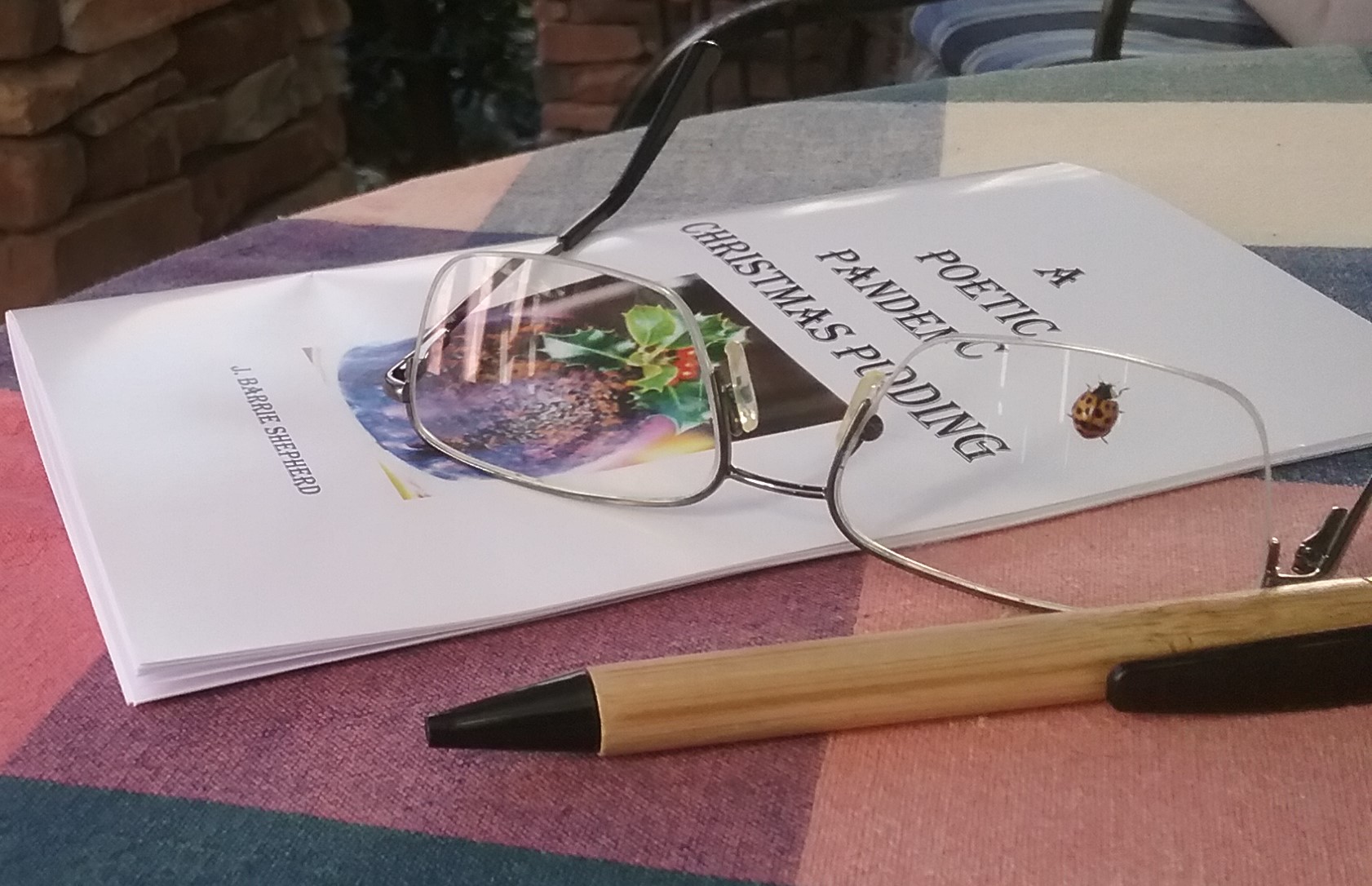
Ladybug season again at our place. 
This one crawled along the book, the pen and then my glasses.

Spiritual gurus admonish us to “go toward the light,” and especially in this winter season of a pandemic, that seems preferable to wallowing in darkness. But a line in a poem entitled “Lux et Veritas” in J. Barrie Shepherd’s latest chapbook, A Poetic Pandemic Christmas Pudding, reminds me of the vitality of darkness.

Contrasting our light displays during this season with the humble lighting of Jesus’ stable cave that allowed “the clear radiance that streamed above, around, beyond that battered-blessed manger,” poet and pastor Shepherd recalls introducing his first granddaughter to “the black-velvet-spread celestial of The Milky Way” “one sparkling island night in Maine”:

Her sheer astonishment made clear that we must

claim our darkness too, if we would glimpse

the glory of the elemental light.

Sunday over Zoom, Ormewood Church had a glimpse of the glory that may come when we “claim our darkness too.” Preaching on Mary’s Magnificat, Rev. Jenelle Holmes shared a recent dark moment in her life and offered her own “Magnificat,” and she has graciously allowed me to share it with you: 

My soul deepens and broadens the Lord’s presence and my spirit rejoices with God who saves me each and every day. God has looked with eyes of mercy on me, when some in the world have looked on me with disdain. God has seen the ways I am held back by others and has handed me support. People call me blessed because God has walked with me on hard roads of rejection, depression and anxiety and anger, and God has carried me through. God’s name is holy and God is a holy space for me. When I could have turned around and cursed God, I took God’s presence seriously and God has honored that with a strong arm of confidence and love.  

Those who wish me harm through rejection or fear or ignorance, God has dealt with in the privacy of their hearts. Those who have sought to harm me by using their voices of privilege, even in the church and in my family, God has shouted over them that I am loved and that I am who I was created to be.  

And as I look to my neighbors who are without homes, I have seen God’s people provide shelter. As I look to my neighbors who have lost their jobs, I have seen God’s people write checks. As I look to my neighbors who are lonely and isolated, I have seen God’s presence ignite ideas and rhythms of faith. As I look to my neighbors who have experienced one setback after another, I have seen God provide one day after another.  

And the rich, the powerful, the ignorant: God will show them the emptiness of their greed. They will be hungry for the good work of God.  

And as I think of how God helped ancient Israel escape Pharaoh, how God has helped the barren experience new life and the dead come back to life, and the marginalized be handed a voice, I remember God’s mercy forever, in every generation, even my own, even in 2020. My soul magnifies the Lord and my spirit rejoices with God who saves me each and every day.                                                                                    –Rev. Jenelle Holmes

Having lived in a metaphoric dark closet during my childhood and youth as a gay kid, I knew where the light was—it was outside my protective, defensive, even necessary shell. The glory of God and my own glory lay beyond my captive, seductive defenses and others’ captive, destructive offenses. Remember Jung’s suggestion that religion is a kind of defense against God? My closet—my and others’ rigid conceptions of God—kept me from God’s glory. 

My most recent “aha” about who God is, is that God is the glory at the climax of the prayer Jesus taught us: “For thine is the kingdom and the power and the glory.” That glory is unknowable but visible in the infinite wonders of the universe, in myriad forms of life, and in human compassion and imagination. This is the prophet Isaiah’s “light that shines in darkness.” It is the “shekinah” of Yahweh’s divine presence. It is the glory that brightened Moses’ face and lifted Mary’s soul, as well as our own souls through Immanuel, God-with-us.

I pray this glory for you as you approach this Christmas: 

God bless you and keep you;

God make God’s face to shine upon you,

and be gracious to you;

God lift up God’s countenance upon you,

            and give you peace.  Numbers 6:24-26

Then we may attend to this summons in another of Barrie’s poems, “The Coming of the Light”: “Look deep into this gentle fire, and then go forth to bear it, far and tender, to wherever infants, cold and frightened, tremble in the dark with no bright star, no kings to greet.”


For your own copy of poet and pastor J. Barrie Shepherd’s holiday chapbook: A Poetic Pandemic Christmas Pudding, please send a check to J. Barrie Shepherd at 15 Piper Road – K325, Scarborough ME 04074. Copies will be signed and can be inscribed by request. Or order though his email: barrieshep@aol.com. $10 per copy plus $2 postage. Proceeds go to food pantries in his area of Maine.

Donations to Progressive Christian Reflections may be given safely by clicking here and scrolling down to the donate link below its description. Thank you!

Contemporary Magnificat © 2020 by Rev. Jenelle Holmes, used by permission. 

Copyright © 2020 by Chris R. Glaser. Permission granted for non-profit use with attribution of author and blogsite. Other rights reserved.  


Wednesday, October 21, 2020

God and the Emperor

Congressman John Lewis quote and mug shot on our street.

This is a guest post from our pastor, the Rev. Jenelle Holmes, from her sermon of October 18, 2020 to Ormewood Church over Zoom. Used by permission.

Then the Pharisees plotted to entrap Jesus in what he said. So they sent their disciples to him, along with the Herodians, [asking] “Is it lawful to pay taxes to the emperor, or not?”  (See full text, Matthew 25:15-22, NRSV.)

As we inch closer to the election, any scripture that mentions anything political is bound to hit harder. This particular story about Jesus has been used as a political defense throughout history. It’s been used to defend a separation of church and state: give to the emperor, king, or president what is theirs and to God what is God’s. It’s been used to bolster the defense of high taxation when people start to grumble. It’s been used to support the argument that Christians must submit to the powers of government, just like they submit to the powers of God.

As you can tell—it is truly a very useful story for people in power.

However, before you use this passage in these ways you need to know exactly what was going on between the Herodians, the Pharisees, and Jesus.

This story in the book of Matthew happens in the dead center of Holy Week. Jesus has entered Jerusalem triumphantly on a donkey, thrown out the money changers, and offered some radical teachings that challenge those in power. All of this is leading up to the Friday of Jesus’ crucifixion. In the meantime, the religious leaders are closing in on Jesus.

And the identity of the different leaders play a really important role in understanding Jesus’ words. The Pharisees must be really desperate to get rid of Jesus because they are partnering with the Herodians, their enemies. The Pharisees are religious rule followers. They want to do their religion correctly. The Herodians, on the other hand, are the region’s ruling people for the Roman empire and have been known to make Jewish rule-following tough.

Case in point: the Jewish folks do not want to own, use, or touch the denarius coin used for the tax to Caesar. This coin not only has a graven image on it (a religious no-no), it also reads “Caesar is the son of God.” Well, the tax that the Herodians collect is exactly one denarius--so the Jewish folks HAVE to touch them.

And now the ambush. After a little false flattery the Pharisees ask Jesus a trick question: Tell us, then, what you think. Is it lawful to pay taxes to the emperor, or not?

Trick question. First, revisit what you now know about the denarius. If Jesus says yes, we should pay the tax, the Jews would feel betrayed by Jesus. They would claim Jesus is siding with the empire that forces them to break their religious laws. But if Jesus says that Jews should not pay the tax because of religious reasons, he is a traitor to the empire and in very deep trouble with the Herodians.

It’s a trick question. The answers of yes or no will land him in hot water either way.

But Jesus musters a rather clever response: Show me the coin used for the tax.” And they brought him a denarius. Then he said to them, “Whose head is this, and whose title?” They answered, “The emperor’s.” Then he said to them, “Give therefore to the emperor the things that are the emperor’s, and to God the things that are God’s.”

Now, to the non-Jewish listener, this is a decent and satisfactory answer. The emperor gets his money and the people get their God. The Herodians most likely see this as a compromise between the state and the church, a binary of sorts that suits them just fine.

But, to the first-century Jewish listener, especially a Pharisee, there would have been no binary in this answer. Jesus answered this question in just as tricky a way as it was asked. Jesus’ final statement is “to God the things that are God’s.” Do you know what the Bible says are “God’s things?” ALL OF IT.

In fact, Psalm 24, which was used at the entrance to the temple, starts like this: The earth is the Lord’s and all that is in it, the world, and those who live in it. No Pharisee would have missed Jesus’ meaning when he says we should “Give to God the things that are God’s.” All things are God’s--even that denarius.

So while the Herodians see a nice division of labor in Jesus’ response, so too do the Pharisees see his play on words and cannot condemn him.

All things are God’s things.

And for us in 2020 this offers some insight and perhaps comfort.

In a political time like ours, where it’s easy to see people dividing up their lives based on power and political party, it is all the more important to remember that all that we have and all that we are, are ultimately to live in and grow out of the love of God. There is no binary where Christians get to divide some of our priorities to the state and some to God. That type of quarantine does not exist.

As my friend Rev. Dr. Richard Floyd says, “we only give to Caesar what can be done as a faithful service to God.” We only give to our government, to our communities, what can be done as a faithful service to God. God is our first loyalty and our first calling. In what is perhaps our most momentous and divisive election in the history of our nation, we as Christians are called to only give to Caesar what can be done as a faithful service to God. There is no part of our lives that can be lived outside of the scope of God’s reign. All things are God’s things.

And while saying that all things are God’s things is an exhortation to live a certain way, it is also a declaration of comfort. It is a declaration that God’s love knows no bounds. The Heidelberg Catechism proclaimed this comfort long ago: What is your only comfort in life and death? That I am not my own, but belong with body and soul, both in life and in death, to my faithful Saviour Jesus Christ.

When you feel pulled in different directions, disappointed in the loyalties of others or maybe even yourself, when you are exhausted by all the graven images being tossed around, know that in the end you can rest in the comfort that your life belongs to God. The loyalties on earth cannot tear you apart, you are made whole and wholly made by and for God.


Copyright © 2020 by Rev. Jenelle Holmes. Permission granted for non-profit use with attribution of author, venue (Ormewood Church, Atlanta) and blogsite. Other rights reserved.

Click here to safely make a donation to Ormewood Church.

Donations to Progressive Christian Reflections may be given safely by clicking here and scrolling down to the donate link below its description. Thank you! 


Wednesday, March 4, 2020

Our "Spiritual Universe"


As happened last week, I am writing this the day before posting it, a rarity. Usually I have several days or weeks to write and review (and review again) a post. Despite my occasional despair at the large empty spaces that I experience in retirement, I still find that life is often full, and this week served as an example.

This past Sunday, with others from what is now Ormewood Church, I attended a brief and informal graveside service commemorating the life of Rev. Peter Denlea, the one-time pastor of our predecessor Ormewood Park Presbyterian Church. It was organized by one of his sons, Colin, also a pastor, at Georgia National Cemetery to which Peter’s first vocation as a Navy bomber pilot gave him access. I wondered if the cemetery rules (above photo) really permitted a spirit as expansive as Peter’s, given its prohibition of “boisterous actions”! Later this month, his boisterous spirit will be celebrated at a wake in our neighborhood, where he once lived at the end of our block.

With a similar group from Ormewood Church the next day, I attended the celebration of the life and legacy of Judge Elaine L. Carlisle at Cascade United Methodist Church in Atlanta, a member of Ormewood Park Presbyterian Church who lived three houses uphill from us. The largely African American church was packed with fellow judges and lawyers, the City of Atlanta Police Honor Guard, and sister members of Delta Sigma Theta Sorority. Mayor Keisha Lance Bottoms also attended.

Our pastor, Rev. Jenelle Holmes, offered moving and meaningful prayers at each service.

And synchronicity strikes again as, at both services, we sang “How Great Thou Art.”

I lost it each time we sang it. Remember, I mentioned last week that I had been viewing the mind-boggling 2007 series The Universe, now available on Netflix. I had just finished watching the final episode, so these words by Stuart K. Hine particularly moved me:

O Lord my God, when I in awesome wonder
Consider all the worlds Thy hands have made,
I see the stars, I hear the rolling thunder,
Thy power throughout the universe displayed.
Then sings my soul, my Savior God to Thee:
How great Thou art, how great Thou art!

I’m losing it again as I type these words. They take me back to my childhood faith, which included Billy Graham evangelical meetings featuring George Beverly Shea boisterously singing this hymn. As the song affirms, I want to believe that Peter, who lived longer than I have, and Elaine, whose life was cut shorter than mine by an as-yet-unexplained traffic accident, have been “taken home.”

Former Mayor and later Ambassador Andrew J. Young, who appointed Judge Carlisle to the bench, offered “Words of Comfort” to us. His storytelling gifts as an elder preacher and politician served us all well, bringing smiles and laughter, including one tender story about his affectionate but mistaken greeting of Elaine’s twin sister in the airport of Gary, Indiana, their hometown!

But then something he said comforted me very personally in the midst of my “lost in space” doubts. He said that now Elaine was part of our “spiritual universe,” the commonwealth of God. A spiritual universe is no more unimaginable to me than the physical universe.


I was invited to be among the contributors to Ashes to Rainbows: A Queer Lenten Devotional that includes meditations for Ash Wednesday, the Sundays of Lent, and the days of Holy Week. Go to: https://justiceunbound.org/queerlent/

You may support this blog by clicking here. Please scroll down to the donate link below its description. Thank you!

Copyright © 2020 by Chris R. Glaser. Permission granted for non-profit use with attribution of author and blogsite. Other rights reserved.  “How Great Thou Art” copyright © 1953 by S. K. Hine, renewed 1981 by Manna Music, Inc. All rights reserved.

I will be co-leading “Beside Still Waters: A Contemplative Retreat” with Debra Weir April 27-May 1, 2020 at Sacred Heart Monastery in Cullman, Alabama. It is open to the public, and some limited scholarships are available. Three readable texts are recommended to prepare but are not required to have been read by opening day. Here is the link: https://app.certain.com/profile/form/index.cfm?PKformID=0x3039640abcd


Wednesday, July 3, 2019

Children of Stonewall--and the Kingdom!

Our group at Creative Camp.

This past Sunday I stumbled offering the Moment for Mindfulness at Ormewood Church about the 50th anniversary of the Stonewall uprising. I had originally planned to do it from notes, but decided to write it out so I would say precisely what I intended briefly. But I momentarily lost my place, I guess because I rarely do public speaking these days.

But I did get in my thought that the several-day-and-night 1969 resistance of drag queens, people of color and LGBT folk to the harassing bar raids of New York City police officers served as a “foundational myth” of our present-day movement. As such, it’s been useful for political and, I’d say, spiritual organizing and mobilization.

Yet our contemporary movement did not begin there. In the U.S., it began long before when Phyllis Lyon and Del Martin founded the Daughters of Bilitis in 1955, a lesbian activist group. It began in 1964 with the foundation of the Council on Religion and the Homosexual in San Francisco. It began nine months before Stonewall when the Rev. Troy Perry and 12 brave souls founded Metropolitan Community Church in 1968. It began with the work of people like Bayard Rustin, Christine Jorgensen, Barbara Gittings, Frank Kameny, and many more, as well as multiple social, political, and religious groups building an activist base. This is true in other nations as well.

All resistance movements, however, can trace their roots to ancient times, to yes, even biblical times. Our pastor, Jenelle Holmes, gave an artful sermon on Rizpah’s resistance, protecting the bodies of her dead sons (2 Samuel 3:7; 21:1-14), drawing parallels to Matthew Shepard’s mother, Judy Shepard, creating a foundation that helped pass hate crimes legislation, Emmett Till’s mother, Mamie Till, insisting on an open coffin so the world could see his battered body, lynched after he was falsely accused of flirting with a white woman, and last week’s photograph of a drowned Salvadoran migrant, Oscar Alberto Martínez Ramírez and his 23-month-old daughter, Angie Valeria, on the shores of the Rio Grande River.


I can’t recall Jenelle “losing it” in a sermon, but tears came as she approached its final page. And she wasn’t the only one. She turned it into an occasion for lament, and instead of our usual small group discussions, provided three holy spaces for our responses: one with candles to light for lives lost to injustice, another with prayers for justice we could read silently to God, and one for writing cards to legislators expressing our grief for lives lost in our country due to injustice. Many visited more than one of the three stations.

A few weeks ago, we held a “Creative Camp,” Ormewood Church’s version of Vacation Bible School, for our own and our neighbors’ children. I helped with the 2-4-year-olds, all boys, and I saw where notions of “Original Sin” as well as “Original Innocence” came from! Yet I was moved by their willingness to buy into the program, so to speak, though our most prolonged conversation was about farts, ha!

The experience no doubt prepared me to be moved, at the end of the service honoring the ripples of Rizpah’s resistance, when Jenelle’s nine-year old daughter, Darcy, presented me with the artwork to the right, depicting my partner and me. I learned later she had done the same for a lesbian couple in the congregation, Ceej and Cathie. I lost it. Tears of grief, of gratitude, of hope.


 She represents for me the children of Stonewall and more broadly, the children of the Kingdom of God.

Progressive Christian Reflections is entirely supported by reader donations. To support this blog: https://mccchurch.org/ministries/progressive-christian-reflections/   Scroll down to the donate link below its description. Thank you!

Copyright © 2019 by Chris R. Glaser. Permission granted for non-profit use with attribution of author and blogsite. Other rights reserved.

Wednesday, July 25, 2018

Wade's Mezuzah


As you might expect, our home is filled with religious artifacts accumulated over the years, most gifts from thoughtful friends. Like many Christian clergy, I have my share of Communion chalices and bread plates, crosses and icons, most of which live in my home office.

I work on a small desk adorned with a colorful Latin American altar cloth on which a Sacred Heart of Jesus sacramental lies beside my laptop and the Hindu god Ganesha, the Remover of Obstacles, sits nearby to solve computer issues.

Two clay Muslim men in kaftans embrace on top of my bookshelves, and Arabic phrases from the Quran beautifully illustrate two round metal plates hanging in another room. A ceramic tile from Israel welcomes visitors before entering our kitchen with the word Shalom in Hebrew.  

Upstairs a Christ Pantocrator placidly blesses an African goddess dancing above a Balinese mask and a Pharaoh judgment scene on papyrus. All are facing a handwoven Tree of Life across the room above our bed.

Well, you get the picture.

But never have I ever thought of having a mezuzah, despite my deep respect for the tradition.

Wade saw it at a booth during the Dogwood Festival here in Atlanta, a booth featuring the delicate art of Israeli artists from Brooklyn. Stavit Allweis and Nachshon Pelig are graduates of the Bezalel Academy of Art and Design in Jerusalem.

Wade appreciates its spiritual meaning, but more so its aesthetic appeal. It didn’t even cross his mind that, because we’re not Jewish, it might not be “kosher”! So, he purchased it, after carrying on a meaningful conversation with the handsome vendor, one of the artists.

When we came home from the festival we showed it to Jenelle Holmes, our pastor two doors down, and she asked us if we could do a “show and tell” about it as our moment of mindfulness the following day at Ormewood Church. We went online to prepare.

Mezuzah is Hebrew for “doorpost.” It contains Hebrew verses from the Torah, Deuteronomy 6:4-9 and 11:13-21, the first of which begins, “Hear, O Israel, the Lord our God, the Lord is one. You shall love the Lord your God with all your heart, and with all your soul, and with all your might.” The passage ends urging that we write these words on the doorpost of our house.

A mezuzah is traditionally hung on the right side of the door and—I especially love this as good Jewish compromise—tilted because early practitioners differed as to whether to hang it vertically or horizontally.

But Wade wanted it mounted vertically on the more prominent left side of the door, and so, apologies to Yahweh for being loosey-goosey progressive Christians, that’s where it is. We followed the tradition of reciting this blessing in Hebrew as we held it against the spot it was to be placed: “Blessed are You, Lord our God, King of the Universe, Who sanctified us with Your mitzvot (Law) and commanded us to affix a mezuzah.”

I always knew that summer-long intensive in Hebrew would come in handy.

You might think this an imperialistic appropriation of a spiritual practice of another culture and religion, but if you saw Wade’s innocent delight and wonder you may excuse us.

And I enjoy the practice of touching the mezuzah as I enter our home, remembering that the Lord our God is one, and that we are to love God with all our heart, soul, and might.

This post has a follow-up: It’s a Wonderful Life

Your donations are this blog’s only means of support. Please follow this link to make your gift: http://mccchurch.org/ministries/progressive-christian-reflections/
Be sure to scroll down to the donate link below its description. Thank you!

Copyright © 2018 by Chris R. Glaser. Permission granted for non-profit use with attribution of author and blogsite. Other rights reserved.  

Wednesday, May 30, 2018

Invisible Means of Support


Years ago, a Japanese steamship for the first time went up the great Amazon river in South America. It was a long voyage, and they ran out of drinking water. Fortunately a British ship came by. The Japanese ship asked them by signal, “Have you drinking water to spare?” They signaled back, “Put your buckets down into the water, if you please.” The surprised Japanese crew did as instructed, and sure enough, it was drinking water. For the Japanese crew who were used to seeing small rivers in Japan, the River Amazon was too big for them to recognize as a river. They thought they were still in the ocean. Aren’t we, without realizing it, making such mistakes every day? 
—A Flower Does Not Talk: Zen Essays by Abbot Zenkei Shibayama, 93-94. 
This story reminds me of an exchange between the journalist Bill Moyers and the mythologist Joseph Campbell in The Power of Myth. After Campbell confirms his experience of “hidden hands” helping him when he is “following [his] bliss,” Moyers asks, “Have you ever had sympathy for the man who has no invisible means of support?”

Campbell replies, “Who has no invisible means? Yes, he is the one that evokes compassion, the poor chap. To see him stumbling around when all the waters of life are right there really evokes one’s pity.”

“The waters of eternal life are right there? Where?” Moyers asks.

“Wherever you are—if you are following your bliss, you are enjoying that refreshment, that life within you, all the time,” Campbell answers.

In both stories, that of the ship’s crew and that of the person who has no invisible means of support, the waters of life are right under their noses—the first in potable water and the second in metaphorical waters of life, both potentially salvific. Both needed guides to help them see this.

The Moyers-Campbell exchange occurs in their conversation about the idea of bliss in Sanskrit, which Campbell regarded as “the great spiritual language of the world.” He explains:
There are three terms that represent the brink, the jumping-off place to the ocean of transcendence: Sat, Chit, Ananda. The word “Sat” means being. “Chit” means consciousness. “Ananda” means bliss or rapture. I thought, “I don’t know whether my consciousness is proper consciousness or not; I don’t know whether what I know of my being is my proper being or not; but I do know where my rapture is. So let me hang on to rapture, and that will bring me both my consciousness and my being” (p 120, The Power of Myth).
Shibayama writes that Zen Master Hakuin taught that we mistakenly try to look outside ourselves for Enlightenment, for Buddhahood:

Like water and ice,
There is no ice apart from water;
There are no Buddhas apart from beings.

Shibayama explains further, “If it is really like the relationship of ice and water, then we are Buddhas as we are. So he goes on to say, ‘It is like those who, being in water, cry out for water, feeling thirst.’” What follows is the story about the Japanese ship on the Amazon.

The organizing pastor of Ormewood Church, the Rev. Jenelle Holmes, gave an intriguing sermon during Eastertide about Simon Peter plunging into the Sea of Galilee when he realized a risen Jesus had just told them where to drop their nets for their big and only catch of the day, and awaited them on the shore with a meal prepared.

As I was still anxious about plunging into co-leading a weeklong contemplative retreat, I told Jenelle that her sermon really helped me. I needed to just plunge in the waters and trust that I would find Jesus on the shore, in the midst of those attending, in the silence that would surround us. After all, we had titled the retreat, “Beside Still Waters.”

I didn’t realize it at the time, but I was following my bliss and relying on my invisible means of support, as were all who came on the retreat.

Frederick Buechner clarifies the nature of bliss for many of us: “The place God calls you to is the place where your deep gladness and the world’s deep hunger meet.”


Find out how you can support this blog—thank you!
Be sure to scroll down to the donate link below its description.

Copyright © 2018 by Chris R. Glaser. Permission granted for non-profit use with attribution of author and blogsite. Other rights reserved.