Showing posts with label Gay. Show all posts

Wednesday, June 30, 2021

The Inner Light

Celebrating a gay couple's wedding in Florida
a few years ago.

A beloved transgender member of Ormewood Church, formerly a member of Ormewood Park Presbyterian Church, died unexpectedly last week, and, in addition to her own outstanding “Message of Hope” about this longtime member, our pastor Jenelle requested me to offer a brief reflection on her life based on our shared love of Star Trek during her memorial service this past Sunday afternoon. Afterward, her lifelong spouse gave me a beautiful Star Trek t-shirt commemorating its various incarnations over 55 years, 1966-2021. 

In recent weeks I had tossed about various ideas for my final post on this blog. Should I re-post an earlier blog about LGBT Pride for this Pride Month or write something new? I’ve decided that this reflection is a fitting way to end this ten-year-long blog. 

Star Trek, The Next Generation, was one of my binge-watched series during the pandemic, and one episode in particular stood out, entitled, “The Inner Light.” For those who want to watch it on Netflix, it is episode 25 of season 5. I had talked with Jenelle about it at the time, and I discovered lots of other people liked it too, receiving awards. 

The episode is simply described: “Picard awakens to find himself in a village where he is a well-known member of the community suffering from a delusion of being a starship captain.” I watched it again to prepare. 

I have come to think of Star Trek as a kind of “biblical stories of the future.” They often relate to something going on in the present, offering meaning and values and purpose, just as the Bible does. 

Spoiler alert, but what occurs in this episode is that the current Enterprise has happened upon an unoccupied alien spacecraft that sends a beam of memory into Captain Picard’s head, causing him to faint, unconscious for half an hour. But during that brief period, Picard realizes a whole lifetime on another planet. No one in his village believes him to be a starship captain, no one affirms his own “inner light,” thus the reason he is considered under a delusion. 

Instead he is recognized as a community leader and scientist who tackles his host planet’s own form of global warming, an unrelenting drought. He is married and has children, and we watch them grow from infancy to adulthood, as Picard and his wife age, and as Picard finally learns to play the flute. 

He eventually finds a solution to the planetary drought and offers it to his community leaders. Come to find out, their own scientists had figured out the same solution, but the local leaders (read “politicians”) refuse to make the hard choice to put it into practice, for fear of the average citizen. Again, his own “inner light,” his own “aha,” is rejected. 

The beam directed into Jean Luc Picard’s inner consciousness is the way the people of this now destroyed planet have finally told their story, perhaps as a warning for those of other planets. The people of the planet have been gone for a thousand years, but their history and their lives have been preserved and now communicated. Their inner light has become Picard’s (and our own) inner light. The parallel with scriptures and sacred texts of every faith handed down to us is clear, at least to me. 

What really moves me about this story is that this is what I experience in every death, including our beloved church member. With every death, we lose a vital (as in “life-giving”) story about ourselves, about life, about the universe, about the nature of things. We will miss their “inner light.” 

I will miss her grin, cheerfulness, intelligence, wit, and welcome. I will miss her story, her own inner light. Surely it was a reflection of the very nature and nobility of God. 

Some outside our welcoming community of Ormewood Church may have written off as delusion her inner light. But she came to understand something about herself, her gender experience and expression, and I would say, something about all of us and about all of our gender expressions. 

Her inner light has brightened our world on her journey into the inner light of God. To quote the opening of Star Trek episodes: “Space, the final frontier…[our] mission is to explore strange new worlds, to seek out new life and new civilizations, to boldly go where no one has gone before.” 

Hallelujah! Amen! Thanks be to God!


Please visit my website: https://chrisglaser.com  

Though this is my final post, more than ten years of posts remain available to you on the blogsite, https://chrisglaser.blogspot.com and I encourage you to enjoy them. I regret that I never created an index of post titles, but the search engine in the upper left corner of my blog can help you find posts of interest by typing in a subject, topic, name, scripture reference, religious season or holy day. Or you may work through them by year and month listed in the right column. 

Comments are still welcome on any post. 

Though they may have been written with current events in mind, I intended them each to be read meaningfully at any point in time. It has been a pleasure writing this blog, but now, I believe, is a time for silence, something I considered when writing the Zen series. 

I assure you I am well, content, and thankful to God for this extension of my ministry. Thank you for your interest, comments, correspondence, and contributions. I am grateful to Metropolitan Community Churches for recognizing this blog as an “Emerging Ministry” and ProgressiveChristianity.org for reposting many of my reflections, as well as the dozens of Facebook pages that allowed me to provide links to particular posts. I am grateful for the free services of Blogspot, Google, Facebook, and the delivery service, FeedBurner. I am grateful for artist and friend Becki Jayne Harrelson and my husband Wade Jones for their technical and moral support. 

To date, the blog has had 512,500 visits, a count that does not include 500 free weekly subscribers. Subscriptions have always been free and the blog non-monetized (no ads). Permission is granted for non-profit use with attribution of author and blogsite. 

Donations may still be made through the links provided at the end of this post. Thank you! 

Copyright © 2021 Chris R. Glaser. Permission granted for non-profit use with attribution of author and blogsite. Other rights reserved. 

Tax-deductible donations may be made safely to the “Chris Glaser Archive” through the Tribute Gift section of The Center for LGBTQ and Gender Studies in Religion. 

Personal gifts may be made safely by clicking here.  Thank you!


Wednesday, June 23, 2021

At Most a Lighthouse Can Beam an Instant

A friend caught my surprise when the congregation
applauded my ordination at Christ Covenant MCC, October 2, 2005.

I miss a custom I created for myself when living in Southern California. New Year’s Eve parties left me wanting some more meaningful way of observing the passing of an old year and the welcome of a new year. I did not want to “pray in” the new year as we did in my Baptist church with us kids keeping one eye open to see the sanctuary clock silently clap its hands together on the number 12. 

But the ticking of a clock or the descent of a ball in Times Square felt artificial, so I began watching the sun set as I walked along the beach in Santa Monica every New Year’s Eve. I would spend the time revisiting the events of the past year and imagining what the new year might bring, thanking God for the good and the bad as well as the possibilities. It was something I could do alone, well before the parties. And it felt more natural. 

This bit of shoreline is the sanctuary where, in college, I ruminated on my sexuality, spirituality, and call to ministry. This is where I thought I’d like to be reincarnated as a seagull so I could stay near the shore and see my friends on the beach occasionally! This is where I stumbled onto a gay meeting place long before I knew about gay bars. This is where, on a day off from my church work, I would do a long run and work out on the outdoor gymnastic bars. 

This is a walk I’ve shared with many friends, including some of you, and others you might know, such as John Boswell, Isabel Rogers, and Malcolm Boyd. This is the walk that Henri Nouwen declined, insisting instead that we sit down on my sofa and “have a really good talk”! 

This is where I walked weekly on Thursday evenings with a partner to share whatever was on our minds and hearts. This is where we walked one Easter after worship, ending up at Christopher Isherwood and Don Bachardy’s hangout, the S. S. Friendship, bumping into an old friend there whose partner we learned had died the previous week, who gave me the Easter message I needed to hear, “He died in my arms. I felt him leave his body. That’s why I’m sure I’ll see him again.” 

This is where I took my mom and her dog for her last walk along the shore a few weeks before she died, where she mischievously chose an ice cream cone over lunch. And this is where at least some of my ashes will be scattered. 

Though I live far from that shore now, I go there often. 

There is no lighthouse there, but in college I composed this poem using the metaphor, which feels all the more apt in later life: 


            To Be the Sea 

The sea beside, I stand alone,

By seasons, wait and search

To be discovered and to discover

In boundless quest.

The sea has all at any time—

No search nor wait.


At most a lighthouse

Can beam an instant

Before bowing to the sea.


This post originally appeared as “New Year” on January 1, 2014.

Please visit my website: https://chrisglaser.com  

My final post on my blog “Progressive Christian Reflections” will occur next Wednesday, June 30, 2021. More than ten years of posts will remain available to you on the blogsite, https://chrisglaser.blogspot.com and I encourage you to enjoy them. I regret that I never created an index of post titles, but the search engine in the upper left corner of my blog can help you find posts of interest by typing in a subject, topic, name, scripture reference, religious season or holy day. Or you may work through them by year and month listed in the right column. 

Though they may have been written with current events in mind, I intended them each to be read meaningfully at any point in time. You may continue to contact me at my email address used by the delivery service or by leaving a comment on a particular post. FeedBurner has announced it will discontinue all subscription services sometime in July, the occasion for my timing. It has been a pleasure writing this blog, but now, I believe, is a time for silence, something I considered when writing the Zen series. 

I assure you I am well, content, and thankful to God for this extension of my ministry. Thank you for your interest, comments, correspondence, and contributions. I am grateful to Metropolitan Community Churches for recognizing this blog as an “Emerging Ministry” and ProgressiveChristianity.org for reposting many of my reflections, as well as the dozens of Facebook pages that allowed me to provide links to particular posts. I am grateful for the free services of Blogspot, Google, Facebook, and the delivery service, FeedBurner. I am grateful for artist and friend Becki Jayne Harrelson and my husband Wade Jones for their technical and moral support. 

To date, the blog has had 512,000 visits, a count that does not include almost 500 free weekly subscribers. Once donations were possible, the highest annual income ever was $2,000. Subscriptions have always been free and the blog non-monetized (no ads). Permission has always been granted for non-profit use with attribution of author and blogsite. Donations may still be made through the links provided at the end of this post. Thank you! 

Copyright © 2014 Chris R. Glaser. Permission granted for non-profit use with attribution of author and blogsite. Other rights reserved. 

Tax-deductible donations may be made safely to the “Chris Glaser Archive” through the Tribute Gift section of The Center for LGBTQ and Gender Studies in Religion. 

Personal gifts may be made safely by clicking here.  Thank you!

Wednesday, June 2, 2021

Where Your Treasure Is

Chris at Kirkridge. Photo taken by Brendan Fay.

 “Master, you are wonderful! You have renounced riches and comforts to seek God and   teach us wisdom!” 

“You are reversing the case!” The saint’s face held a mild rebuke. “I have left a few paltry rupees, a few petty pleasures, for a cosmic empire of endless bliss. How then have I denied myself anything? I know the joy of sharing the treasure. Is that a sacrifice? The shortsighted worldly folk are verily the real renunciants! They relinquish an unparalleled divine possession for a poor handful of earthly toys! … The world is full of uneasy believers in an outward security.” 

I chuckled over this paradoxical view of renunciation—one that puts the cap of Croesus on any saintly beggar, whilst transforming all proud millionaires into unconscious martyrs. 

Paramahansa Yogananda tells this story about Bhaduri Mahasaya on page 63 of his Autobiography of a Yogi (1946) that I am presently reading. In a previous post I referred to Yogananda as founder of the Self Realization Fellowship whose grounds in southern California I frequented in college. While the supernatural experiences of Eastern tradition reported in this book are hard for this Westerner to believe, the philosophy is persuasive and powerful. 

While I have not attained the saint’s dispassion toward rupees and “earthly toys,” many if not most of my colleagues in ministry will identify with the saint’s preference for the spiritual life. To whatever degree we have “gone without,” given the culture’s greater monetary valuing of other professions, we have realized our greater dependency on spiritual treasure—the satisfaction of pastoral care, of preaching and writing, of attending to matters of the heart and soul rather than simply to matter and materialism. 

A church member once told me that she was well into adulthood before she understood that ministers were paid! And I’ve met people who think spiritual leaders should do what they do for the sheer joy of it, unlike other vocations. 

“Worldly people do not like the candor that shatters their delusions,” Bhaduri Mahasaya explained to Yogananda. The gurus Yogananda writes about receive rupees in their slippers from followers. And though I am not a guru, I am grateful that a few of my readers have put rupees in my slippers! 

When I was ordained by MCC in 2005 after a professional lifetime denied ordination by the Presbyterian Church simply because I’m gay, I chose for the Gospel lesson Jesus’ words on God’s Providence from the Sermon on the Mount, which reads in part, “Do not worry about your life, what you will eat or what you will drink, or about your body, what you will wear. Is not life more than food, and the body more than clothing? Look at the birds of the air; they neither sow nor reap nor gather into barns, and yet your heavenly [Creator] feeds them.” It is the scripture that gets me through the tough times when I do not rise to the level of a saint’s disposition!

This post was published July 24, 2013. 

Copyright © 2013 Chris R. Glaser. Permission granted for non-profit use with attribution of author and blogsite. Other rights reserved. 

Tax-deductible donations may be made safely to the “Chris Glaser Archive” through the Tribute Gift section of The Center for LGBTQ and Gender Studies in Religion. 

Personal gifts may be made safely by clicking here.  Thank you!


Wednesday, April 14, 2021

A Healing Touch


As our pandemic makes us all “untouchables,” I thought this post of June 13, 2018, might “touch” our experience. 

As I get older, I have fewer opportunities to be touched. I knew that about old age even before I got there, and that’s why I’m sitting so close to my mother in the above photograph, my arm around her. I had noticed the need particularly among the older women of our neighborhood church. The passing of the peace was an opportunity for older folk to receive and give full-on hugs. Now I too am grateful for such hugs in greeting or in parting worship. 

Perhaps it’s because we regard older people as fragile. Perhaps because of due respect for the aging process, a reverential aspect. Perhaps because we older people are less attractive or no longer “breeding material.” 

I have written of an experience of lovemaking that restored my sense of lovability in my book, Come Home! The “healer” in that case visited Atlanta last year and I was able to give him a copy of the book, marking the passage and expressing my gratitude. 

But those opportunities are rarer as one ages, even when in a relationship. 

In an email exchange with a friend and reader of this blog concerned about losing the gay parts of himself as he enters an assisted living program, I waxed philosophic about my own situation: 

As a youth I had fantasies. As an adult I had experiences. As a senior I have memories. I need to hold on to my memories even though they don’t have the anticipatory ecstasy of fantasies or the existential bliss of experiences. 

So, simple touch becomes all the more important. 

When I was a kid, I used to love sitting in the car as a gas station attendant cleaned our windshield, enjoying the gentle rocking of the car—oh, the olden days of full service stations! I also enjoyed getting my hair cut, and my initiation rite into manhood was when, after many years, the barber finally honed a straight razor to trim my sideburns. These were gentle and safe ways to have a man touch me, and I found them healing. 

My father enjoyed telling the story of rocking me as a baby while I steadfastly refused to go to sleep. I no doubt simply enjoyed my father or mother’s touch, being held close to their hearts. (As late as my teens, my joke with Mom was that I could still sit on her lap!) No doubt my body remembers and that’s why I enjoy cuddling so much. 

All of this comes to mind because of a transforming incident during my recent contemplative retreat. Though our Roman Catholic hosts were welcoming beyond mere hospitality, their church does not allow offering Communion to Protestants. I do not like this, as you might guess, and I had decided not to go forward to merely receive a blessing. But in moving out of the way to let others in my pew pass by, a smiling sister gently urged me to go forward for a blessing. So I did, crossing my arms to indicate my heresy of being a Protestant. 

I expected the tall and very aged priest to simply make the sign of the cross in the air and say a blessing. Instead, he gently touched my forehead while saying a blessing. The power of his touch jolted me. I immediately felt good inside, and the bliss remained with me for an hour. I could not help but think his power was deeply spiritual. 

The next time I went forward for Communion, another aged priest made the sign of the cross on my forehead with oil, and I did not experience the same jolt of spiritual power. And I realized I couldn’t even remember if the earlier priest had made the sign of the cross on my forehead; I just felt power from the palm of his hand on my head. 

With all the conversation these days about inappropriate touching, by priests and other professionals, I sorrow that this may lead to less healing touch. I remember how my mother’s first graders used to hang on her, begging to be touched and hugged, even after they went on to higher grades. 

Being old, I have during this same time had to go to a dentist, an orthodontist, and an oral surgeon to repair or remove two “virgin” teeth which broke. My dentist praised me as one of his best patients, I think because I have a high tolerance for discomfort and pain, no doubt learned in part as a gay activist in the church! (Smile) 

But their healing touch also made it possible for me to sit still for some difficult procedures. After two root canals, I explained that the orthodontist’s abdomen pressed against my head during the procedure was somehow comforting. I asked if he did that intentionally to calm his patients, but he explained it was just ergonomically sound, otherwise his reach over me would tire his shoulders as he worked on my teeth with the help of the lens of a microscope over my head. 

I thought of Temple Grandin, the autistic expert in animal science who discovered she could calm herself by a device of her own invention that held her and later applied that to an invention to calm cattle on the way to slaughter. There is something calming about being held and touched, whether facing life or death. 

As a progressive Christian, one of my reservations about Jesus being known as a physical and mental healer is that such magical qualities do not fit my desire for him to be known rather as a spiritual mentor and healer. 

But maybe his touch was like that of the priest’s, or that of the orthodontist’s, or that of a hugger, or that of a lover—especially when visited upon so many people who were “untouchables”: lepers, epileptics, the sick, the dying and dead, those with physical or developmental disabilities. Women of his time were considered untouchable during menstruation. Children were assumed unclean, one of the reasons his disciples tried to send them away. 

“Suffer the little children to come unto me” could as easily mean “Suffer those who are untouchable to come unto me.” 


FYI-I considered retiring from my blog on its tenth anniversary in February but didn’t want to “abandon” readers during the pandemic! My brother suggested I run “the best of” posts, and I decided to run past posts that still speak to current issues. This will also give me the opportunity to write a new post occasionally. Thanks for your continued interest! 

Copyright © 2018 by Chris R. Glaser. Permission granted for non-profit use with attribution of author and blogsite. Other rights reserved. 

Tax-deductible donations may be made safely to the “Chris Glaser Archive” through the Tribute Gift section of The Center for LGBTQ and Gender Studies in Religion. 

Personal gifts may be made safely by clicking here.  Thank you!

Wednesday, March 24, 2021

Jesus as the New Adam

Michelangelo's Naked Christ

I offered this post on May 3, 2017.

Jesus as the new Adam is a trope familiar to Christianity since Paul’s letters to the Romans and Corinthians. It has come to be reinterpreted by others, and perhaps what I present here has already been imagined, as anyone reading this blog knows my knowledge is limited. But I want to offer what meaning came to me as I grappled with the notion of Jesus “dying for my sins” during this recent Holy Week. 

I have flat out written on this blog that the God who is worthy of my devotion would never require the death of any kind of scapegoat as a stand-in for me taking responsibility for my own sins. 

But I have also written that the sacrificial love represented in the story of the cross mythologically conveys the absolute and eternal depths of God’s compassion. Many theologians have focused on the concept of God dying on the cross rather than “his only son,” taking the onus of a demanding, bloodthirsty God off the table. And anyone who has had a terrible sin to forgive of another knows the suffering such compassion entails. 

Longtime readers may remember that one of my Holy Week practices is to read one chapter each day of a short book, The Temple of God’s Wounds, in which the narrator visits a mythological monastery at a turning point in his life. I’ve written that I overlook his transactional understanding of atonement to contemplate other, deeper spiritual wisdom contained therein. 

This time I focused on how difficult it is for him (and  for me) to face that which is absolutely holy. I understand better the “mysterium tremendum,” the “terrible” face of God or, as the OED adds in its definition, of existence itself. 

During our last visit shortly before his death, an elderly dedicated churchman surprised me by his sudden tears and seemingly non-sequitur confession, saying something like, “I hope dear old Mother Church can forgive me for any embarrassment I’ve caused her.” I don’t think this was prompted solely by his having been a closeted gay man. 

Age may make us aware how far we have fallen short, not only of the glory of God, but of the glory of being a child of God, because I found during Holy Week that, along with the writer of The Temple of God’s Wounds, I felt such a need for forgiveness! Now, I know, as an introvert, that even the good I may do can embarrass me; but I’ve done plenty of things I’d prefer not to have in my eulogy! 

I have a depiction, acquired in Egypt, of a Pharaoh being weighed on scales opposite a feather. The tradition was that if the Pharaoh’s heart was heavier than a feather, he could not enter eternity.  Few if any of us could pass such a test! 

I have been reading The Islamic Jesus by Mustafa Akyol. A reader and contributor to my blog had asked me if there was a book I was eager to have in my library. Having just read a review of this book, that’s what I asked for. What’s remarkable to me is that the Qur’an, while not supporting Jesus’ divinity, reveres him as a prophet, like Moses and Muhammad. The writer suggests that this was the view of the Jerusalem church and its Jewish Christians led by James and represented in Christian scriptures by the epistle of James, which does not refer to the divinity of Jesus and famously includes, “Faith without works is dead.” This contrasts with other Christian emphases on mere belief, and specifically belief in Jesus’ divinity and substitutionary atonement. 

Thus I realized that progressive Christians have that in common with the early Jewish Christians, not to mention Muslims and Jews. We may or may not hold to Jesus’ divinity, and consider that doing justice and practicing charity and showing mercy are what the Lord (i.e. God) requires of us. 

For me as a progressive Christian, Jesus is the “new Adam”—not the innocent and perfect and beautiful (and initially sexless) Ken and Barbie doll of Adam and Eve; rather the tried and tested, unappealing and vulnerable and wounded one, acquainted with sorrows and grief, the bearer of the sins and injustices of the world—political, religious, and personal. Treasonous and blasphemous, betrayable and deniable, because compassion was all he held dear. 

Thus he knows the trouble I’ve seen, the trouble I’ve gotten into, and the trouble I’ve caused, not just personally but throughout the world. He is the real human being that Adam and Eve could not even imagine in their innocence and privilege. They were rough drafts, prototypes, not as fully human. 

So when Jesus prays, “Forgive them, for they know not what they do,” it seems genuine, true, and possible. 


Copyright © 2017 by Chris R. Glaser. Permission granted for non-profit use with attribution of author and blogsite. Other rights reserved.  

Tax-deductible donations may be made safely to the “Chris Glaser Archive” through the Tribute Gift section of The Center for LGBTQ and Gender Studies in Religion. 

Personal gifts may be made safely by clicking here.  Thank you!

Wednesday, December 16, 2020

Go Toward the Dark

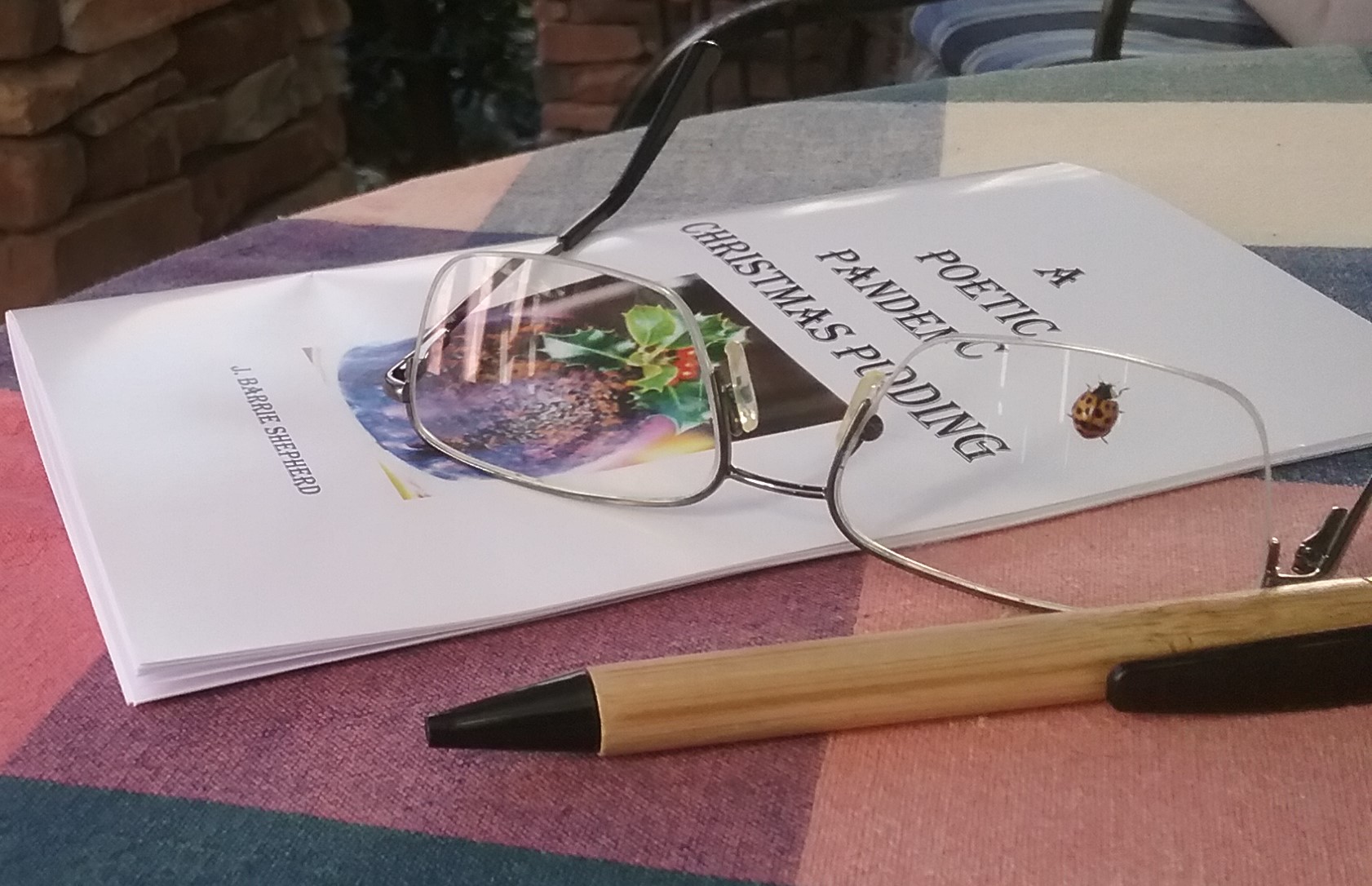
Ladybug season again at our place. 
This one crawled along the book, the pen and then my glasses.

Spiritual gurus admonish us to “go toward the light,” and especially in this winter season of a pandemic, that seems preferable to wallowing in darkness. But a line in a poem entitled “Lux et Veritas” in J. Barrie Shepherd’s latest chapbook, A Poetic Pandemic Christmas Pudding, reminds me of the vitality of darkness.

Contrasting our light displays during this season with the humble lighting of Jesus’ stable cave that allowed “the clear radiance that streamed above, around, beyond that battered-blessed manger,” poet and pastor Shepherd recalls introducing his first granddaughter to “the black-velvet-spread celestial of The Milky Way” “one sparkling island night in Maine”:

Her sheer astonishment made clear that we must

claim our darkness too, if we would glimpse

the glory of the elemental light.

Sunday over Zoom, Ormewood Church had a glimpse of the glory that may come when we “claim our darkness too.” Preaching on Mary’s Magnificat, Rev. Jenelle Holmes shared a recent dark moment in her life and offered her own “Magnificat,” and she has graciously allowed me to share it with you: 

My soul deepens and broadens the Lord’s presence and my spirit rejoices with God who saves me each and every day. God has looked with eyes of mercy on me, when some in the world have looked on me with disdain. God has seen the ways I am held back by others and has handed me support. People call me blessed because God has walked with me on hard roads of rejection, depression and anxiety and anger, and God has carried me through. God’s name is holy and God is a holy space for me. When I could have turned around and cursed God, I took God’s presence seriously and God has honored that with a strong arm of confidence and love.  

Those who wish me harm through rejection or fear or ignorance, God has dealt with in the privacy of their hearts. Those who have sought to harm me by using their voices of privilege, even in the church and in my family, God has shouted over them that I am loved and that I am who I was created to be.  

And as I look to my neighbors who are without homes, I have seen God’s people provide shelter. As I look to my neighbors who have lost their jobs, I have seen God’s people write checks. As I look to my neighbors who are lonely and isolated, I have seen God’s presence ignite ideas and rhythms of faith. As I look to my neighbors who have experienced one setback after another, I have seen God provide one day after another.  

And the rich, the powerful, the ignorant: God will show them the emptiness of their greed. They will be hungry for the good work of God.  

And as I think of how God helped ancient Israel escape Pharaoh, how God has helped the barren experience new life and the dead come back to life, and the marginalized be handed a voice, I remember God’s mercy forever, in every generation, even my own, even in 2020. My soul magnifies the Lord and my spirit rejoices with God who saves me each and every day.                                                                                    –Rev. Jenelle Holmes

Having lived in a metaphoric dark closet during my childhood and youth as a gay kid, I knew where the light was—it was outside my protective, defensive, even necessary shell. The glory of God and my own glory lay beyond my captive, seductive defenses and others’ captive, destructive offenses. Remember Jung’s suggestion that religion is a kind of defense against God? My closet—my and others’ rigid conceptions of God—kept me from God’s glory. 

My most recent “aha” about who God is, is that God is the glory at the climax of the prayer Jesus taught us: “For thine is the kingdom and the power and the glory.” That glory is unknowable but visible in the infinite wonders of the universe, in myriad forms of life, and in human compassion and imagination. This is the prophet Isaiah’s “light that shines in darkness.” It is the “shekinah” of Yahweh’s divine presence. It is the glory that brightened Moses’ face and lifted Mary’s soul, as well as our own souls through Immanuel, God-with-us.

I pray this glory for you as you approach this Christmas: 

God bless you and keep you;

God make God’s face to shine upon you,

and be gracious to you;

God lift up God’s countenance upon you,

            and give you peace.  Numbers 6:24-26

Then we may attend to this summons in another of Barrie’s poems, “The Coming of the Light”: “Look deep into this gentle fire, and then go forth to bear it, far and tender, to wherever infants, cold and frightened, tremble in the dark with no bright star, no kings to greet.”


For your own copy of poet and pastor J. Barrie Shepherd’s holiday chapbook: A Poetic Pandemic Christmas Pudding, please send a check to J. Barrie Shepherd at 15 Piper Road – K325, Scarborough ME 04074. Copies will be signed and can be inscribed by request. Or order though his email: barrieshep@aol.com. $10 per copy plus $2 postage. Proceeds go to food pantries in his area of Maine.

Donations to Progressive Christian Reflections may be given safely by clicking here and scrolling down to the donate link below its description. Thank you!

Contemporary Magnificat © 2020 by Rev. Jenelle Holmes, used by permission. 

Copyright © 2020 by Chris R. Glaser. Permission granted for non-profit use with attribution of author and blogsite. Other rights reserved.  


Wednesday, December 9, 2020

A Comfort Dream

Good neighbors!

As last week’s post published at 5 a.m. last Wednesday, I was awaking from what I would call a comfort dream. A beautiful Southern California day found me walking a favored walk, along the steep cliffs that line the coast in Santa Monica, overlooking the beach far below. It was here and on the sands below that I occasionally sorted out life as a young man—not to say I resolved everything or anything, but it gave me a place to walk and run, think and pray. Now living in Atlanta, this is the West Coast feature that I miss the most.

It was the place I began to reconcile my sexuality and my spirituality, my love of nature and my love of God. My first book, Uncommon Calling: A Gay Man’s Struggle to Serve the Church, described it as a welcoming and gracious sanctuary for all of me in a way the church was not yet. 

Harper & Row changed the subtitle I had, A Gay Christian’s Struggle to Serve the Church because the publisher feared that in those “early days” of the movement “gay Christian” might sound like an oxymoron! After four printings, the book was passed on to Westminster / John Knox Press, which accepted the original subtitle.

In the dream I enjoyed something along the Santa Monica business strip that was not and is not there: a several level store called Pickwick’s, a beloved old Hollywood bookstore where I used to enjoy browsing and buying books to read. I still have Pickwick bookmarks, which were inserted in every book I purchased there. I was introduced to Charles Dickens’s Pickwick Papers in high school. It was among the countless books that encouraged my own writing vocation.

I forget who it was who said this—a writer, no doubt—that heaven should be a beach with a big library. I would add at least a wine bar, and there was a bar near the gay beach in Santa Monica, the S. S. Friendship, once frequented by writer Christopher Isherwood and his partner, artist Don Bachardy, who lived up Chautauqua Canyon, named no doubt for the adult education and social movement in the U.S. in the late 19th and early 20th centuries.

So, in my dream, I was essentially in heaven. I believe it was Gertrude Stein who said of readers, “They have no need of heaven, for they have had books.”

Anyway, in the midst of our pandemic and the stress of the U.S. election process, my dream offered much needed comfort. That it came just as my last post was published seemed somehow auspicious. In that post I wrote of the integrity of science and religion, of nature and spirituality: calling us to remember we’re all in this together as inheritors of billions of years of evolution from the Big Bang to the common wealth and the common responsibility we share.

As if an incarnational exclamation point on this scientific and spiritual truth, Friday afternoon close friends/neighbors/members of Ormewood Church “res-erected” Wade’s and my mailbox after being dashed to the ground by falling trees a few weeks back, an urban version of rural barn-raising followed by socially-distanced wine on our deck.

In the meantime, Vicki, our mail carrier, had kindly walked the mail to us on our front porch or to the mailbox’s temporary location leaning against a Japanese maple that survived the earlier onslaught.

Photo by Cathie McBeth.


Donations to Progressive Christian Reflections may be given safely by clicking here and scrolling down to the donate link below its description. Thank you!

Copyright © 2020 by Chris R. Glaser. Permission granted for non-profit use with attribution of author and blogsite. Other rights reserved.  


Wednesday, August 26, 2020

House Arrest


On my office file cabinet I have a magnet that scolds, “You’ve been bad. Go to your office!”

Of course this echoes what some of us heard as children, “You’ve been bad. Go to your room!” The isolation, the confinement, and the implied restrictions served as punishment to dissuade us from bad behavior. In more recent times it was called a “time out.”

In the olden days, when I was growing up, it meant no television, no telephone, no play, and for some, no dinner—this in the days when there was only one TV and one phone in the house, and no devices on which to play games or watch something in your room. Do we mistake our present isolation as a kind of punishment?

This is how those most privileged among us might experience the “stay-at-home” confinement of our worldwide pandemic. A slight inconvenience, but a nagging reminder of the dangers of our footloose-and-fancy-free days when we could do just about anything we wanted.

It reminds me of when I was once shushed by a favored aunt as a little boy. Me, trying to be the best-little-boy-in-the-world, an offender?! How could this be?

Now, don’t get me wrong. As an introvert, I appreciate time alone or time with a few. As a spiritual person, I know I am not alone, but surrounded by a great cloud of witnesses before God. As a reader, I enjoy hearing from all kinds of people. As a writer, I am gratified to have people read my stuff. Even this post I feared would sound like whining!

But I’m writing this because I know I am not the only one who feels discombobulated by the necessity of social distancing, limited physical contact, and fearful interactions. When I go to buy our groceries, I feel as if I’m on a risky venture. When I don my mask and sometimes gloves, I feel like I’m getting ready for a walk in space.  

I couldn’t bring myself to watch the prison drama series, Orange Is the New Black, because I find the idea of imprisonment depressing. The earlier prison drama series, Oz, also didn’t appeal to me, despite its erotic male content.

Long ago I had a dream in which I found myself in prison, cut off from all those people I cared about and cared about me. I thought, well, with so much time on my hands, I could get a lot of reading done! But, in the dream, I was too depressed to pick up a book.

Maybe all this reminds me of my years in the closet as a gay youth. Maybe it’s reminiscent of the limitations of an early adolescent political conservatism that was transformed by education and compassion and maturity. Undoubtedly it smacks of the confining Christian fundamentalism that held me down and held me back from truly enjoying the world and even enjoying myself until I was in college.

The apostle Paul had his own fundamentalism to overcome, one that prompted his initial persecution of liberalizing Christians. And he purportedly produced one of his finest epistles while under house arrest in Rome: Ephesians. Concerned with the partisanship within the early church, he eloquently argued that now, in following Jesus, Christians were one, overcoming any “dividing wall of hostility.” 

I pray those who believe in a fair and just representative democracy may share such a vision of unity in our present state of house arrest.


Related posts:

I will be leading a virtual, at-home retreat open to the public for Columbia Seminary’s Spiritual Formation Program with Zoom sessions September 17-19, 2020 entitled 
You are invited! The site’s dates include “reading weeks” beginning August 31st in which you are invited to comment on the texts for the retreat and a final day “Sabbath” for rest and reflection on September 20th.

Donations to this blog ministry may be given safely by clicking here and scrolling down to the donate link below its description or by mailing to MCC, P.O. Box 50488, Sarasota FL 34232 USA, designating “Progressive Christian Reflections” in the memo area of your check or money order. Thank you!

Copyright © 2020 by Chris R. Glaser. Permission granted for non-profit use with attribution of author and blogsite. Other rights reserved.

Wednesday, September 4, 2019

The Gospel According to Jessica Fletcher and Frasier Crane


Okay, I’ve written enough heavy posts in recent weeks to warrant one that’s just for fun. I mentioned in passing in last week’s entry that one of my self-care habits is watching old episodes of Murder, She Wrote and Frasier.

First, both TV programs overlapped my move from Los Angeles to Atlanta, so they gave me continuity. And I shared Murder, She Wrote with Mom and Frasier with both Mom and my brother, more continuity. (This may make you nostalgic for the days when we all watched the same programs on the same day at the same time and thus could  talk about them the next day!)

Both helped me survive the death of my mom, followed by the death of what had promised to be a lifelong relationship, followed by the death of Open Hands magazine, whose editorship accounted for about half my income.

I know you’re thinking, where’s the lighter part of this post?

At the time, Murder, She Wrote episodes aired twice in the morning and twice in the late afternoon. I would only allow myself one episode per day, given my work ethic! But escaping to the homely and picturesque Cabot Cove, Maine, and hanging out with both a writer and a motherly figure (pardon me, Angela Lansbury) trying to solve a mystery was just the escape I needed. I preferred the episodes in her hometown to the ones on location or in New York City. (Of course I noted the scenes filmed in my home state of California, which I missed.)

What I subsequently discovered is that many clergy LOVE crime dramas, maybe because the solution to a life’s mystery can be discovered within an hour, whereas most life mysteries require a lifetime to solve, if then.

Plus, watching the show encouraged my own new project, writing a mystery novel and spoof about a “spiritual profiler” named John Boswell, not to be confused (wink) with that medieval history professor at Yale. Every afternoon I would escape to my fictional town of Crowbar, Mississippi (the prototype of which I discovered on a solo road trip) where Boswell interviewed, one by one, selective citizens of the town to determine who murdered the pastor of Primitive Presbyterian, Angus MacDonald. Originally I called it A Presbyterian Murder, but later renamed it Angus Dei.

In his sometimes stodgy first person narrative, the Roman Catholic Boswell describes how he realized his gift of spiritual profiling:

As I look back, my adulthood prescience of the spiritual dimensions of traffic accidents should have intimated to me the possibility of applying my gifts to crime scenes. One traffic accident I happened onto, for example, I sensed, came from one driver’s inability to forgive the trespass of another, and that first driver’s insistence on his right-of-way brought them together in death, though never meeting in life, giving a spiritual if not ecumenical twist on the traffic instruction, otherwise ignored, to “merge.” And another: A one-way street seemed to confirm the theology of one driver, only to run into a universalist going in the other direction. Unbelievably, only their theologies were badly shaken. And you can imagine the multiple car pile-up when a fundamentalist refused to “yield.”

Back-to-back Frasier reruns came on twice in the evening between 6 and 7, my dinner hour. And since I was now eating dinner alone (though my dog Calvin was mindfully aware of any dropped or leftover food), far from family, the ensemble cast of characters became a kind of substitute family. And it was a non-traditional family, and the stories were often about love sought and found and lost, with the “loser” always able to return to the bosom of the extended family. Of course, there were some hilariously gay episodes, my favorite, and plenty of gay sensibility humor in others, which got the series written up in a New York Times article lauding subtle gay themes and jokes in otherwise mainstream sitcoms!

The truth is, Frasier can still make me laugh out loud! So when I need a laugh, I watch an episode on Netflix or Cozi TV, the latter of which also runs Murder, She Wrote.


Progressive Christian Reflections is entirely supported by reader donations. To support this blog: https://mccchurch.org/ministries/progressive-christian-reflections/
Scroll down to the donate link below its description. Thank you!

Copyright © 2019 by Chris R. Glaser. Permission granted for non-profit use with attribution of author and blogsite. Other rights reserved.

Wednesday, August 21, 2019

Armchair Contemplatives

Mount Shasta photo by Bill Buchanan.
Bill and Ruth are regular readers of this blog.

At the end of Book One of The Dark Night of the Soul by St. John of the Cross, I wrote, “I don’t like his God.” What I felt is that his God is incredibly demanding, and I found myself yearning for the homeliness of Evelyn Underhill’s God in her two-level House of the Soul.

But then it occurred to me that Juan de la Cruz’s book could be compared to a manual on how to climb Mt. Everest. To do that requires demanding training, sacrifice and investment. It’s not God who’s “demanding,” any more than it is Mt. Everest that’s demanding. What’s demanding are efforts to scale seeming insurmountable heights.

I’d rather see Mt. Everest from a distance than from the top. I guess the same goes for my preferences of seeing God. Ninety-nine+ percent of the Hebrews saw Mt. Sinai from the plain. Only Moses ascended to commune with Yahweh, sovereign of the universe.* And we have his testimony of what God calls us to be and do, along with the testimonies of all the prophetic mystics of every age, of every faith and culture.

With many of you, I am content to remain an armchair contemplative. I am grateful for the stories and writings of saints, contemplatives, mystics, and spiritual authors. The spiritual horizons they offer inform and inspire our own spiritual quests. “Success” is not my spiritual objective; in fact, I don’t consider success a spiritual objective, period.

I’ve written elsewhere that a sense of “having arrived” is when we may be in the most spiritual danger. John of the Cross understood this; he warns that such folk judge others as the boastful Pharisee contrasting himself with the Publican sinner. John writes that it may be best that God not free such people from their imperfections, despite their petitions, lest they “wax haughtier in their pride.”

So I guess I should thank God for my imperfections!

John of the Cross is the first to admit that the purgation of dark nights, first of the senses and second of the intellect, does not “earn” God’s companionship. Rather it allows God’s ever-present, unyielding love to touch us, to infuse our souls.

As I move into Book Two of Dark Night, however, I resist John’s supposition that he is sufficiently purged as well as his original premise of purging the sensual and the intellectual.

Moses first encountered I AM in a lowly desert shrub that was burning and yet unconsumed. Jacob physically wrestled with God in the middle of the night. Ruth embraced Yahweh in her fidelity to Naomi. Elijah heard God in a “sound of gentle stillness.” Hannah’s fervent prayers to get pregnant were answered. God blessed Solomon with wisdom at his request. Jewish faith has been traditioned in teaching and chavrusa, debating the meaning of sacred texts in small groups or partnerships.

Mary experienced birth pangs to give rise to a refreshing renewal of the faith of Abraham and Sarah. Jesus prayed in lonely places and was sought out for his healing touch and compassionate wisdom. The Christian story is that God has been embodied in Jesus himself, whose Spirit inspires and empowers his followers. And Christians believe themselves to be members of the Body of Christ, which cannot say to the head or the hand, the intellect or the senses, “I have no need of you.”

John of the Cross’s spirituality appears to be, to me at least, more a product of Hellenistic dualism than of the Bible. Though his concept of letting go of all that is not God is admirable, I myself find everything good is of God.

Four decades ago, an elderly gay Roman Catholic priest visited the congregation I was serving and joined us for brunch afterward. He told us he first learned of God as a child on his grandmother’s knee, and though he grew up learning and studying a harsher and more demanding God, he now, in retirement, was welcoming a gentler understanding of a “grandmother God.”


*Moses was accompanied part way by others and further by Joshua but only Moses entered Yahweh’s cloud at the summit as described in Exodus 24.

Progressive Christian Reflections is entirely supported by reader donations. To support this blog: https://mccchurch.org/ministries/progressive-christian-reflections/
Scroll down to the donate link below its description. Thank you!

Copyright © 2019 by Chris R. Glaser. Permission granted for non-profit use with attribution of author and blogsite. Other rights reserved. Photo used by permission.