Showing posts with label J. Barrie Shepherd. Show all posts

Wednesday, December 16, 2020

Go Toward the Dark

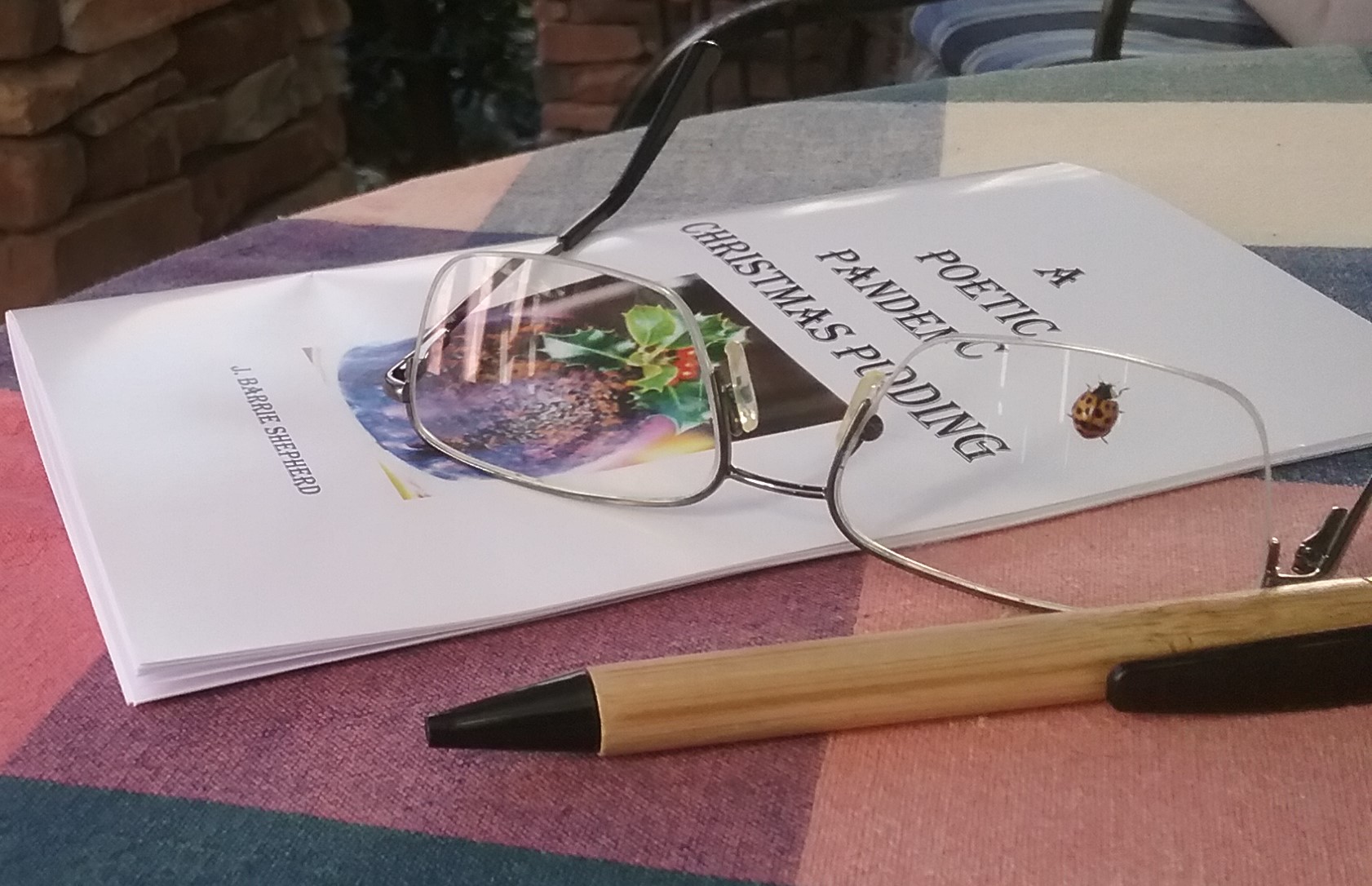
Ladybug season again at our place. 
This one crawled along the book, the pen and then my glasses.

Spiritual gurus admonish us to “go toward the light,” and especially in this winter season of a pandemic, that seems preferable to wallowing in darkness. But a line in a poem entitled “Lux et Veritas” in J. Barrie Shepherd’s latest chapbook, A Poetic Pandemic Christmas Pudding, reminds me of the vitality of darkness.

Contrasting our light displays during this season with the humble lighting of Jesus’ stable cave that allowed “the clear radiance that streamed above, around, beyond that battered-blessed manger,” poet and pastor Shepherd recalls introducing his first granddaughter to “the black-velvet-spread celestial of The Milky Way” “one sparkling island night in Maine”:

Her sheer astonishment made clear that we must

claim our darkness too, if we would glimpse

the glory of the elemental light.

Sunday over Zoom, Ormewood Church had a glimpse of the glory that may come when we “claim our darkness too.” Preaching on Mary’s Magnificat, Rev. Jenelle Holmes shared a recent dark moment in her life and offered her own “Magnificat,” and she has graciously allowed me to share it with you: 

My soul deepens and broadens the Lord’s presence and my spirit rejoices with God who saves me each and every day. God has looked with eyes of mercy on me, when some in the world have looked on me with disdain. God has seen the ways I am held back by others and has handed me support. People call me blessed because God has walked with me on hard roads of rejection, depression and anxiety and anger, and God has carried me through. God’s name is holy and God is a holy space for me. When I could have turned around and cursed God, I took God’s presence seriously and God has honored that with a strong arm of confidence and love.  

Those who wish me harm through rejection or fear or ignorance, God has dealt with in the privacy of their hearts. Those who have sought to harm me by using their voices of privilege, even in the church and in my family, God has shouted over them that I am loved and that I am who I was created to be.  

And as I look to my neighbors who are without homes, I have seen God’s people provide shelter. As I look to my neighbors who have lost their jobs, I have seen God’s people write checks. As I look to my neighbors who are lonely and isolated, I have seen God’s presence ignite ideas and rhythms of faith. As I look to my neighbors who have experienced one setback after another, I have seen God provide one day after another.  

And the rich, the powerful, the ignorant: God will show them the emptiness of their greed. They will be hungry for the good work of God.  

And as I think of how God helped ancient Israel escape Pharaoh, how God has helped the barren experience new life and the dead come back to life, and the marginalized be handed a voice, I remember God’s mercy forever, in every generation, even my own, even in 2020. My soul magnifies the Lord and my spirit rejoices with God who saves me each and every day.                                                                                    –Rev. Jenelle Holmes

Having lived in a metaphoric dark closet during my childhood and youth as a gay kid, I knew where the light was—it was outside my protective, defensive, even necessary shell. The glory of God and my own glory lay beyond my captive, seductive defenses and others’ captive, destructive offenses. Remember Jung’s suggestion that religion is a kind of defense against God? My closet—my and others’ rigid conceptions of God—kept me from God’s glory. 

My most recent “aha” about who God is, is that God is the glory at the climax of the prayer Jesus taught us: “For thine is the kingdom and the power and the glory.” That glory is unknowable but visible in the infinite wonders of the universe, in myriad forms of life, and in human compassion and imagination. This is the prophet Isaiah’s “light that shines in darkness.” It is the “shekinah” of Yahweh’s divine presence. It is the glory that brightened Moses’ face and lifted Mary’s soul, as well as our own souls through Immanuel, God-with-us.

I pray this glory for you as you approach this Christmas: 

God bless you and keep you;

God make God’s face to shine upon you,

and be gracious to you;

God lift up God’s countenance upon you,

            and give you peace.  Numbers 6:24-26

Then we may attend to this summons in another of Barrie’s poems, “The Coming of the Light”: “Look deep into this gentle fire, and then go forth to bear it, far and tender, to wherever infants, cold and frightened, tremble in the dark with no bright star, no kings to greet.”


For your own copy of poet and pastor J. Barrie Shepherd’s holiday chapbook: A Poetic Pandemic Christmas Pudding, please send a check to J. Barrie Shepherd at 15 Piper Road – K325, Scarborough ME 04074. Copies will be signed and can be inscribed by request. Or order though his email: barrieshep@aol.com. $10 per copy plus $2 postage. Proceeds go to food pantries in his area of Maine.

Donations to Progressive Christian Reflections may be given safely by clicking here and scrolling down to the donate link below its description. Thank you!

Contemporary Magnificat © 2020 by Rev. Jenelle Holmes, used by permission. 

Copyright © 2020 by Chris R. Glaser. Permission granted for non-profit use with attribution of author and blogsite. Other rights reserved.  


Wednesday, December 26, 2018

Peace of Mind


Plettenberg Bay, South Africa, photo (c) 2018 by Wade T. Jones

In recent troubles and dark days, personal and political, my peace of mind has been “saved” by reading one poem a day by J. Barrie Shepherd, an octogenarian retired Presbyterian pastor but unretired author who this summer sent me his “chapbook” (a small collection of poetry) entitled, If You Don’t Have Twenty Minutes Don’t Stop! The title is a reference to a sign on Chebeague Island off the coast of Maine that graced the garage door of an inveterate storyteller who loved chatting people up.

After floundering for morning prayer reading material following the eventually overwhelming Tao of Physics, which regular readers will remember, I chose Barrie’s brief book of poetry. Initially I read several poems at a time, but soon realized contemplation was better served by reading only one per day. “Be here now!” each poem urged, as poems tend to do, much like pericopes of scripture, exactly what I needed as Wade and I dealt with the vicissitudes of a friend dealing with mental health and addiction issues, even as we in the United States deal daily with a leader like that in our government.

Focusing on one-a-day made me think of that wonderful Psalm 131 (NJB):

Yahweh, my heart is not haughty,
            I do not set my sights too high.
I have taken no part in great affairs,
            in wonders beyond my scope.
No, I hold myself in quiet and silence,
            like a little child in its mother’s arms,
            like a little child, so I keep myself.
Let [us] hope in Yahweh
            henceforth and for ever.

Barrie and I have exchanged emails from time to time about this blog, and I am grateful to have his encouragement and readership. I have told him that his books of poetic meditations helped me, early in life, to maintain a steady prayer life. Knowing I had one of his books made me eager to make time in my morning routine to read and reflect and pray. His gifts and those of others whose meditations I have used inspired my own books of meditations and prayers, including this blog to encourage progressive Christians to take time for contemplation.

Longtime readers will remember that I began this blog when I was told by publishers that there was no market for meditation books for progressive Christians because we supposedly don’t take time for contemplation! My first publisher told me the same thing about LGBT Christians when I wrote Coming Out to God: Prayers for Lesbians and Gay Men, Their Families and Friends. Publication of those prayers by another publisher helped create a market, and then my first publisher asked me to write a daily med book for LGBT Christians, which I entitled The Word Is Out.

As we approach and begin a new year and through the season of Epiphany, I’ve decided to  re-present some of my writings for you in the hopes that they will have the same effect Barrie’s poems have had on me during the last several weeks, offering you peace of mind. I begin with Day 10 of Coming Out to God, a book whose prayers are broken into phrases not with any poetic pretensions but to slow the reader down:

All-embracing Spirit,
I don’t know what to say to you today.
It’s like sharing a meal in silence with a friend,
or dropping wordlessly exhausted once home from work.

I do not believe
I will be saved by my words,
though I usually feel compelled
to say them.

I do believe, God,
your grace is sufficient
to save me
even if I were silent.

I believe
I need times
to express your grace
in words.

I also believe
I need times
to experience your grace
in silence.

Intimate Spirit, today
I simply want to be in your presence.
Speak to me in this silence,
and let this silence speak to me.


Copies of either J. Barrie Shepherd’s If You Don’t Have Twenty Minutes Don’t Stop! or his latest chapbook, A Piper Shores Christmas may be purchased @ $10 + $2 shipping by writing: J. Barrie Shepherd, 15 Piper Road, Apt K325, Scarborough, ME 04074. Proceeds go to charities. (Remember, there are twelve days of Christmas to use the latter chapbook!) You may also write him at barrieshep@aol.com. 

Progressive Christian Reflections is entirely supported by readers’ donations. To support this blog: http://mccchurch.org/ministries/progressive-christian-reflections/
Scroll down to the donate link below its description. Thank you!

Copyright © 2018 and Coming Out to God copyright © 1991 by Chris R. Glaser. Permission granted for non-profit use with attribution of author and blogsite. Other rights reserved. 

Wednesday, December 27, 2017

Poetry Makes Life Last Longer

"The breakers steady crash..."

The end of a year seems a good time to reflect on time: what shortens it, what stretches it. The beginning of this year I eagerly read most of Alan Burdick’s Why Time Flies: A Mostly Scientific Investigation (2017). Though I recommend it, I found the text sometimes contradicted the title as I trudged through scientific studies and jargon.

A similar fate awaited me as I read a book about spirituality toward the end of this year. I felt as if I needed to come up for air, and found my eyes pausing over the text and searching the ravine behind our house from the vantage point of our deck for something more, something inspiring, maybe even God.

Then I remembered J. Barrie Shepherd had sent me a copy of his latest book of poetry, entitled Bench on the Bluff, and I set aside my dutiful reading of the somewhat dry tome on the spirit and sought the poetic wisdom of a writer who had been my spiritual director as a young man, unbeknownst to him, one whose books of daily reflections helped me establish my morning prayer routine and inspired my own desire to provide such reflections for others in my books and now this blog.

The image of a “bench on the bluff,” taken from his Maine retirement village’s cliff overlooking the Atlantic, reminded me of a tranquil spot on the palisades of Santa Monica overlooking the Pacific, where, according to an inscription on a circular stone bench (as I remember it) “in the sunset of his life, John P. Jones used to come here every evening to watch the sun set over the ocean.”

At 81 years of age, that is similar to what Barrie Shepherd is doing in what he calls a “chapbook”: “a small collection of poetry…that often centers on a specific theme.” It is dedicated to his and Mhairi’s Yorkshire Terrier, Iona, and “all her canine neighbors.”

In college I had a double major: English Literature and Religious Studies. So I’ve loved poetry from the start, and used to write poetry regularly, like many a youth. But I had to read so much of it, so quickly for courses, and think too much about what made poetry work that my first love became a source of anxiety and even competition. One of my texts, Understanding Poetry (a good book despite a presumptuous title), made me sympathize with Robin Williams’ character in The Dead Poets’ Society who advised his prep school students to rip out the first chapter of a similar text.

Poetry, like art and scripture and pornography, is something you know when you see it. And poetry, when unhurried and absorbing, stretches time for me.

And so it is with Barrie’s poems, and it was all I could do to restrain my impulse to read them all in a few sittings. I’ve mentioned in an earlier blog that I can’t read anything meaningful without a pen, underlining or marking texts to return to. The problem I’ve faced reading Barrie’s book is that I’ve wanted to underline and mark everything. Writing about it as I’m doing now made me want to quote so much of it that I would be infringing on his copyright!

I will never look the same way at the slender month of February or the shimmering surface of a lap pool. I will find haikus in every aspect of my community. I will look to nature and the seasons to welcome my own life cycle. His encounter with the Perseid meteor shower took me back to my own encounter in the night skies above Santa Barbara’s Mount Calvary Retreat House. I will counter the pains of aging with laughter in the wisdom of an “even-older-than-I-am-now lady” advising “When you wake up in the morning and nothing new hurts…you know you’re dead.”

And did I just call him “Barrie”? A person I’ve encountered less than a dozen times, but whose words befriended me in his books and now, continue to “friend” me in email exchanges about my blog. Yes, I feel like we are chums, and I am sitting with him on that bench missing the latest news “in an age of the absence of angels,” but watching: 
The breakers steady crash
and crumple as they rolled ashore
reporting on the deepest state of things,
reminding me that they will still be singing here
when all my news has fled like so much sea spray
on these stark, primeval rocks.

Copies of Bench on the Bluff are available @ $10 plus $5 shipping from:

The Rev. Dr. J. Barrie Shepherd
Piper Shores Retirement Community
15 Piper Road, Apt. K325
Scarborough, ME 04074

Proceeds are donated to charity.

For my other posts that mention J. Barrie Shepherd, go to:

Here’s hoping we all have happy and new years!
Thank you for donations to this blog ministry: 
Be sure to scroll down to the donate link below its description.

Or mail to MCC, P.O. Box 50488, Sarasota FL 34232 USA, designating “Progressive Christian Reflections” in the memo area of your check or money order. Thank you!

Copyright © 2017 by Chris R. Glaser. Permission granted for non-profit use with attribution of author and blogsite. Other rights reserved.  Photo from visit to Hawai'i, October, 1985.

Wednesday, November 9, 2016

The Road Not Taken

As a result of an e-mail conversation about something on my blog, poet and preacher J. Barrie Shepherd sent me his delightful book, Whatever Happened to Delight? Preaching the Gospel in Poetry and Parables. It inspired me to reclaim excerpts from a reflection I wrote for a Christian poetry spiritual formation course, which here I blend with thoughts from Barrie's book, properly credited in text.

The road not taken. The poet Robert Frost’s famous line has been used so often, many think of it as a cliché. But it yet carries poetic power, because many, if not most, if not all of us have roads not taken in our lives, roads whose destinations are hidden from us, just as the lion Aslan explains to the children in The Narnia Chronicles that we are not told what might have been.

In college I was a double major: English Literature and Religious Studies. I loved literature but I loved God more, and though literature might have been the safer path for someone who was gay, introverted, and a writer, the devotion, service, and activism of ministry was the higher calling and I went on to seminary and ministry. 
Let us risk the wildest places,
Lest we go down in comfort, and despair. 
Mary Oliver writes this about the explorer Magellan.

I confess literature and religion have never been that far apart for me, nor in reality. Both are at their best when they tell a story. Both are at their best when, even deconstructed or dymythologized, they reveal a better, deeper, and more meaningful story.

Analysis reveals the parts—the bones, the sinews, the surfaces—without breathing life into the whole, without giving it a heart that pumps life through the body, without creating soul. Just as a human skeleton hanging in a medical classroom is far from life as we know it, theology worked out on paper or chalkboard or worse, by church votes, loses its liveliness when it is far from the story, the myth, the Word made flesh.

“If God had wanted to appeal directly to our minds, Mary would have written a book instead of bearing a child,” Barrie quotes The Ironic Christian’s Companion by Patrick Henry.

My youthful poetry expressed my passionate, earnest self. My early prose wanted to tell a story—often my story, disguised. Novelist Saul Bellow has said that “Fiction is the higher autobiography.” The most puzzling comment I received from a reader of my first (unpublished) novel was, “What are you trying to say?” I wasn’t trying to “say” anything so much as tell a story.

Barrie mentions Ruben Alves’ observation “that the verbs ‘to explain’ or ‘to explicate’ come from Latin roots that mean to flatten, to spread out, to make level,” and then quotes Peter Gomes to the effect that at first, in preaching, he felt called to explain, and later to apologize, but only toward the end of his preaching career to celebrate “the holy mysteries of the faith.” Gomes concludes, “We are saved by our metaphors, not our metaphysics.”

My poetry became liturgies and my prose became sermons and subsequently, a dozen published non-fiction books focused on the biblical stories, stories of others, and my own stories. Along the way I’ve written four unpublished novels as well, the last of which is my life revisited, as if I had pursued “the road not taken,” resisting ministry and writing fiction.

Writing is my central spiritual discipline. Kathleen Norris considers writing her form of lectio divina. This is where and when and how I figure out the why and the who. Spiritual pilgrims once meandered here and there on their way to holy sites, and that’s what I do, in words, hoping that I might happen onto a sacred place or two in the process, perhaps encounter God, or the Word made flesh, or the Spirit’s pentecostal gift.

I do not outline beforehand, I do not “plan” the outcome, but “wait for the Lord” and the serendipitous gifts of water from rock, manna from sky, quails overhead, a still, small voice or “the sound of sheer silence,” the providential beauty of lilies, the thrill of promised land, the in-breaking commonwealth of God, the birthpangs of all creation. Like Emily Dickinson, I don’t need to go somewhere to witness these wonders—I experience them in my room, in my case, a tiny office off the garage with windows to see outside.

And, according to Barrie, “Emily Dickinson once wrote in a letter to a friend that ‘consider the lilies of the field’ was the one commandment she had never disobeyed.”

 “We are put on earth a little space that we may learn to bear the beams of love,” the mystical poet William Blake wrote.  Oliver includes an homage to Blake in her poem The Swan, declaring, 
The path to heaven
doesn’t lie down in flat miles.
It’s in the imagination
with which you perceive
this world,
and the gestures
with which you honor it.
Thank God for poets and visionaries, artists and children, cooks and gardeners, mystics and musicians, scientists and writers, professors and preachers, mentors and colleagues, contemplatives and activists, who have helped us, who have helped me, see the big picture, the grand scheme, the expanding universe, the enlarging heart—and where I belong.


You may support this blog ministry by clicking here and scrolling down to the donate link below its description or by mailing to MCC, P.O. Box 50488, Sarasota FL 34232 USA, designating “Progressive Christian Reflections” in the memo area of your check or money order. Thank you!

Copyright © 2016 by Chris R. Glaser. Permission granted for non-profit use with attribution of author and blogsite. Other rights reserved.