Showing posts with label Nelson Mandela. Show all posts

Wednesday, October 3, 2018

My Birthday Wish

Children in Soweto.

Several readers of last week’s post responded that they too had visited Soweto. One mentioned that he had been taken to a children’s cemetery there. I wrote back that one thought nagged me when visiting: how can a kid born and reared in the shacks of Soweto rise above the mentality/culture instilled by such an upbringing?

I immediately recognize the paternalism inherent in my thinking. Poverty and poor housing do not automatically “mark” someone for life. At the same time, they can limit one’s hopes and dreams. I know my own hopes and dreams were limited in scope by a working-class upbringing. As I listened to the Senate hearings of Christine Blasey Ford and Brett Kavanaugh last week, I caught a glimpse of a privileged, preppy, country club world that surely gave them both a boost in their own careers, though it also propelled them toward the incident that Dr. Ford convincingly described and Judge Kavanaugh unconvincingly denied.

I mentioned last week that Dennis, the guide who took us to Soweto, had grown up there and had never seen a skyscraper until he was 22 years old. The government had built an earthen ridge so Soweto’s residents could not see the skyline of Johannesburg, lest they aspired to a life apartheid denied them.

Now there is better housing and schools in Soweto, with more to come. Satellite dishes on even some of the smallest homes suggest access to a larger world. And that two of South Africa’s national heroes had residences there, Nelson Mandela and Desmond Tutu, surely must elevate the hopes and dreams of even the most destitute.

But the contrast between Soweto and Sandton—the upscale financial district of Johannesburg where we were staying—indicates an income inequality that could breed discontent if not revolution.

Me and Wade in Nelson Mandela Square,
a huge, upscale shopping mall in Sandton.

Dennis told us that he had lost relatives as a result of apartheid. But he credited Mandela with his family’s ability to cope, even as they heard from those responsible for their deaths during the hearings of the Truth and Reconciliation Commission, a process that offered amnesty to those who would come forward and honestly admit what they had done. Dennis told us of later running into one of those men who confessed, and both were able to greet one another civilly. He said honestly that if it had not been for Mandela’s example he might have killed the man. Mandela averted a blood bath, he explained.

But then I wondered about the children living in poverty in Soweto who are growing up without a Mandela at the helm of the South African government.

As I write this, it occurs to me that we in the United States could benefit from a Truth and Reconciliation Commission that could help us talk about sexual assault, racial violence, LGBT bashing, and other ills. We too suffer from income inequality that breeds discontent if not revolution.

We could use both a Nelson Mandela and a Desmond Tutu.

Today is my birthday. Most of my birthday wishes throughout my life have been for peace on earth, sometimes for a particular region, sometimes for the whole world. And I’ve meant a full-bodied peace—that is, peace with justice but not revenge.

Today I wish for peacemakers.


Yours truly. 

Blog subscribers: if you did not receive delivery of last week’s post, please let me know. I didn’t receive it, but others did. Thanks!

To support this blog:
Scroll down to the donate link below its description. Thank you!

Text and photos copyright © 2018 by Chris R. Glaser and Wade T. Jones. Permission granted for non-profit use with attribution of author and blogsite. Other rights reserved. 

Wednesday, September 26, 2018

Silencing while Assaulting

Dennis, our guide to Soweto.

Not saying I know it to be true, but the image of a potential Supreme Court justice as a youth muzzling a woman while sexually assaulting her serves as a powerful metaphor for how men have too often treated women. That men do the same when legislating and adjudicating women’s reproductive choices cannot be denied.

I would not want to be judged by my own careless acts as a youth, but by what I have become since. So the question for me is if this nominee has sufficiently matured to keep his hands off a woman’s uterus when it comes to her choice to bear or not bear a child. I am not pro-abortion, I am pro-choice.

Last week I attended a book launch for Connie Tuttle’s fa-bu-lous memoir, A Gracious Heresy: The Queer Calling of an Unlikely Prophet. In a blurb for the book, I described it as a book full of “extraordinary stories extraordinarily well told.” One of those stories, and one she read for the launch, is about her attending a presbytery meeting that was to vote on the ordination of lesbians and gay men and thus, the possibility of her own ordination. To be silenced, to be disallowed from speaking in her own defense because she was neither an ordained elder or minister, was and is what countless LGBT Christians endured and still endure in too many religious communities.

Three weeks ago Wade and I visited Soweto, where I learned that one of the breaking points of apartheid was when the South African government in the mid-1970s insisted all citizens of color had to learn and speak Afrikaans, a language only spoken in South Africa. It was to silence protest and prevent their mobility to other countries. Non-violent student protests to this led to massacres of innocent children and youth. The world took notice and imposed sanctions.

I was describing Soweto to a young person when I realized she had never heard of “townships.” I grew up reading about them in my high school current events publications, and I was horrified to think that blacks and other nonwhites lived in what the government called “townships,” and could only leave them when going to and from work, expected by authorities to show their passes on demand.

Soweto is short for “southwest township.” Our guide, Dennis, grew up in Soweto, and he referred to townships as “concentration camps.” He picked us up at our Hilton (!!—Wade had points to cover the hotel) in Sandton, the very upscale financial district of Johannesburg, for a personal tour and history lesson. On the drive to Soweto, he taught us more about South African history then I ever learned in any history class.

As we got close to Soweto, he pointed out huge earth ridges that had been constructed long ago to prevent its residents from seeing the skyline of Johannesburg in the distance. He said he was 22 years old before he ever saw a skyscraper!

Shacks in Soweto.

What surprised Wade and me was the contrast between shanty town homes (that the government is gradually replacing with better housing) and plainly middle- and upper-class homes, usually reflecting the architecture of the countries from which their residents came. Dennis explained that as apartheid came to an end and Nelson Mandela was released from prison and eventually came to power, many nonwhite South Africans returned and built homes that reflected the education, businesses and professions they had been able to pursue elsewhere.
Middle class Soweto homes.

Dennis told us that, upon hearing the plight of those in the townships, who were not allowed education, Scandinavian churches had built churches and schools, smuggling promising students out of the country for higher education. It was in front of one of those schools that a massacre of students occurred. There is a museum nearby named for the first child who fell, caught in a photograph that incensed the world:


Soweto boasts the only street in the world whose residents included two Nobel Peace Prize laureates: Nelson Mandela, whose modest brick house is now a museum, and Bishop Desmond Tutu, an occasional and modest residence for the Anglican churchman who chaired South Africa’s Truth and Reconciliation Commission.

The street where Mandela and Tutu resided.

From prison in 1977, Nelson Mandela wrote to his wife, Winnie Madikizela Mandela, these words, which are now on a plaque at the museum:

In judging our progress as individuals, we tend to concentrate on external factors such as one’s social position, influence and popularity, wealth and standard of education…but internal factors may be even more crucial in assessing one’s development as a human being: humility, purity, generosity, absence of vanity, readiness to serve your fellow men—qualities within the reach of every human soul.


Your donations are this blog’s only means of support. Please follow this link to make your gift: http://mccchurch.org/ministries/progressive-christian-reflections/
Be sure to scroll down to the donate link below its description. Thank you!

Text and photos copyright © 2018 by Chris R. Glaser. Permission granted for non-profit use with attribution of author and blogsite. Other rights reserved. 


Wednesday, September 12, 2018

The Lion God


Nothing says a vacation is over like a spider bite immediately upon arriving home, a new nest of stinging bees to address, a tire blowout, a lingering case of jet lag after a 15-hour nonstop, and fresh reports of a White House in disarray.

One after-effect of our three-week trip though South Africa is that Wade forgot his work password and had to go into the office to reset it. He noted that’s the sign of a good vacation! Then he had to deal with 600 emails, despite his “away” response message.


Our South African friends, Elize and Andre, helped Wade arrange the many details of our trip and traveled with us the first two weeks. They are Afrikaners and twins. Elize lives in Pretoria and Andre lives in Atlanta, a bi-national whose encounter with a nativist rant at one of our local grocery stores was recorded in an earlier post.

Wade, Andre, Elize, and me. 
Photo taken by our guide, Biggie.

I brought along the recently released Prison Letters of Nelson Mandela and an unlikely companion book, The Tao of Physics. But I found myself wanting to take a vacation from words, so I only occasionally read them, and I wrote nothing.

Even my prayers sometimes needed to be abbreviated because of our early morning jaunts, and I found praying for “all those we hold dear in our hearts” sufficient and the Lord’s Prayer well-summarized in “thy kingdom come, thy will be done.”

Now I’m finding it a challenge to get back up on the writing horse, partly because I am still absorbing what I saw and experienced, both in South Africa’s natural surroundings and its cultural/historical story. I hope to unravel my complex impressions in the next few posts.

Wade's photos on Instagram are far better than mine!

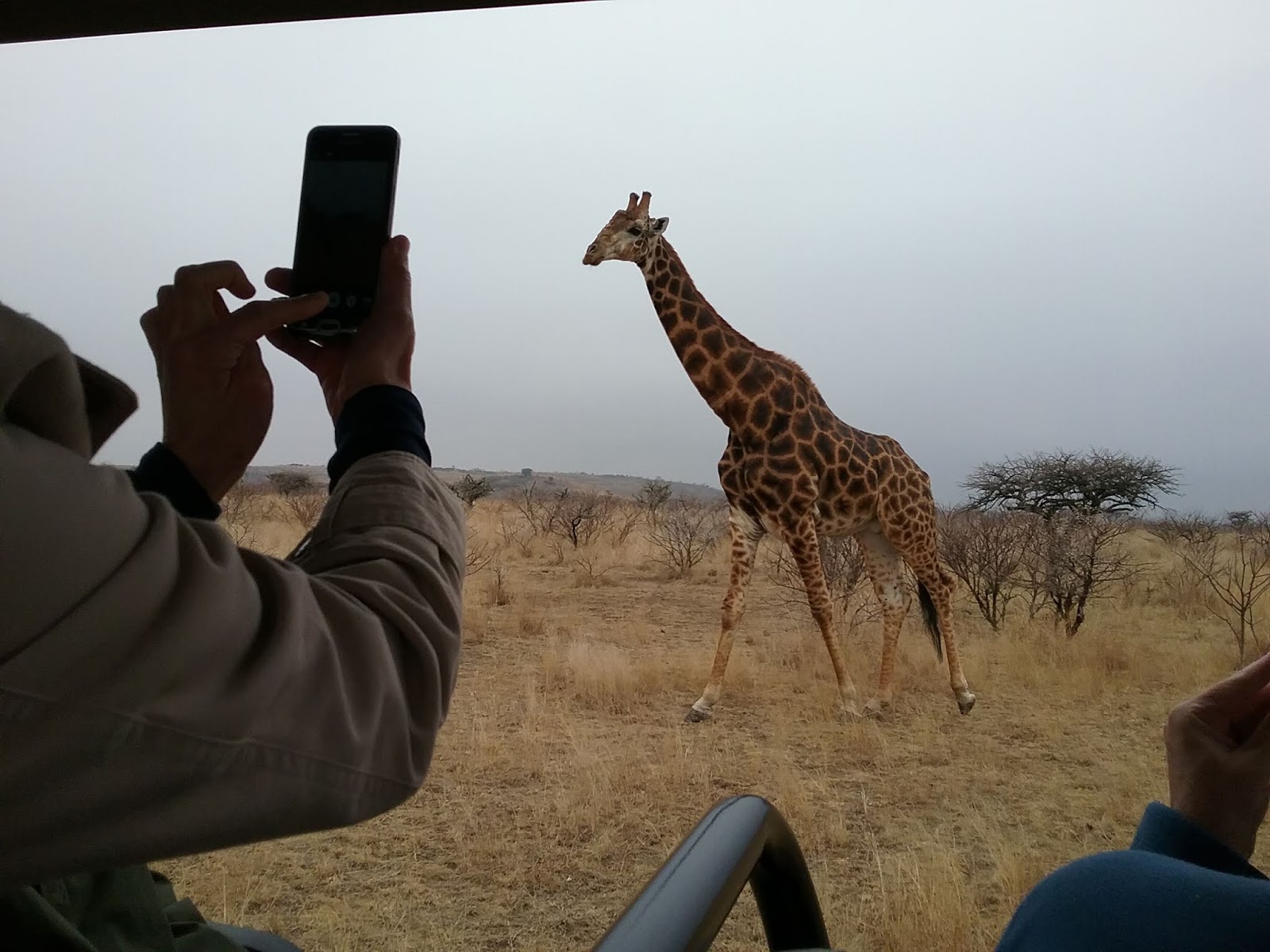
We spent three days in a game reserve at the Nambiti Hills Lodge that featured a schedule not unlike a monastery’s. We were awakened at 5 a.m. for “morning prayers”: coffee and snack before boarding an open-air Land Cruiser at 5:30 for a wild ride pilgrimage up and down hills and across plains as the sun rose, going to various points in the reserve where we were most likely to encounter animals, returning for breakfast at 9 a.m. “Vespers” began with tea and snacks at 3 p.m. followed by another safari that lasted till dinner at 8 p.m., featuring spectacular sunsets and a break for gin and tonics or wine.


Our “priest” for these services was “Biggie,” an experienced and informative and gregarious guide whose fearless approach to the animals matched his fearless driving over bumpy, winding, steeply descending and ascending dirt roads as we held on for dear life. We became kids again, enjoying the ride, while keeping our eyes peeled for wildlife. To Biggie’s credit, we never felt unsafe or in danger.


But there were moments when I felt nervous excitement—for instance, when an elephant came toward us, turning a one-lane road one-way, requiring us to back up as he lumbered toward us, not in attack mode but going about his daily business.


I have never been so close to giraffes, elephants, rhinos, hippos, impalas, wildebeests, springbok, wart hogs, ostriches, huge and little birds and more in their natural habitats. One morning we woke a sleeping herd of Cape (or African) buffalo on the road, prompting them to reluctantly rise and saunter out of our way as we inched forward.

Photo by Wade Jones

One outing, a tingle of dangerous pleasure came up my spine as a male lion and three female lions padded toward us and then right beside our stopped vehicle, as did three cheetahs a day or so later. There were no doors or windows or any barrier between us, and you will roll your eyes, but I thought at the time it was like a defenseless encounter with God, powerful enough to devour you yet docilely and peaceably passing by.


You can see why this became a vacation from words, and why they fail even now to capture the wonder we experienced.

A Cape Town art museum featuring African artists displayed this quote from Middlemarch by George Eliot:

If we had a keen vision and feeling of all ordinary life, it would be like hearing the grass grow and the squirrel’s heart beat, and we should die of that roar which lies on the other side of silence.

Grazing rhino.

Your donations are this blog’s only means of support. Please follow this link to make your gift: http://mccchurch.org/ministries/progressive-christian-reflections/
Be sure to scroll down to the donate link below its description. Thank you!

Text and photos copyright © 2018 by Chris R. Glaser. Permission granted for non-profit use with attribution of author and blogsite. Other rights reserved. 

Wednesday, June 7, 2017

The Truth below the Truth

Rev. Bill Johnson was the first gay minister I met,
and he became a role model for me.
I took this photo in San Francisco in the fall of 1972.

In honor of Pride month, this is the first of four posts adapted from a Meekhof Lecture I gave at Newport Presbyterian Church in Bellevue (WA), January 11, 2014, regarding the meaning of the LGBT movement for the broader church. You will notice some references I’ve used before on this blog.

One of the members of Newport Presbyterian Church has written a remarkable “coming out” memoir, The Last of the Good Girls: Shedding Convention, Coming Out Whole. In it, she quotes poet Judith Barrington: “The poet’s job is to write the truth. And then write the truth below the truth.” And that’s what Mary Ann Woodruff has done in lyrical prose and occasional poetry.

I believe that was the job description of the biblical writers, “to write the truth below the truth.” And I believe that’s the job description of preachers, prophets, and professors, “to write or tell the truth below the truth.” And that’s what I hope to do in this and the posts that follow: to talk about the underlying truths regarding the LGBT movement within the church.

Now, trying to tell the truth below the truth led in my seminary days to demythologizing, and in today’s seminaries it has led to deconstruction. That’s well and good if you have someone like the late Joseph Campbell, who could take a myth apart and put it back together again in such a way that its meaning is enhanced rather than diminished.

In the words of Kathleen Norris, “Human beings, it seems to me, require myth as one of the basic necessities of life. Once we have our air and water and a bit of food, we turn to metaphor and myth-making,” she writes. To me, myth is not a story that is untrue, but a story that carries a deeper truth that draws us in. As a 5-year-old once said, a myth is a story that is true on the inside. (Gertrud Mueller Nelson tells this in Here All Dwell Free.) Within the words is a Word with a capital “W.”

So for me, this is an opportunity to find the deeper truth of the LGBT Christian movement, and because I have devoted my life to that movement, it’s very personal—it’s about the meaning of my own life. And because the church has wrestled with the LGBT Christian movement over the past forty years, it’s very personal for the church as well, it’s about the meaning of church life.

What is the inside truth? What is the truth beneath the truth?

Nelson Mandela’s death reminded us of a segment of the South African population known as the “born freers,” those born after the end of apartheid, who have little idea what separation of the races meant, how oppressive was the domination of the white race.

It reminded me of the last book my mother was reading before her death at age 84, Tom Brokaw’s The Greatest Generation, a book lauding my parents’ generation for enduring the hardships of the Depression and then World War II.  I had sent her the large print edition of the book for Valentine’s Day because she had watched Brokaw’s television special of the same name, telling me over the phone, “I’m glad our generation is finally getting the credit it deserves.”

Timewise, I was in a like place as South Africa’s “born freers,” having been born five years after the end of World War II, having no direct experience of what my parents went through: separated by the war, living on my father’s army pay, having goods rationed, losing friends and family in far off battles or having loved ones return home with physical and psychological wounds.

And now I have a similar experience, along with today’s church, witnessing young people, “born freers” who will never understand why we struggled so over homosexuality, why it seemed so important, why the church resisted full membership and society resisted full citizenship, why the church refused the ministries and marriages of its gay, lesbian, bisexual, and transgender members, and why, when so many gay men were falling to a pernicious disease, there was so much resistance to helping persons with HIV and AIDS.

Younger people who watched this year’s television series about the secular LGBT movement, When We Rise, remarked their surprise at what earlier generations endured. “I had no idea what you went through,” one millennial told her mom.

This post will be the first of four segments for LGBT Pride Month, not so much describing “what we went through” in the church as much as discerning the “truth below the truth.”

What did it all mean, for God’s sake?


I urge you to make a donation and/or attend these once-in-a-lifetime ingatherings of LGBT saints and allies:

Oct 31-Nov 2, 2017
St. Louis Airport Marriott

Sept 8-10, 2017
Kirkridge Retreat & Study Center

Btw, the LGBT Religious Archives Network updated my bio earlier this year: https://www.lgbtran.org/Profile.aspx?ID=4

To support this blog ministry: 
Be sure to scroll down to the donate link below its description.

Or mail to MCC, P.O. Box 50488, Sarasota FL 34232 USA, designating “Progressive Christian Reflections” in the memo area of your check or money order. Thank you!

Copyright © 2017 by Chris R. Glaser. Permission granted for non-profit use with attribution of author and blogsite. Other rights reserved.  

Wednesday, May 10, 2017

"Go Back to Your G--D--- Country!"

In some perhaps too tightly wound circles, it is considered a “micro-aggression” to ask “Where are you from?” or “Where are your ancestors from?” The prejudice of those who think this way is that the questioner has a hostile intent.

But Wade and I delight in finding out the origins of someone’s name, or accent, or heritage. This is the pleasure of a multi-cultural, multi-national world.

Lazy Eye, a recent gay film, mentions the classic Harold and Maude. The unusual relationship between a morbid young man and a vivacious old woman—a Holocaust survivor, no less—contains a scene in which they are walking among daisies as she explains her love for flowers. He grimly observes, “They’re all the same.”

“No, each one is different,” she points out, naming how so.  “Much of the world’s sorrow comes from people who are this,” as she holds up one daisy, “but allow themselves to be treated like that.” As she gestures broadly, the camera pulls back to show them sitting in a veterans cemetery covered with identical grave markers.

I would say that too many of us have a “lazy eye” when it comes to appreciating differences and diversity.

Nelson Mandela insisted on a staff that mirrored the diversity of the new South Africa when he became its president. He and the people he represented had more than a little right to exclude those Europeans who had come to their continent and excluded them from rights, privileges, and participation in government. But he insisted on modeling the necessary collegiality among the races to bring his post-apartheid nation together.

This was brought home to me as I read the memoir of an Afrikaner whom he chose as his personal assistant, Zelda la Grange. The book, Good Morning, Mr. Mandela, was lent to me by the twin sister of one of our close friends. They are themselves Afrikaners, but she resides in South Africa, while he is a naturalized citizen of the United States.

A few weeks ago, Wade and I were enjoying drinks and dinner out with him when he described an incident at a market here in Atlanta.  He was checking out, and his order included the last banana cluster on the shelves. “Are you going to take those bananas?” an older woman behind him in line questioned. Taken aback by her accusatory tone, our ever polite friend explained in his accented English, “Yes, but I’m sure they have more in the back.”

Angered, she stormed off, admonishing him, “Go back to your goddamn country!”

“Go back to your goddamn country!”

He said he was stunned beyond belief.  “Why would bananas be so important?” he wondered, aghast.

Mocking her rhetoric, this became the toast of the evening. More than once, we lifted our glasses, laughing, saying in unison, “Go back to your goddamn country!”

Admittedly her nativist rant was less damaging to three privileged white men, but still, to a foreign born citizen like our friend, it must have stung.

In that moment, she proved herself to be less of an American than our friend.


Please support this blog ministry: 
Be sure to scroll down to the donate link below its description.

Or mail to MCC, P.O. Box 50488, Sarasota FL 34232 USA, designating “Progressive Christian Reflections” in the memo area of your check or money order. Thank you!


Copyright © 2017 by Chris R. Glaser. Permission granted for non-profit use with attribution of author and blogsite. Other rights reserved.  

Wednesday, December 11, 2013

Knowing Your Place

“Knowing your place” reeks of paternalism, of social control, of political, economic, or religious domination. Yet it may also speak of recognizing your rightful place, your context, your own calling in the scheme of things—not above another, not below another, but next to one another in the march, the dance, the race toward freedom, justice, and peace.

I write these words while watching the memorial service for Nelson Mandela—one who had the audacity and right to call the Queen of England by her Christian name, Elizabeth; one who knew how to disarm an opponent by serving tea, by refusing to humiliate those with whom he struggled, by realizing that the end of apartheid would not bring dignity to black South Africans (whose dignity was inherent) but to the shamed ruling white South Africans. Repeatedly Mandela is recognized as one of an elite circle of African liberators, but one who knew when to step down, when to let others lead, and when, as President Obama has been characterized, to be seen as “leading from behind.”

According to The New York Times: 
In his autobiography, Mr. Mandela recalled eavesdropping on the endless consensus-seeking deliberations of the tribal council and noticing that the chief worked “like a shepherd.”

“He stays behind the flock,” he continued, “letting the most nimble go out ahead, whereupon the others follow, not realizing that all along they are being directed from behind.”

That would often be his own style as leader and president.
Noting a memorial service speaker visibly angry at the crowd singing as she tried to speak, a news commentator got it right when observing that Mandela’s approach would’ve been to start swaying and dancing to their music before attempting to address the gathering.

In an interview this week as a Kennedy Center honoree, the performer Santana declared that truly great musicians “remind you of a song you already know.” I think that’s also true of truly great leaders, political or spiritual.

Those of us watching surely feel humility in this celebration of Mandela’s greatness. Our own roles on life’s stage may feel like bit parts, walk-ons, stagehands, or audience. “Knowing our place” means appropriate humility. But, as Mandela’s royal tribal lineage might have helped his confidence addressing “the powers that be,” our own lineage, made in the image of God and fellow citizens with the saints in God’s commonwealth, may give us similar confidence.

The words of the old Hasidic Rabbi Zusya both comfort and challenge: “In the life to come, they will not ask me: ‘Why were you not Moses?’ They will ask me, ‘Why were you not Zusya?’”

And in his book Reaching Out, Henri Nouwen reminds, “The great saints of the past don’t ask for imitation. Their way was unique and cannot be repeated. But they invite us into their lives and offer a hospitable space for our own search.”

Some of you know my fondness for the metaphor of God as shepherd, one who persuades rather than coerces, one who “leads from behind,” one who “reminds us of a song we already know,” one who invites us into the divine life, offering “a hospitable space for our own search” in making our unique contributions to the world.

Mandela once said he was not a saint, “unless a saint is a sinner who keeps trying.” His life invites us to keep trying.


Related post:
God Is Not a Control Freak


Post related to the first anniversary of the Newtown massacre:

Progressive Christian Reflections is an authorized Emerging Ministry of MCC. Please click here to provide financial support. Thank you!

Copyright © 2013 by Chris R. Glaser. Permission granted for non-profit use with attribution of author and blogsite. Other rights reserved. Check out past posts in the right rail on the blogsite. Consider using a post or quotes in personal reflection, worship, newsletters, and classes, referencing the blog address when possible: http://chrisglaser.blogspot.com.